Handling Out-of-Spec Parts Without Delaying an Assembly Schedule
A disposition framework cuts decision time, which is where most schedule delays actually come from.

A part fails inspection mid-assembly, and now two clocks are running at once: one on the defect itself, one on the decision about what happens next. Most schedule damage doesn't come from the nonconformance. It comes from the part sitting in limbo while engineering, quality, and procurement each wait for someone else to make the call. A working disposition framework doesn't make manufacturing faster. It makes the decision faster, which is usually the bigger lever.
The four disposition options and what each one commits you to
Material Review Board practice runs on four dispositions: use-as-is, rework, return to vendor, and scrap. Each one is a different trade between time, cost, compliance exposure, and risk, and none of them is free.
Use-as-is means the part ships in its current condition, untouched. That's only defensible when the nonconformance provably doesn't affect form, fit, or function. "Looks fine to me" doesn't clear that bar. This can be the fastest disposition on the table, or the slowest, depending on whether it needs customer or regulatory sign-off first. Under AS9100 in aerospace, use-as-is often requires formal customer approval and a documented rationale before the part moves, and regulated medical device programs impose similarly strict traceability requirements on nonconforming product handling. Skip that step to save time, and the schedule savings evaporate the first time an auditor asks for the paperwork.
Rework sends the part back through a manufacturing step, machining a dimension again, re-welding a joint, re-finishing a surface, to bring it back to the original spec. It only makes sense when the defect is localized, the rework process is well understood (not experimental), and the time it takes is genuinely shorter than sourcing a replacement. Rework is not repair. Repair gets a part to a usable condition without fully meeting the original print, and in regulated industries that distinction triggers a different approval chain almost every time. Treating a repair like a rework is a compliance trap, not a shortcut.
Return to vendor, or replace, rejects the nonconforming part and sources a conforming one, either from the original supplier or an alternate. Everything here hinges on lead time. A supplier running a multi-week queue changes the math completely compared to a fast-turn manufacturing partner that can deliver in a matter of days with same-day engineering support. Procurement teams often stall the replace decision simply because nobody has a real number yet, and getting that number early is itself a scheduling move, not a side task.
Scrap destroys the part outright. It's the cleanest disposition from a quality standpoint, since it removes any ambiguity, but it also forces a full replacement with no shortcuts. Scrap is mandatory when the nonconformance creates a safety risk, a regulatory violation, or structural damage that no amount of rework fixes. Scrap-and-replace gets confused with return-to-vendor often enough that it causes traceability problems later, and the two need to stay separate in the record.
How the Material Review Board structures the decision so it doesn't stall
The MRB is the only body with authority to disposition nonconforming material. It's a required pillar under ISO 9001:2015 Clause 8.7, AS9100, and IATF 16949, not an optional review layer.
Membership scales with shop size. Larger facilities typically staff it with a manufacturing engineer, a quality engineer, a purchasing rep, and someone from materials. Smaller shops run the same logic with fewer people: a quality lead, a shop supervisor, a shop rep, someone from purchasing. Regulated programs sometimes require a customer representative or a government rep to sign off on specific nonconformance categories.
The workflow has five steps, and each one is a schedule gate as much as a quality gate:
Detection happens when an operator, an automated inspection system, or a sensor flags the defect. That triggers a Non-Conformance Report, which captures the discrepancy, the batch number, and the inspection data, the formal document the MRB actually reviews. The suspect material then goes into quarantine, physically separated and clearly tagged, so nothing downstream moves until a decision is issued. The board reviews the NCR against engineering impact and the four disposition options, then issues a documented decision, and the part either continues forward, goes back for rework, or exits the production flow entirely.
MRB cycle time, the span from detection to final disposition, is worth tracking as its own operational metric. Long cycle times don't just delay one part. They build hidden work-in-process and compliance exposure across the whole line. Digital MRB systems built into MES or QMS platforms replace paper routing and signature chains with a shared workspace, which compresses that cycle from days to hours without changing who's accountable for the call.
One distinction gets blurred constantly: MRB decides what happens to this specific batch of material, right now. CAPA (Corrective and Preventive Action) addresses why the defect happened in the first place, so it doesn't recur. They're linked, but mixing them up slows both down.
Evaluating use-as-is: the form, fit, and function test under schedule pressure
Under schedule pressure, use-as-is looks like the obvious answer. Zero added lead time, no procurement cycle, assembly keeps moving. But "we're in a hurry" has never been the standard, and it shouldn't become one now.
Three questions have to get answered with engineering data, not assumed:
Form asks whether the dimensional deviation causes interference, with a mating feature, a housing, a fastener pattern. Fit asks whether the deviation disrupts the interface with adjacent parts, sealing surfaces, bearing seats, locating features. Function asks whether the part can still do its job under actual loads, temperatures, and operating conditions while sitting correctly on a bench.
For CNC machined parts, this gets specific fast. Critical features like bearing journals, locating dowels, and dynamic seals often run tolerances of ±0.005 mm to ±0.025 mm. Whether an out-of-spec dimension lands inside or outside the functional envelope for that particular feature is the entire question, and it can't be eyeballed.
Then there's the compliance layer, which doesn't bend for schedule pressure at all. Regulated quality standards can require customer approval before a use-as-is or repair disposition moves forward. FDA 21 CFR Part 820 makes traceability of nonconforming product handling a mandatory system requirement. Skipping the approval step to save a few days doesn't save anything: it just relocates the delay to an audit finding or a recall, later and worse.
Even a fully justified use-as-is disposition needs the engineering rationale written into the NCR. An undocumented use-as-is is a shortcut standing in for a disposition. It's an escape hatch dressed up as one.
And if the same part keeps landing on use-as-is over and over, that's a signal, not a coincidence. Either the spec is tighter than the application actually needs, or the process can't reliably hold the tolerance as written. The fix at that point is a spec change or a process change, distinct from a standing waiver that quietly becomes policy.
Evaluating rework: when fixing the part is faster than replacing it
Rework earns its place on the table when three things are all true at once: the defect is localized and well understood, the correction process is proven rather than experimental, and the total rework turnaround beats the replacement lead time.
That turnaround estimate needs every leg of the trip, including the machine time. Transit back to the operation, queue time once it's there, the actual machining or fabrication, re-inspection, and transit back again. Engineers frequently price only the machining step and miss the rest of the round trip, which is exactly how a "quick rework" ends up costing more schedule than a replacement would have.
Rework and repair are not interchangeable words for the same thing. Rework returns the part to its original specification and typically falls within the supplier's own authority to perform. Repair brings the part to something usable without fully meeting the original print, and in aerospace or automotive that almost always demands documented customer sign-off first. Approving a repair under the rework label is a compliance failure waiting to surface.
Sheet metal offers a clean example. Press-brake forming tolerances typically run ±0.30 mm to ±0.50 mm on linear formed dimensions. A deviation inside that range on a non-critical feature might be a fine rework candidate. The same deviation on a sealing or mating surface needs a harder engineering look before anyone authorizes touching it again.
Sometimes rework is the wrong call no matter how fast it could go. If the nonconformance already compromised material integrity, over-machined wall thickness, a heat-affected zone from a bad weld, reworking it can make the condition worse, not better. That's a structural judgment, not a dimensional one, and it has to come from engineering, not from whoever's closest to the machine.
The NCR needs to spell out exactly what operation gets performed, to what spec, and under what re-inspection standard. "Send it back" is a hallway comment, requiring a disposition to follow.
Evaluating replacement: getting a real lead time number before the schedule gap grows
The most expensive mistake in this whole process is waiting for use-as-is or rework to fail before starting replacement sourcing. By the time that failure is confirmed, the schedule gap has already grown by however long that evaluation took, and now sourcing starts from behind.
Running replacement sourcing in parallel with the use-as-is or rework review is prudent schedule management. It's hedging the schedule. If the other disposition gets approved, cancel the replacement inquiry with no cost. If it doesn't, the clock never stopped running while the evaluation happened.
Lead time means different things depending on the part. For standard machined or sheet metal components, a fast-turn manufacturing partner can deliver conforming parts in a matter of days, which puts replacement in real competition with rework on schedule grounds alone. Complex or multi-process parts, weldments, carbon fiber layups, investment castings, run longer, which means the decision to start sourcing needs to happen earlier in the review, not later. Specialty processes like custom springs, tube bending, or wire EDM add another variable: a partner who handles those in-house, without routing the job to a sub-vendor, can shrink the lead time estimate meaningfully.
Replacement also opens a door that's easy to miss under pressure. If the original part failed because of an over-tight tolerance or a feature that's genuinely hard to hold in production, the replacement order is the moment to submit a DFM-reviewed revision, not something to handle after the assembly has already shipped.
There's a coordination cost too, one that rarely appears in the lead time number itself. Sourcing a replacement across separate vendors, machining here, finishing there, hardware from a third, adds handoff time that's invisible on paper but very real on the shop floor. A partner who quotes, builds, inspects, and ships the full part under one purchase order removes that layer entirely.
Like every other disposition, replacement needs to go into the record: the lead time commitment, the supplier, and the inspection standard the new part will be held to.
Building the triage sequence: the order in which to ask the questions
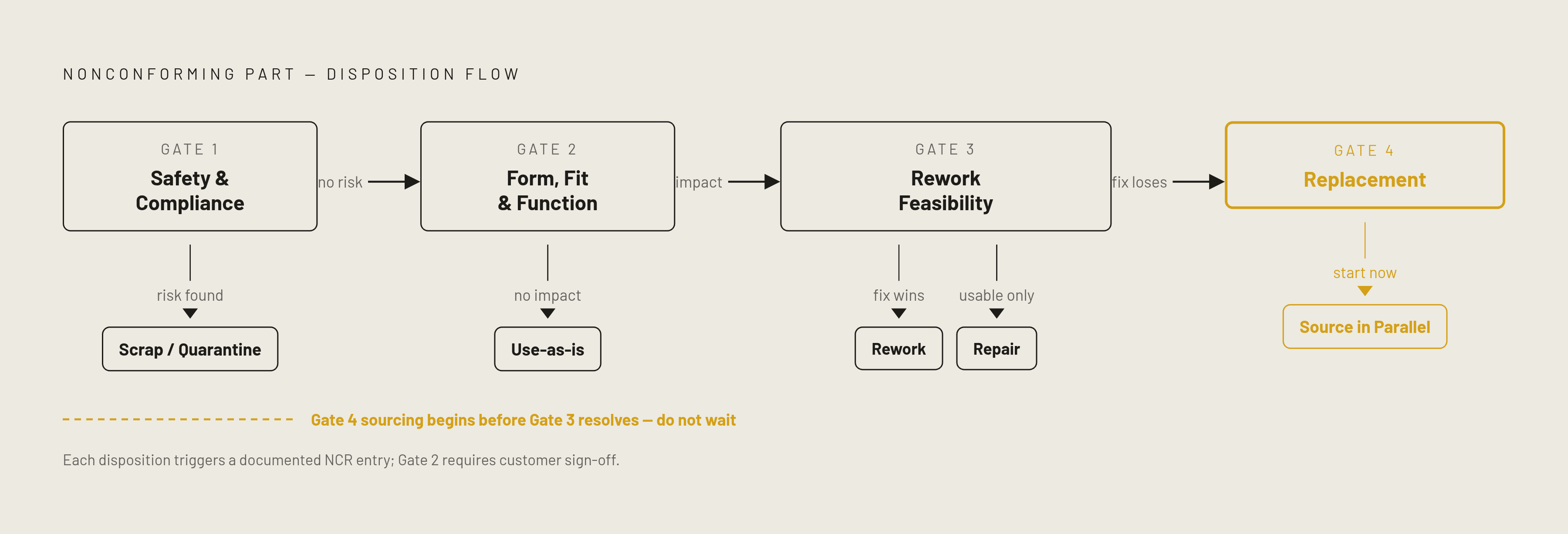
The four dispositions are a sequence of gates, each either closing off a path or handing the question to the next one. They're a sequence of gates, and each gate either closes off a path or hands the question to the next one.
Gate one is safety and compliance. Does the nonconformance create a safety risk or trigger a mandatory regulatory hold? If yes, the part goes to scrap or stays quarantined pending a regulatory ruling, and no other path opens. If no, move to gate two.
Gate two is form, fit, and function. Does the deviation actually affect how the part fits into the assembly or performs under real operating conditions? No impact means use-as-is becomes the live candidate: document the engineering reasoning, check whether the applicable standard requires customer sign-off, and close the NCR. Any real impact on form, fit, or function sends the question to gate three.
Gate three is rework feasibility. Is there a known, proven operation that fixes the defect, and does the full rework cycle, transit, queue, machining, re-inspection, return, beat the replacement lead time? If both hold, authorize the rework with the specific operation and re-inspection standard written into the NCR. If the fix would only make the part usable without meeting the original spec, that's a repair, not a rework, and customer approval starts before anything else moves. If the rework cycle loses to replacement lead time, or the process itself is uncertain, move to gate four.
Gate four is replacement, and the sourcing inquiry should start immediately rather than waiting for gate three to fully resolve. Lead time is the one thing in this whole sequence that can't be recovered once it's spent on evaluation instead of action.
Sources
- Material Review Board (MRB): Managing Nonconforming Material - SCMEP Online
- A Guide to Nonconformance Management
- Material Review Board (MRB) in Quality Management Systems: Meaning, Process, and Role in Controlled Nonconformance Decisions - eLeaP Quality
- Material Review Board: Deciding the Fate of Nonconforming Materials
- medicaldeviceacademy.com
- fabcon.com
- arenasolutions.com
- preteshbiswas.com