Mechanical BOM Structure for Multi-Process Assemblies
Hierarchy mirrors how parts actually flow through different processes.
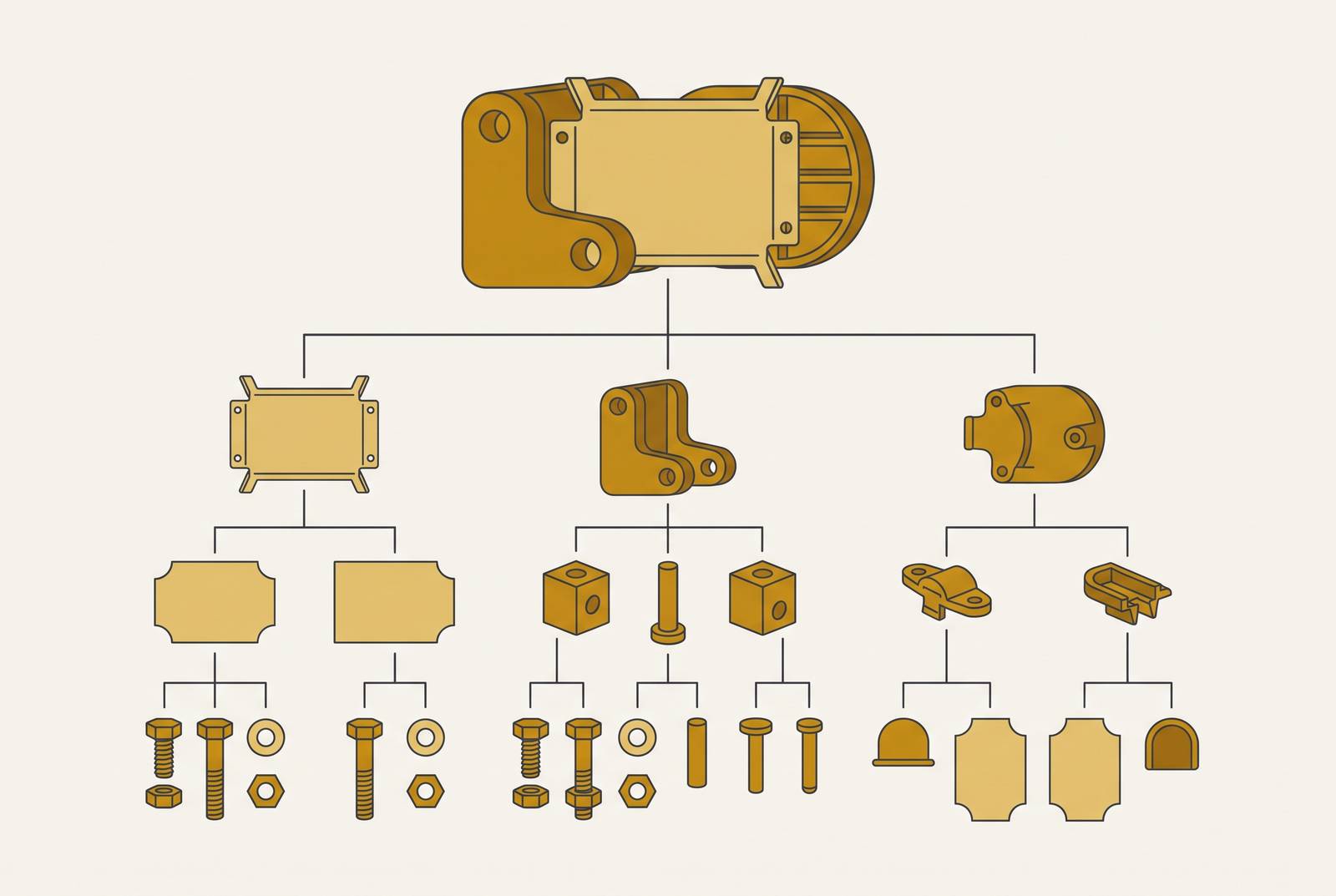
A flat parts list works fine when every component feeds straight into one final build step. Add a casting that needs machining before it can be welded into a frame, and that same list stops telling anyone anything useful. This piece is about why multi-process mechanical assemblies need a BOM structured around process boundaries, not just parts, and what breaks when that structure is missing.
Picture an HMLV shop running a job with a machined housing, a sheet metal enclosure, a cast bracket, custom springs, and a handful of purchased fasteners. Each of those has its own supplier, its own lead time, its own tolerance regime. A flat BOM collapses all of it into rows that look identical. Sourcing can't tell which order needs to go out first. Production can't tell what has to finish before the next operation starts. Quality has no defined place to check anything. The fix is a hierarchy that mirrors how the thing actually gets built, with fewer identical-looking columns. It's a hierarchy that mirrors how the thing actually gets built.
How a multi-level BOM represents assembly reality as a hierarchy
Think of it as a tree. Level 0 is the finished product. Level 1 is the major subassemblies that feed into it. Level 2 breaks each of those subassemblies into their own components, and it keeps nesting as deep as the actual build requires.
Every line still carries the basics: part number, description, quantity, unit of measure, cost. That much a flat list has too. What the hierarchy adds is context a spreadsheet can't fake. It shows where each part enters the build sequence. It shows how quantities roll up from raw stock to finished unit. And it shows how a single change ripples through the rest of the product, instead of getting buried in a row nobody's watching.
A subassembly, in this context, is any intermediate good with its own manufacturing process attached to it. Maybe it's built on a different line. Maybe a different supplier owns it entirely. Maybe it needs its own inspection before anyone lets it move forward. If any of that is true, it deserves its own level.
Here's where a lot of teams get tripped up: the engineering BOM and the manufacturing BOM aren't the same document, even though they describe the same physical product. The eBOM reflects design logic, how the engineer thought about the assembly. The mBOM reorganizes that same information around production sequence, workstation assignment, and routing. Manufacturing doesn't care how elegantly the design team grouped things. It cares which process has to run first, which subassembly has to be finished before the next operation can even begin, and which long-lead component needs to be ordered today instead of next week.
Another wrinkle: phantom subassemblies. These exist on paper but never get built as a standalone unit. Their components pass straight into the next assembly without a discrete manufacturing step in between. Used deliberately, phantoms simplify things. Left unchecked, they multiply quietly and start confusing materials planning until a shortage becomes visible somewhere unexpected.
Using process boundaries as the natural dividing lines between subassembly levels
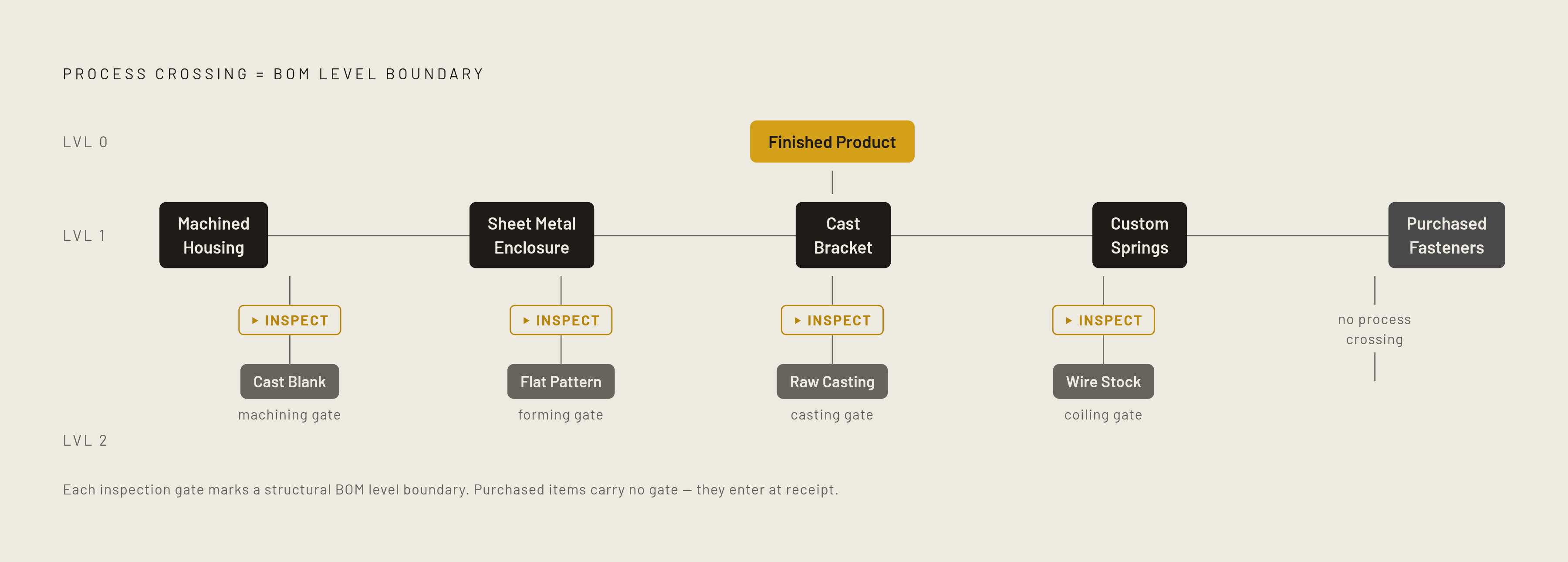
Here's the rule that actually does the work: every time parts cross from one manufacturing process into another, that crossing is a candidate for a new BOM level. Casting into machining. Sheet metal forming into welding. Spring forming into heat treatment. Each of these transitions marks a place where the item fundamentally changes character.
Why does this matter structurally, and not just semantically? A few reasons stack on top of each other.
Each process carries its own tolerance regime and its own quality gate. A cast blank and the machined surface it becomes afterward are, functionally, two different items with two different inspection requirements. Different processes usually mean different suppliers and different lead times too, and folding them into a single BOM row hides which vendor needs a purchase order today versus next month. And sequence depends on process completion in ways that are just physically non-negotiable: a casting can't be machined before it's poured and cooled, and a sheet metal enclosure can't be welded before it's bent to dimension.
So how do you decide when something earns its own sub-BOM versus staying flat? A workable test: if it's built by a different process, at a different workstation, or by a different supplier, and if it might get overbuilt, stocked, or shared across multiple products, give it its own level. If it's a one-off grouping with no independent manufacturing step behind it, a phantom or a flat inclusion is simpler and probably more honest.
Assembly Magazine has used a boat-building example that illustrates this well. A single BOM covering the entire boat will technically produce a boat. But separate subassemblies for the engine, the shell, and the wheelhouse let each one get managed on its own production timeline, by its own team, tracked independently. Same end result, very different ability to manage the work getting there.
There's a failure mode on the other side too: too much structure. Adding sub-BOM levels for groupings that don't reflect a real process dependency just adds tracking overhead for production teams managing work orders. The goal is structure that matches reality, no more and no less. It's structure that matches reality, no more and no less.
How CNC machining, sheet metal, casting, and specialty fabrication each impose different BOM requirements
Each process leaves its own fingerprint on how the BOM needs to be written.
CNC machining demands material specificity that goes past the generic label. "Aluminum" isn't a spec. 6061-T6 and 7075-T6 behave completely differently under load, weld differently, and anodize differently, so the grade and temper have to live on the BOM line, not get assumed at the shop. Tolerance callouts belong there too, either directly on the line or on the referenced drawing, and a recurring mistake is specifying the tightest tolerance a team has ever used historically, without checking whether the current part actually needs it. Every tolerance tighter than functionally necessary adds cost, full stop. Hard materials like stainless and titanium need slower speeds and specialized tooling, which changes lead time estimates and narrows which suppliers can even take the job, and both of those facts need to show up in how the BOM routes that subassembly. When tolerance requirements on critical surfaces exceed what casting alone can hold, the correct structure is two levels: the cast blank at one, the machined component at the next, each with its own inspection step.
Sheet metal work brings its own set of traps. Bend allowance and K-factor assumptions need checking against the actual material and tooling in use, since anisotropy in the sheet and distortion from welding are recognized sources of dimensional drift, and they only show up after forming and welding respectively, when it's expensive to fix. The BOM has to distinguish the flat pattern, what the material supplier delivers, from the formed part, what comes back from the fabricator. These are two different items with two different quality checks, not one thing described twice. DFM questions belong here too: tool access, wall thickness, internal radii, hole depth, thread design. All of it affects whether the part forms cleanly or needs rework, and all of it needs resolving before the mBOM locks.
Casting raises a process-selection question first. High volume and a finalized design point toward casting. Tight tolerances on critical surfaces point toward planning a cast-plus-CNC hybrid from day one, rather than discovering the mismatch after the casting shows up and doesn't hold spec. Alloy choice narrows the field of available foundries: Inconel, titanium, and specialty nickel alloys draw from a much thinner foundry supplier base than aluminum or iron. Single-source exposure on certain alloys is a genuine procurement risk worth accounting for in how the BOM routes that component. CNC machining, by contrast, has a wider supplier base and more redundancy if one shop falls through, which matters when deciding whether a risk-conscious BOM routes a component to casting or to machining in the first place.
Specialty fabrication, meaning custom springs, gaskets, and tube bending, gets treated as an afterthought more often than it should. Spring specs need the relevant material, type, load requirements, and finish all spelled out, because none of these are interchangeable. A spring headed for a corrosive or high-heat environment needs its material and heat treatment defined on the BOM itself, not left for the shop to guess. After forming, stress relieving is its own process step with its own time and temperature parameters depending on material, and it deserves its own line rather than getting silently folded into the forming operation. Tube bending has its own variable: Different bending methods achieve different radii and carry different wall integrity implications. Specify the method, or at minimum the required bend radius, or the fabricator may default to an approach that produces wall thinning at tight radii.
The pattern across every one of these processes is the same. Research citing Promwad puts the figure at 70 to 80 percent of a product's final manufacturing cost locked in by decisions made during design. Getting process-specific detail into the BOM early, instead of leaving it to whichever supplier interprets it first, is exactly where that leverage gets spent or wasted.
How lead times, quality gates, and inspection points map onto BOM levels
A structured BOM makes lead time visible in a way a flat list simply can't. It shows which subassemblies take the longest to source and which ones need to launch first. A flat list, on the other hand, makes every part look like it belongs to the same procurement wave, even when one component carries a far longer lead time than another.
Treat the BOM as a risk map. Long lead times, high inventory carrying costs, single-source suppliers, all of it becomes visible in the structure once it exists, and sourcing teams can act on that visibility, finding alternates or building buffer stock before a shortage turns into a stalled production line.
Quality gates belong at the transitions between levels, not scattered arbitrarily through the process. Every time a subassembly finishes one process and moves into the next, that handoff is the natural place for an inspection point. Without explicit subassembly levels, there's no defined place to put that gate, so it either gets skipped or gets assigned inconsistently depending on who's running the floor that day.
This same structural accuracy drives four different functions at once. Sourcing uses it to place orders and manage lead times. Production uses it to plan work orders and route material. Assembly uses it to confirm parts and sequence the build. Quality uses it to verify documentation and trace parts back to source. All four are reading off the same structural data, so if that data is wrong, all four functions inherit the error.
ERP practice offers a useful illustration here. When a work order gets entered against a top-level BOM, the system should flag any sub-BOMs underneath it and give the planner real choices: build the subassembly as its own nested work order, treat it as a purchased component instead, or use a phantom to pull its parts straight into the parent. Each option carries different consequences for inventory, scheduling, and where inspection happens.
Version control is where a lot of this quietly falls apart. A supplier substitution, a material update, a tolerance revision, any of these means every BOM referencing that component needs to reflect it. In a manual system, one version can drift out of sync without anyone catching it, and the first sign of trouble is a production run already underway making parts that don't match spec. One documented case: a direct-to-consumer manufacturer restructured its subassembly hierarchy using ERP BOM features and saw order processing speed up by 30 percent, with inventory accuracy reaching 99 percent. That's not organizational tidiness. That's a measurable operational outcome tied directly to how the BOM was built.
DFM decisions that must be resolved at the BOM level before sourcing begins
A well-established two-stage DFM framework addresses this directly, and it still holds. First, pick the right manufacturing process. Second, confirm the design is actually manufacturable within that process's real constraints. Both stages need to close out before a subassembly gets locked into the BOM, not after quotes start coming back.
Process selection itself is a BOM decision, whether people treat it that way or not. Cast housing or machined housing. Sheet metal bracket or welded assembly. Standard gasket or custom-molded seal. These choices determine what subassembly levels even exist and what each one is going to demand from suppliers.
Tolerance discipline matters just as much. Every tight tolerance on a BOM line is a cost driver, and reviewing each one with the design team before the RFQ goes out, asking directly whether the function actually requires that tolerance, is a DFM step. It belongs at BOM review. It does not belong as a surprise after three quotes come back higher than expected.
Material callouts ripple downstream in ways that aren't always obvious at first glance. Aluminum grade affects anodizing quality, weldability, and machinability all at once, so getting the grade wrong produces a part that's dimensionally perfect and still fails on finish or on the weld joint. Sheet metal specs need to account for anisotropy and bend allowance variation, because a material callout that doesn't match what the fabricator actually stocks produces a dimensional deviation that looks like a shop error but is really a design error. Spring wire material governs corrosion resistance, fatigue life, and how the part responds to heat treatment, and underspecifying it just hands that decision to the supplier, when it was the engineer's call to make.
Good suppliers flag problems before they become expensive ones: an unmakeable tolerance, an untoolable geometry, a material combination that won't survive the next process downstream. That feedback needs to flow back into the BOM before production starts. It shouldn't get patched informally between a buyer and whoever's running the shop floor that week, because informal fixes don't make it back into the document, and the next order repeats the same mistake.
That 70 to 80 percent figure from earlier is worth repeating here, because this is exactly where it applies. DFM review at the BOM-structuring stage is the actual point where that cost leverage gets used or gets lost. It's the actual point where that cost leverage gets used or gets lost.
BOM hygiene practices that keep a multi-process assembly sourceable as it evolves
None of this holds up without discipline over time. Naming and numbering conventions need to stay consistent across every level of the BOM. If a component gets named one way in the eBOM and something slightly different in the mBOM, that mismatch turns into reconciliation work at every single revision, forever, for no good reason.
Without clear ownership, BOM accuracy erodes as teams assume someone else is maintaining it. Every BOM, and every sub-BOM nested inside it, needs one person or one team accountable for keeping it accurate. Shared subassemblies used across multiple products are especially exposed here, since ambiguous ownership is exactly the condition under which drift happens unnoticed.
Treat the BOM as a living document, not a record you check quarterly. Supplier substitution, material update, tolerance revision, process change, any of these gets reflected the same day it happens. A BOM that was accurate six months ago and hasn't been touched since is a liability sitting in the system waiting to cause a mismatch on the next production run. It's a liability sitting in the system waiting to cause a mismatch on the next production run.
Shared subassemblies raise their own specific problem: the same subassembly showing up across multiple finished products means an update in one place has to propagate everywhere it's used, without quietly breaking something else downstream. That takes either a system built to manage the relationship or a manual cross-reference discipline that someone actually maintains. The failure mode, when neither exists, is duplicate records slowly diverging from each other until nobody can say which one is correct.
And phantom subassemblies need periodic cleanup, the same way any shortcut does. They're useful when intentional. Left alone long enough, they accumulate quietly, and what started as a reasonable simplification turns into structural noise nobody remembers adding.
Sources
- Multi-Level BOM Explained: Structure, Examples & Best Practices for Manufacturers
- Multi-Level BOM Guide: Examples, Structure & Management
- How to Manage Multilevel Bills of Material
- NetSuite Multi-Level BOM Setup: Assemblies & Work Orders
- Accurate Multilevel Bills of Materials (BOMs) Result in Great Products
- openbom.com
- A Quick Guide to Multi-Level BoM
- dfma.com