NDA and IP Protection Standards When Sharing CAD With Suppliers
Protect CAD from competitors by layering contracts, technical controls, and supplier vetting.

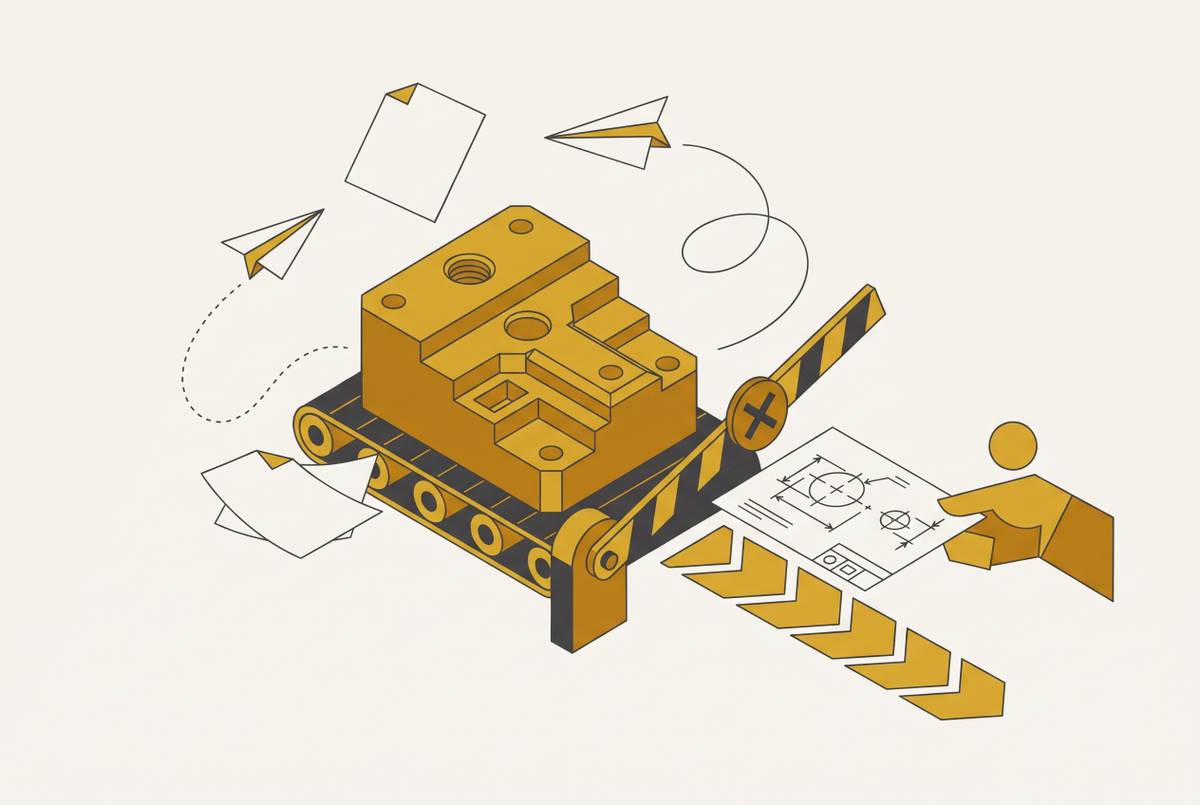
Sharing CAD files with suppliers is an inescapable part of making hardware. The moment of highest exposure is the quote request itself, when design data moves through more hands than engineers typically account for. An NDA alone is a weak defense. The effective approach layers three things: the right contractual language, technical controls on the files themselves, and supplier vetting before anything is shared.
Why CAD files are uniquely vulnerable during the quoting and manufacturing process
A quote request starts with a file. From there, it moves through sales reps, estimators, machine operators, and QC technicians. Each handoff is a potential leakage point, and most of those people never signed anything with you. The exposure is not a failure of process. It is what the process requires.
The file itself carries more than geometry. Modern CAD packages embed parametric features, design intent, material specifications, and manufacturing knowledge. Anyone who opens the native file can see how you arrived at the design, not just what the design is. That is exactly what a competitor wants and what a supplier needs far less of.
The subcontracting multiplier makes this worse. Many suppliers broker work to third parties. Your file, shared under one NDA, reaches fabricators who signed nothing. The NDA binds only the signatory. When a supplier sends your laser cutting to one shop and powder coating to another, your design data travels outside the agreement you negotiated.
Leaks are not always malicious. The risk is real, but it is manageable. The next sections lay out the layers.
Why a standard NDA, signed alone, leaves most of the actual risk unaddressed
A traditional NDA prohibits disclosure. It does not prevent a supplier from using your design to make parts for other customers, or from selling look-alike products through a separate channel. Those are two distinct gaps: non-use and non-circumvention. A standard NDA addresses neither. If a supplier takes your bracket design and ships near-identical parts to a competitor, you have no contractual hook to stop them.
Dewin's sourcing practice documented exactly this scenario. A U.S. client shared bend-line data under a simple English-only NDA and discovered near-identical brackets in a competitor's catalog six months later. It did nothing, because the supplier used the design rather than disclosing it, and the agreement never said they could not.
Language and jurisdiction matter more than most engineering teams assume. Courts in Vietnam, Taiwan, India, and China may not enforce an English-only NDA. Local jurisdiction requires local language and local governing law.
Duration creates another gap. Standard NDA terms run two or three years. Trade secrets require indefinite or substantially longer survival clauses. If your design is a durable advantage, a three-year clock starts running the day you share it.
What the NDA omits is as dangerous as what it says. If the contract does not explicitly list CAD files, 3D models, 2D drawings, process parameters, material specifications, tolerance stacks, bend sequences, and custom tooling designs as confidential information, a court may decide they are not covered. A supplier who retains your CAD files indefinitely extends the risk of leakage long past the project. Responsible fast-turn partners build post-production file destruction and certified data purge protocols into their manufacturing agreements. That way design data does not linger in their systems after parts ship.
The three-document contractual sequence that closes those gaps
Effective contractual protection requires a sequenced three-document stack, not a single agreement. Each phase of the supplier relationship creates different exposures, and each document addresses a different one. The NNN Agreement. This is the first document, signed before any file is shared. NNN stands for non-disclosure, non-use, and non-circumvention. It closes the two gaps a standard NDA leaves open. It must be bilingual and governed by the supplier's local jurisdiction. The must-have clauses include a precise definition of confidential information that names CAD files, 3D models, 2D drawings, process parameters, material specs, tolerance stacks, bend sequences, and custom tooling. It also needs strict receiving-party obligations limiting internal access, permitted-use restrictions, indefinite or long-tail duration for trade secrets, mandatory return or certified destruction of files on termination, governing law aligned to the supplier's jurisdiction, and liquidated damages provisions.
The Product Development Agreement. The PDA assigns all foreground IP and tooling ownership to the buyer before any DFM or development work begins. Without this document, the supplier's contribution becomes their property, and they can use it elsewhere or even against you.
The Manufacturing Agreement. This document locks exclusivity, audit rights, quality control standards, post-production file destruction, and enforceable remedies before any purchase order ships. It is the operating agreement for production. The Manufacturing Agreement must include a mandatory schedule for post-production file destruction. OneWeekParts builds that expectation into its manufacturing workflow, so teams can verify data handling before the first part is manufactured.
Alignment across all three documents is critical. If the NNN is governed by Vietnamese law but the Manufacturing Agreement defaults to English common law, the gap between them is exploitable. Commercially standard survival limits run three to ten years post-disclosure, with specific territorial restrictions. Before any file moves, run the pre-disclosure checklist: NNN bilingual and jurisdiction-aligned, PDA assigning all foreground IP and tooling, Manufacturing Agreement with exclusivity, audit rights, and post-production file destruction, and all three documents aligned on governing law and dispute venue. If any answer is no, do not share files.
Technical controls that make unauthorized use difficult even when contracts are in place
Contracts are remedies after the fact. Technical controls are preventive measures that raise the cost of misuse before it happens. They complement the legal layer. They do not replace it.
Stripping parametric history before export is the first and most important step. Output dumb geometry in STEP or IGES rather than native files. A supplier receives the shape, not the reasoning behind it. Best Parts identifies this as a core technical safeguard for CNC outsourcing.
Need-to-know segmentation follows. Share only what the specific supplier needs for their specific process. A laser cutter needs a flat-pattern DXF, not the full 3D assembly model. For complex projects, divide the design so no single supplier sees the complete picture. This is a security discipline and a workflow discipline. It forces you to classify what each party actually needs before you send anything.
Forensic watermarking adds accountability. Embed supplier-identifying information in drawings. Any leaked document can then be traced to its source. The deterrent is not the watermark itself. It is the certainty of attribution.
Time-limited access grants close the window on misuse. Set access to files or secure data rooms to expire automatically, with TTL of 24 to 72 hours for the highest-risk designs. A file that disappears cannot be forwarded next week.
Client-side controls like right-click disable, screenshot API blocking, and dynamic watermarking deter opportunistic leakage. They cannot stop a determined adversary, and no one should pretend they can. Each layer does part of the job.
Cloud platform due diligence deserves its own scrutiny. Any platform receiving controlled designs must have explicit contractual provisions: license terminates on content deletion, data residency election, personnel NDAs binding platform employees with administrative access, and a formal data destruction certificate on contract termination. Corporate counsel review and a documented risk assessment are also required.
Revision control is a security measure, not just a quality tool. Proper version tracking, change notifications, and removal of obsolete documents from shared environments limit the live exposure surface. Every stale file in a supplier's inbox is a disclosure you no longer control.
Supplier vetting as the third layer: what to verify before any file moves
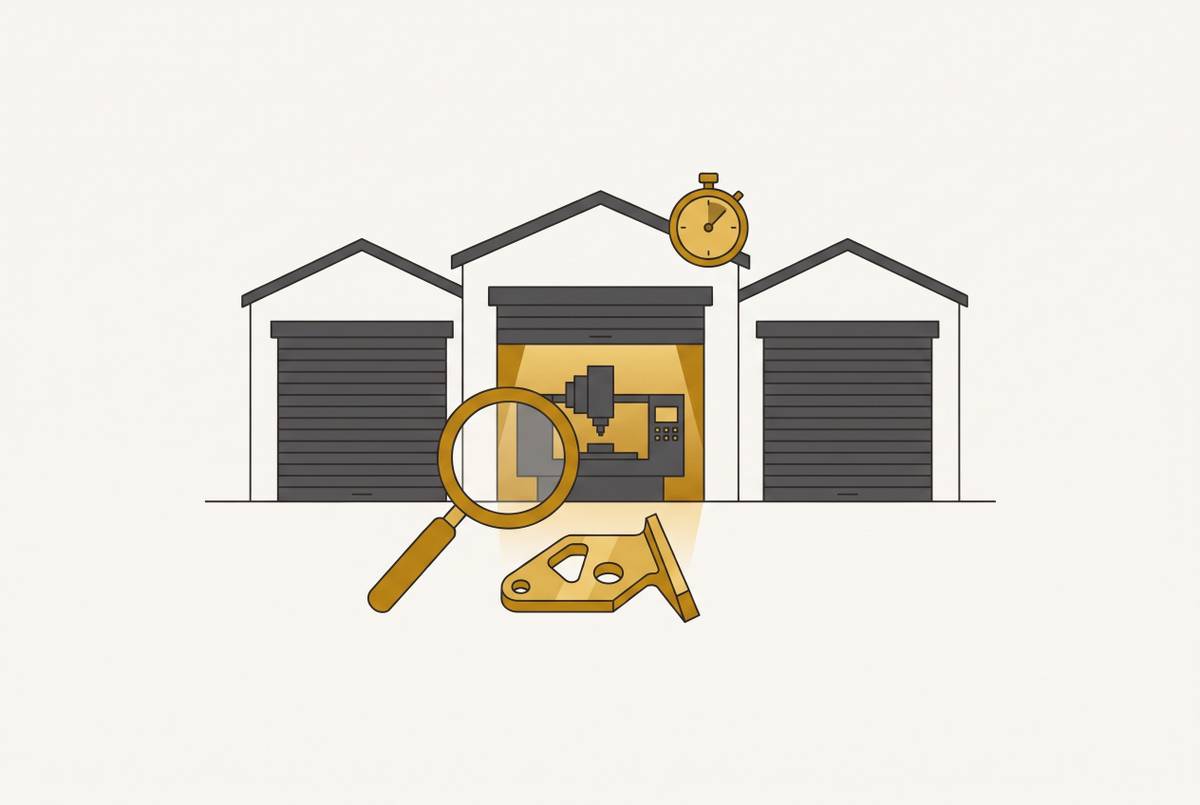
No contractual or technical safeguard compensates for a supplier whose internal practices make IP leakage structurally inevitable. Vet the counterparty before the contract, not after. Subcontracting exposure is the leading structural risk. If a supplier brokers out laser cutting, powder coating, or welding, your CAD files go to third parties who signed nothing. Any sub-supplier who will receive design data should be named, vetted, and subject to equivalent confidentiality obligations before work begins, not discovered after the fact.
Physical security on the shop floor matters as much as digital controls. Unrestricted smartphone use near sensitive fabrication areas, unsecured Wi-Fi on engineering servers, and uncontrolled access to drawing files are all documented leakage paths. A supplier audit should verify encrypted internal document management, restricted-access areas for sensitive programs, documented employee confidentiality obligations, and confirmation of which processes are subcontracted and to whom.
The audit itself is also a signal. If a supplier is willing to discuss IP protection protocols, accept audit rights, and provide subcontractor transparency, that tells you how they will behave later. Suppliers who resist these conversations are telling you something too.
For hardware teams sourcing multi-process assemblies, a consolidated manufacturing partner who handles CNC, sheet metal, and specialty processes under one roof eliminates the subcontracting exposure entirely. It quotes and manufactures the full mechanical BOM, so design data does not fragment across a chain of vendors who each pass files to their own networks. That is a structural IP risk reduction, not a convenience argument.
The ITAR and export control layer that overrides everything else for controlled hardware
For hardware subject to ITAR or EAR, sending CAD files to a foreign supplier is a regulated export regardless of what any NDA says. A confidentiality agreement does not substitute for export authorization. This applies even to suppliers in allied nations, including the UK, Canada, and NATO partners. The NDA is irrelevant to that determination.
Deemed export risk extends the obligation to domestic operations. Releasing controlled technical data to a non-U.S. person inside the United States, even an employee, counts as an export under ITAR. The file never has to leave the building. Hiring decisions carry export compliance consequences.
Encryption requirements are specific. Storage and transmission of controlled technical data that relies on the ITAR encryption carve-out, 22 CFR §120.54, must use FIPS 140-2 or FIPS 140-3 validated encryption. Decryption keys must not be provided to any third party, and in practice are held by U.S. persons. The encryption question is one of the most commonly misunderstood parts of ITAR compliance.
Supply-chain flow-down extends the obligation beyond the prime. Tier-2 and tier-3 machine shops inherit export screening duties through DFARS flow-down clauses. Primes are tightening enforcement and requiring tier-1 suppliers to attest to subcontractors' screening records. A shop that has never heard of ITAR is still bound by it if the flow-down reaches them.
Enforcement is real and getting sharper. It mandated an external Special Compliance Officer for at least 24 months and an independent compliance audit. The 2026 enforcement environment also emphasizes cybersecurity compliance under DFARS 252.204-7012 alongside traditional ITAR requirements, with increased scrutiny on foreign-person access controls.
This section is a flag, not a compliance manual. Engineers working with controlled hardware need specialist legal counsel, not a better NDA template. The commercial protections described earlier still matter, but they operate underneath a legal regime with its own rules, its own penalties, and its own timeline.
The DFM tension: how to give suppliers enough geometry to get useful feedback without overexposing the design
Effective design-for-manufacturability review and strong IP protection pull in opposite directions. More access increases exposure. Most teams resolve this tension by defaulting to the less secure option, not because it is better but because it is faster.
The default workaround is sharing 2D drawings because they travel safely. That is not the best format for DFM feedback. The security benefit is accidental, and the feedback quality suffers for it.
Classification by need is the better discipline. A manufacturing partner may need full drawings, GD&T, and material specs. Determine what each party actually needs and withhold the rest. For the highest-value designs, share only the sub-assemblies relevant to each supplier's scope, so no single vendor can reconstruct the complete product. This reduces exposure without degrading the quality of feedback. Browser-based, view-only model access is an emerging approach that changes the trade-off. The supplier sees what they need and downloads nothing.
A practical pre-share checklist for hardware teams
The layered approach only works if it is executed in sequence. Contractual, technical, and vetting steps must all happen before files move, not after a relationship is underway. Here is the sequence. Before any file is shared:
- NNN agreement signed, bilingual, governed by the supplier's local jurisdiction, covering non-disclosure, non-use, and non-circumvention
- PDA in place assigning foreground IP and tooling ownership to the buyer
- Subcontractor disclosure obtained, with every third party who will receive design data named and subject to equivalent obligations
- ITAR and EAR applicability confirmed, with export authorization in place before any file moves to a foreign person or entity
When preparing the files:
- Parametric history stripped, dumb geometry only in exported formats
- Files segmented to need-to-know scope, with no supplier receiving more than their process requires
- Forensic watermarks applied, and file access time-limited where the platform supports it
- Revision control current, with no obsolete drawings in the shared package
When choosing who to share with:
- Supplier's in-house capabilities verified against every process in the BOM, since any outsourced process is a file that leaves the signed NDA's scope
- Physical security practices confirmed, including encrypted document management, restricted floor access, and employee confidentiality obligations
- Manufacturing Agreement in place before any purchase order ships, with audit rights, exclusivity, and file destruction on termination
The consolidation argument follows from the checklist itself. For hardware teams that depend on proprietary design, that is not a convenience. It is the correct default.