Single-PO Sourcing for Full Mechanical Assemblies
One integrated partner eliminates handoffs, rework, and finger-pointing across your build.
A full mechanical assembly rarely comes from one vendor. Sheet metal gets cut in one shop, powder coating happens in another, and final wiring or assembly might land in a third. The real cost of that setup shows up in the space between the quotes, in the freight between facilities, the hours spent chasing purchase orders, and the finger-pointing that starts the moment a defect turns up after a handoff. Single-PO sourcing removes that space entirely by putting the whole build sequence, and the accountability for it, under one partner.
Rework eats up roughly 30% of total product development time on many programs, tracing back largely to manufacturability issues caught too late to fix cheaply. That number is the payoff. It's what makes the abstract argument about "hidden costs" concrete. Coordination labor, inter-facility freight, quality disputes, and schedule slippage never get fixed because no single vendor's invoice captures them: nobody owns the line item.
What a fragmented multi-vendor BOM looks like in practice
Take a typical enclosure or chassis program. Sheet metal gets fabricated, then shipped out for powder coating, then routed to a CNC shop for machining, then sent somewhere else for wiring and hardware insertion, and finally assembled. Every arrow in that chain is a transfer. Each one carries an incoming inspection, a scheduling buffer, inter-site freight, and an open question about who owns the fix if something's wrong.
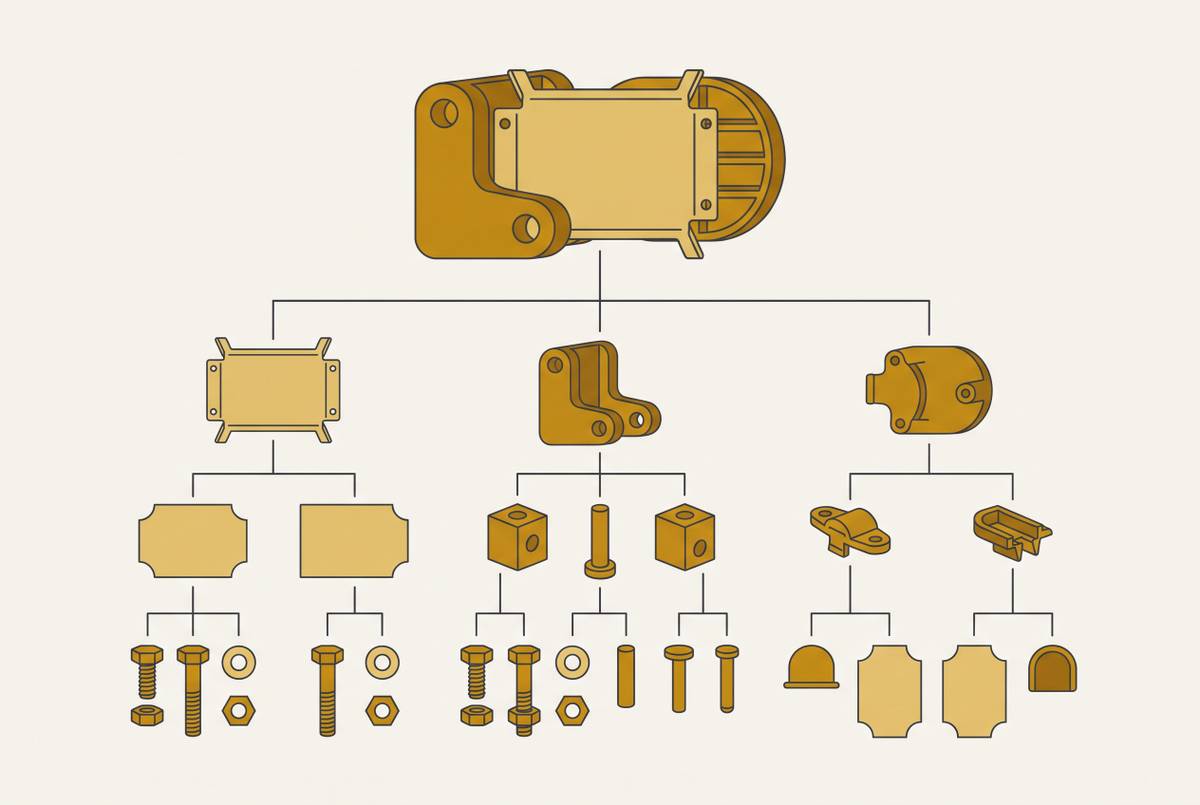
Real hardware products often have BOMs that run five or six levels deep, and configurable options can spin off many variants from one common platform. Every added level widens the coordination surface. More vendors, more inspection points, more chances for a spec to get lost in translation.
Three groups usually sit on this problem, and in a fragmented model, they rarely talk to each other. Engineering cares about tolerances and validation impact. Procurement cares about lead times and supply risk. Manufacturing cares about approved vendor lists and production readiness. When those three groups sit across separate companies with no shared engineering oversight, small disconnects turn into big ones: a tolerance stack-up nobody catches until first article, an assembly sequence that only reveals its flaw once it hits the floor.
Job shops fill part of this gap, but only part. They're transactional, built-to-print operations without deep design-for-manufacturing capability, and they have no real capacity to manage finishing or wiring. The customer absorbs all the coordination. Large contract manufacturers sit on the other end, with plenty of scale but high minimum order quantities, long onboarding cycles, and production structures too rigid for a program moving from prototype to mid-volume. Programs that need flexibility and full ownership of the outcome don't have anywhere to land between those two options.
Why fragmentation costs the most in the design phase
Somewhere between 70% and 80% of total product cost gets locked in during design, before a single part gets cut. That's the number that should reframe how anyone thinks about DFM. Running a design-for-manufacturability review after the design is frozen forfeits most of the yield and cost benefit that early optimization could have delivered.
In a fragmented supply chain, the fabricator has no visibility into how the part gets assembled downstream, and the assembler has no say in the enclosure tolerances upstream. Rework piles up at every stage because no single party sees the whole picture. The common failures are predictable: dimensions over-toleranced for no functional reason, bends placed too close to holes, weld joints with poor access that force manual workarounds, flat patterns that waste material, connectors that don't line up because ECAD and MCAD never talked to each other.
The cost asymmetry here is stark. Catch a DFM issue in a design review, and the fix is a redlined drawing, maybe a day's delay. Catch the same issue at first article inspection, and the fix might mean scrapping an entire tooling run.
Reducing part count is one of the more underrated levers here. Folding multiple features into one multi-functional component often drops assembly time and inventory overhead by more than the part count reduction itself would suggest. It compounds.
Design for testability deserves more attention than it gets, too. Building in features that allow a simple gauge or optical check during production, rather than a complex 3D surface scan, keeps quality control fast and cheap. None of this works, though, unless the engineering team, the fabricator, and the assembler are having the same design conversation before tooling gets committed. In a fragmented vendor chain, that conversation structurally cannot happen. Nobody's in the room.
How single-PO sourcing changes the accountability structure
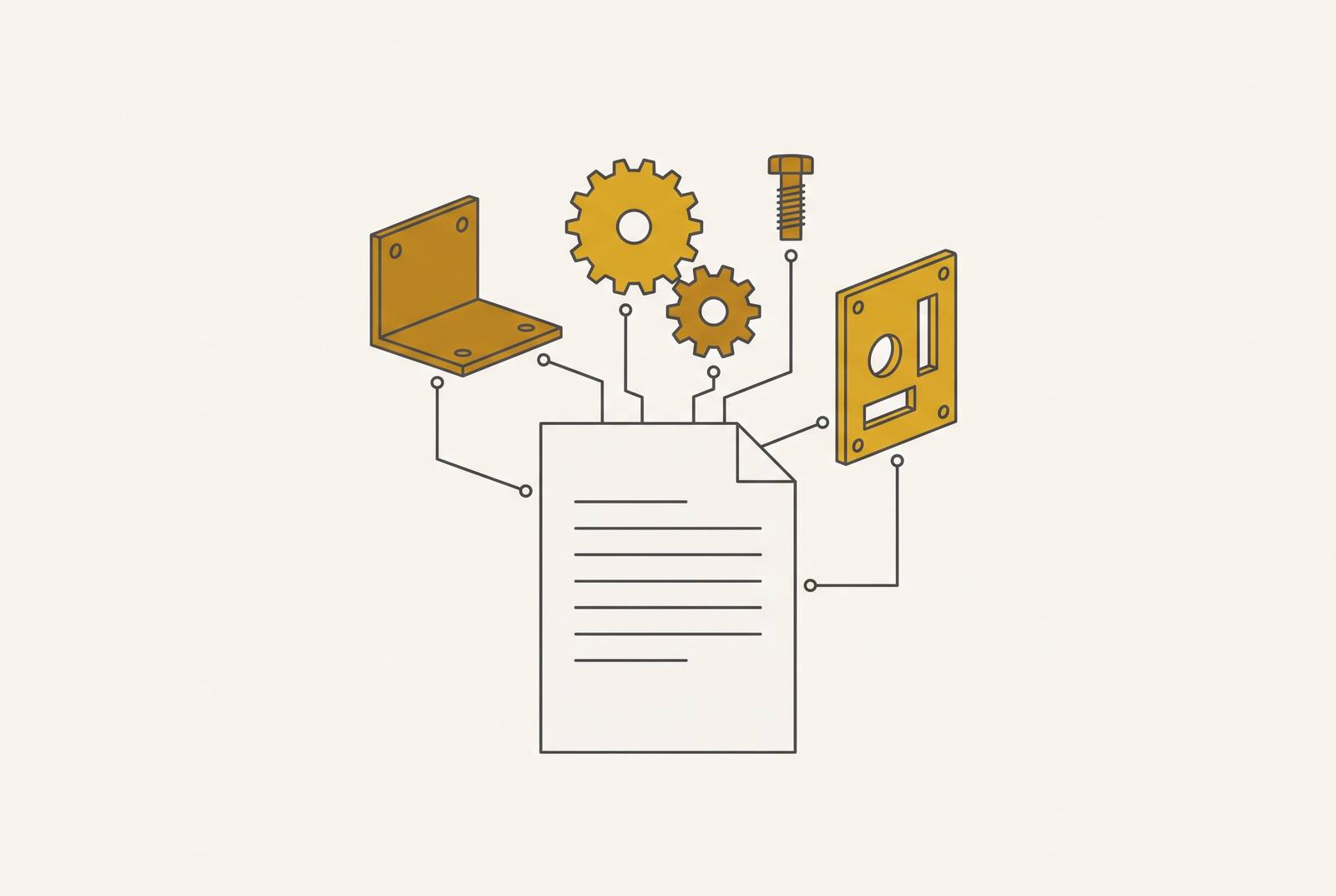
Single-PO sourcing means one purchase order for the entire build, one quality management system governing every stage, one traceability record linking raw material to finished assembly, one point of contact, one shipment landing on the customer's dock.
That's not just tidier paperwork. It changes who owns the outcome when something breaks. In a fragmented chain, a defect after a handoff turns into a dispute over who's at fault. Under one partner, there's no handoff to point at. The partner owns the result from raw stock to shipped unit, so the finger-pointing that eats weeks of a program's schedule simply has nowhere to land.
Traceability turns from a headache into a byproduct of doing business this way. AS9100 Rev D mandates cradle-to-grave documentation for aerospace programs where customers or regulations require full serialized traceability, covering serial numbers, approved suppliers, quality checkpoints, and nonconformance records. The FDA's Unique Device Identifier rules span the full lifecycle of a medical device, from manufacturing through distribution to patient use. Assembling that paper trail across five vendors is a program management job in itself. Inside one integrated quality system, it's just what the system already produces.
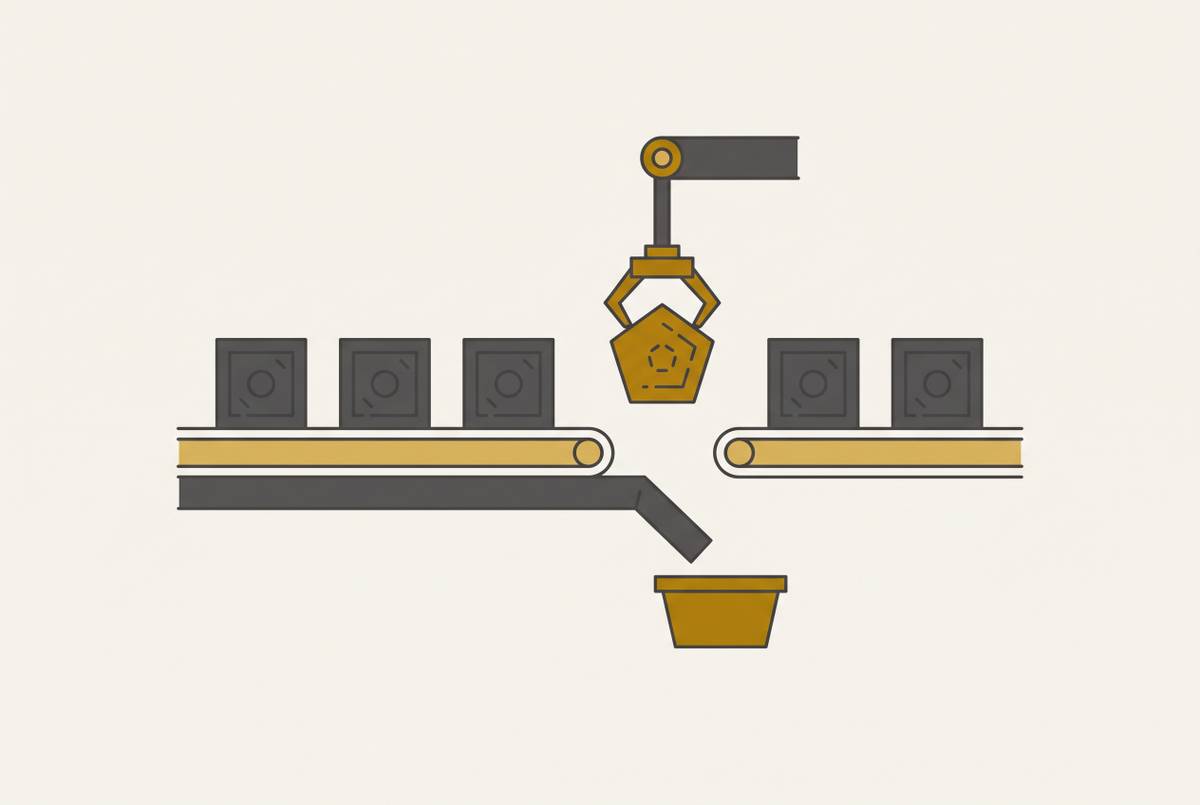
None of this works through a job shop, which lacks the range of process, or a large contract manufacturer, which lacks the flexibility. What it takes is a vertically integrated production setup built as agile cells, capable of shifting between volumes and configurations without the rigidity of a big CM's fixed lines. In-house finishing is a good small-scale example of what that buys a program: when powder coat sits in the same facility as fabrication, finishing gets scheduled while fabrication is still running, instead of waiting on inter-facility transit and another round of inbound inspection.
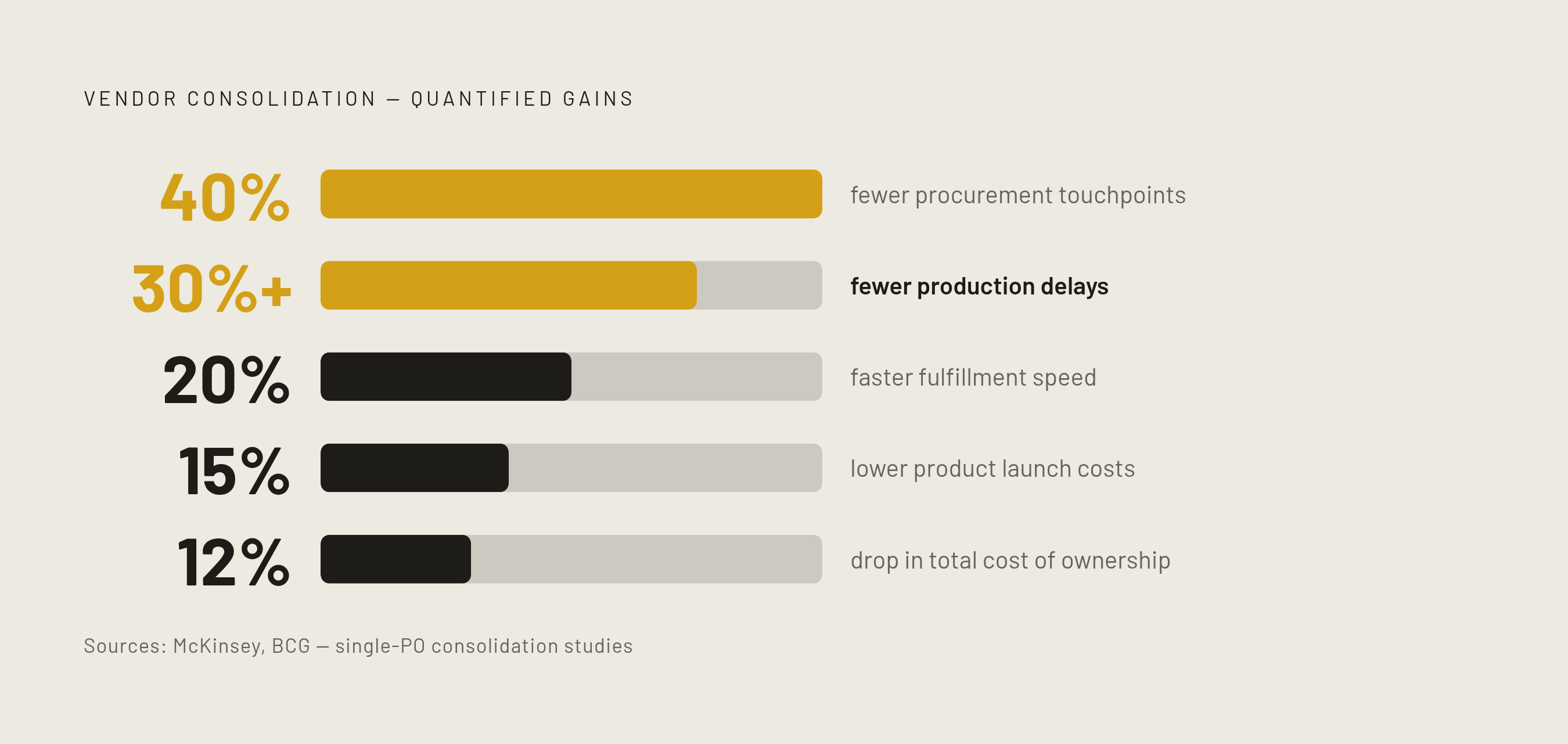
Consolidating vendors this way can cut procurement touchpoints by up to 40% and speed up sourcing cycles by around 15%.
The measurable impact of consolidation on cost, speed, and launch risk
The numbers on consolidation are consistent across sources, and they tell a layered story rather than one simple win. A McKinsey analysis found that a focused, single-partner relationship speeds up communication and decision-making enough to improve fulfillment speed by 20%. Total cost of ownership drops by around 12%, driven by better pricing terms, lower logistics costs, and reduced administrative overhead.
A BCG study found that bringing a manufacturing partner in during the design phase, rather than after drawings are locked, cuts product launch costs by about 15%. That's a design-phase effect. It comes from catching the DFM issues described earlier before they turn into scrapped tooling. Vendor consolidation has also been linked to a reduction of more than 30% in supply-related production delays, and PwC has found that 74% of supply chain leaders are actively consolidating vendors to fight complexity and build resilience into their operations.
There's real urgency behind these numbers heading into 2026. Nearly 245,000 manufacturing jobs were announced through reshoring and foreign direct investment in 2024 alone, which is putting real pressure on the supply of capable domestic manufacturing partners. Section 232 tariffs of up to 50% on steel and aluminum imports are making domestic, consolidated sourcing look a lot more competitive on price than it used to. A labor gap drives this: manufacturing is projected to need 3.8 million workers by 2033, with 1.9 million of those jobs likely to stay unfilled, and that shortage produces quality variability across a fragmented base of small suppliers.
A 2025 Reshoring Initiative survey backs this up directly from the buyer's side. Quality and rework reduction motivated 61% of respondents to consolidate vendors, delivery time improvement drove 54%, and reduced risk of supply chain disruption drove 50%.
Each of these figures maps back to one of the hidden costs named earlier. The 12% TCO reduction is coordination and freight, not price. The 15% launch cost reduction is a design-phase fix. Read individually, they look like separate wins. Read together, they describe one structural change working through a program from four different angles.
Which programs benefit most from single-PO sourcing
Consolidation is an upgrade only under specific conditions. Its value scales with a few specific factors: how many distinct processes the BOM requires, how many handoffs currently exist in the program, whether regulated traceability is in play, and whether the program is in high-mix, low-to-mid-volume territory where a large CM's minimum order quantities don't fit.
Programs that iterate heavily, cycling through prototype revisions on the way to production, benefit especially. In a fragmented vendor chain, every revision resets coordination from scratch. Industries that tend to match this profile include data center hardware (modular rack-mounted enclosures with cable management and cooling built in), energy storage (weatherproof enclosures with electromechanical integration), aerospace and defense (tight-tolerance assemblies needing full traceability), medical devices (finished assemblies with integrated hardware and full documentation), and traffic safety infrastructure (components that need compliance paperwork baked in).
Concentration risk is the honest tradeoff, and it deserves to be named rather than waved off. Putting a whole program behind one partner means a single point of failure, less pricing leverage, and a real risk of supplier complacency setting in over time. None of that goes away by avoiding consolidation, though. It gets managed by choosing a financially stable, properly certified partner, backing the relationship with a contingency plan, and structuring the contract around performance rather than just price. Confidence in the partner's capacity and quality systems has to come first, not get assumed after the fact.
Commodity, off-the-shelf parts are where fragmentation still makes sense. Standard fasteners, connectors, and catalog components sit in deep, competitive multi-supplier markets, and second-sourcing them for price competition is the right call. Consolidating those parts wouldn't meaningfully reduce coordination overhead, since there wasn't much to begin with, and it would cost the program its pricing leverage for nothing in return. Consolidation earns its keep on the custom, process-intensive part of the BOM, the parts that actually move between vendors and create handoff risk. Not on the parts that don't.
Evaluating a potential single-source partner before committing the program
Six things are worth checking before signing on with a consolidated manufacturing partner, and none of them can be skipped safely.
Technical capability comes first: can the partner run every process the BOM needs, sheet metal, CNC, finishing, wiring, assembly, under one roof, or will pieces of it get subcontracted out the back door, quietly recreating the same handoff problem the whole arrangement was meant to solve?
DFM depth matters just as much. Does the partner have in-house engineers reviewing drawings before quoting, catching tolerance stack-up and assembly sequencing problems before any tooling gets cut? Quality and compliance alignment needs a direct check too: ISO 9001:2015 remains valid through its transition period into roughly 2029, with ISO 9001:2026 as the newer standard; AS9100 functions as a de facto requirement for most aerospace work even without being legally mandated; ISO 13485 applies for medical devices, and ITAR registration applies for defense work. A lapsed or mismatched certification creates a risk that no competitive unit price can offset.
Scalability is next: can the partner take a program from prototype quantities into mid-volume without slapping on high minimums or forcing it into a rigid production line built for something else? Supply chain simplification needs verifying directly, too, since a partner can claim "one PO" while still running multiple handoffs behind the scenes. And total value has to replace unit cost as the metric that matters, factoring in coordination labor, freight, rework risk, and schedule buffer rather than just the number on the quote sheet.
Before committing the full program, sit through a DFM review with the shortlisted partner. How engineers engage with that review, what they catch, what they push back on, says more about their integration culture than anything on a capability sheet.
Pilot programs de-risk the transition itself. Start with a small batch of lower-risk SKUs rather than the most complex assembly in the BOM. Run it over a defined test period with clear deliverables on quality, delivery, and responsiveness, and keep the existing suppliers in place during that window so nothing breaks if the pilot doesn't go well.
Once the relationship is running, track lead time consistency, first-pass yield, forecast accuracy, and any cost reduction ideas the two sides develop together. That last one is the real signal. That shift marks the moment the relationship moves from a transactional PO to an actual working partnership, because the two sides have started developing cost reduction ideas together.