What to Look for in a Sourcing Platform When Your Assembly Needs Machining Welding Finishing and Delivery in One Box
Five capabilities decide whether one platform can own your whole build.

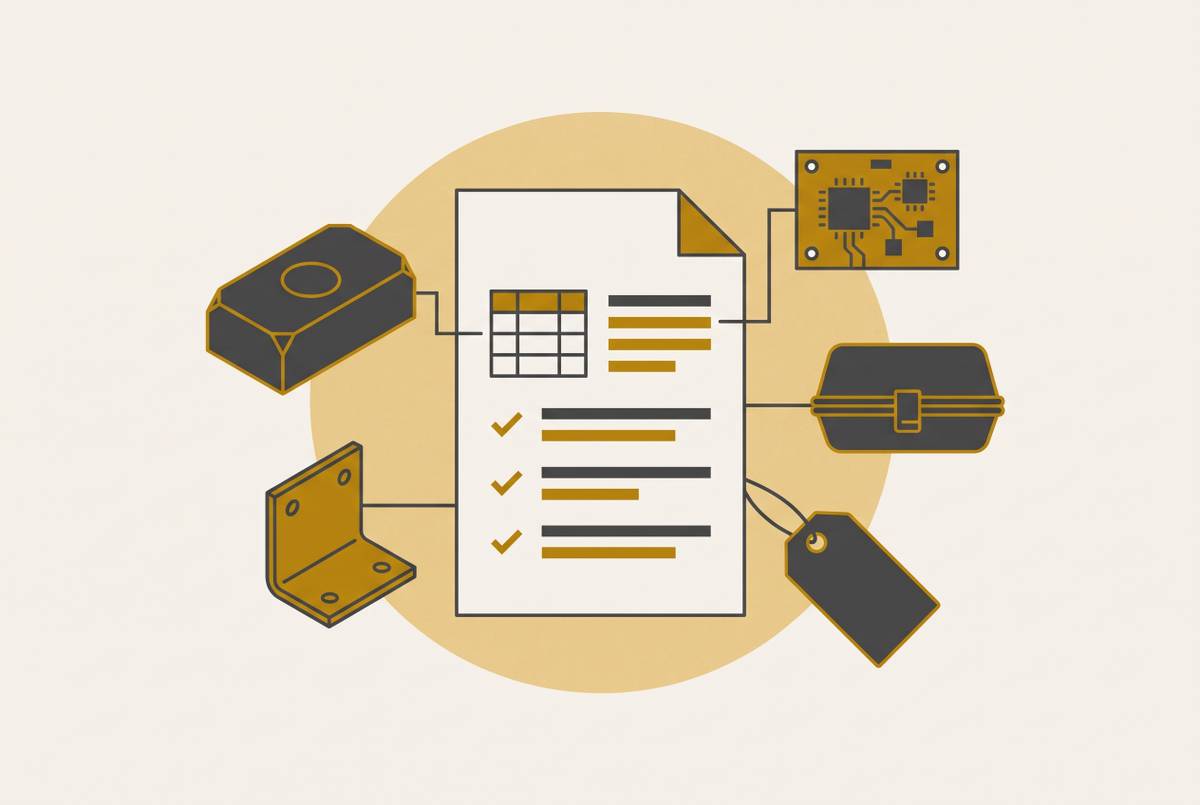
A multi-process mechanical assembly sourcing platform should own the whole build. For an assembly that needs machining, welding, finishing, and delivery in one box, the deciding capabilities are process breadth, consolidated quoting, assembly-level DFM, clear accountability, and coordinated delivery. The right platform connects those capabilities before production begins.
Why a multi-process assembly makes the sourcing platform itself an engineering decision
The job is a set of machined brackets, a welded frame, powder coat, and delivery as a kit. Each operation looks straightforward on its own. Getting them to agree on dimensions, drawing revisions, fabrication sequence, and delivery timing is hard. A bracket that passes inspection is not enough if it does not fit the finished frame. Engineers must also weigh how well the platform can manage those connections.
A typical fragmented vendor base for a mid-sized OEM separates laser cutting, forming, tight-tolerance machining, finishing, and light assembly. Each vendor has its own purchase order, inspection step, and quality record. Those boundaries create room for revision drift, tolerance conflicts, and gaps in responsibility that may stay hidden until assembly. The sourcing model puts those boundaries in place before work starts. A marketplace, a managed network, and a factory-direct or vertically integrated operation differ in how they connect the buyer to production, which affects pricing, lead time, failure resolution, and the response to changing volume.
What genuine process breadth means — and why a platform that skips the hard parts still leaves the job incomplete
A platform that accepts machined brackets and sheet-metal panels but declines the weldment has not covered the assembly. It has covered a portion of the order. The same is true when custom springs, tube bending, gaskets, or finishing fall outside its scope. Those exclusions send the engineer back to separate vendors, with separate schedules and quality records. A broad catalog is useful only when its coverage matches the actual bill of materials, or BOM.
Process breadth therefore needs to be specific. The relevant capabilities may include milling, turning, sheet metal, welding, 3D printing, carbon fiber, urethane casting, custom springs, gaskets, tube bending, precision wire cutting, injection molding, and die casting. Not every assembly needs every process. But a platform’s strength in milling does not answer whether it can handle the spring or gasket that completes the build. The test is coverage of this BOM.
Western Spring Manufacturing says that complex, precision-critical custom work that needs specialty wire, new tooling, and records of the finishing processes can take six weeks or longer. Getting specialty material can take weeks more, depending on the alloy and gauge. When that spring is sourced separately as an afterthought, its timeline still controls when the assembly can be completed. Its small size does not make it a small scheduling risk.
For an engineer evaluating coverage, the practical test is whether the platform will quote every line item in one request for quotation, or RFQ. The difficult items belong in that test from the start. A platform that leaves them unquoted has left the coordination work with the buyer, whatever its marketing promises. Any exclusion needs to be clear before commitment.
How do you get a single quote for a complex assembly requiring multiple manufacturing processes?
A single quote should tie together who does what in production as well as put the separate prices under one cover. A platform can route every line item to a capable shop and still leave the build uncoordinated. The distinction is who controls the interfaces between those shops. A managed network sells that coordination without owning the machines, while a factory-direct or vertically integrated model removes the intermediary layer through one accountable plant, one named engineer, and one quality system.
Tolerance stack-up makes the difference concrete. Wootz’s supplier consolidation analysis describes two shops producing passing inspection reports against their own datum assumptions, even though the parts may not meet positioning requirements when assembled. Yet those results do not establish that the combined assembly works, because neither inspection alone settles the relationship between the parts. Without an owner for that relationship, the buyer inherits the investigation and resolution.
Revision control creates a similar gap. One sub-vendor can cut to Rev C while another works from Rev B, with the mismatch missed until assembly. A genuinely consolidated quote establishes one revision gate that releases every drawing revision to every factory simultaneously. It also assigns ownership of the tolerance stack rather than assuming individual compliance will produce a working build.
One report format covers mill certificates, dimensional reports, and first-article packages, while one shipment plan governs delivery. Wootz’s framework links consolidation to fewer RFQ cycles, a tolerance stack with an owner, clearer documentation, and someone who is responsible no matter which factory caused a failure. The buyer’s test is whether the quote includes those responsibilities.
DFM applied to the assembly as a system, not part by part
Design for manufacturing, or DFM, is weaker when each vendor sees only its own part. A fabricator may make forming more efficient without knowing the assembly sequence. The assembler then receives parts that meet print but assemble poorly, leaving the buyer’s program team to resolve the conflict. Each vendor may have done its own part of the work correctly. The failure sits between their scopes.
An integrated engineering team can look at the drawings, tolerances, material specifications, and fabrication sequences for the whole build. That wider view exposes cost drivers and rework risks before production. A buyer’s team may understand design intent while lacking the manufacturing detail needed to spot conflicts between forming, machining, welding, and assembly. The partner’s contribution is knowledge of how the specified processes interact.
Timing determines how useful that contribution can be. DFM feedback during quoting can influence decisions before tooling is committed, whereas feedback afterward arrives when changes are harder to absorb. Much of a program’s cost locks in during design. Platforms are beginning to put AI-assisted DFM analysis into quoting workflows, but the software label is not the deciding feature. The review needs to happen early enough to prevent rework.
The standard for evaluation is therefore assembly-level DFM built into quoting, rather than a separate service delivered after acceptance. The engineer should ask if the review covers the full BOM and any conflicts between fabrication and assembly sequence. The answer must also establish when that review happens. A detailed review delivered too late does not provide the same protection as one that shapes the quote.
What accountability actually looks like when the assembly fails at the hard parts
Accountability becomes visible when parts pass their individual inspections but fail as an assembly. The engineer needs a contact who owns the resolution. That responsibility has to exist before failure occurs. In a marketplace arrangement, accountability can be split between the platform and the routed partner, even though the buyer contracts with the platform and cannot directly reach the party doing the work. In a managed network, resolution also runs through the platform.
The contract should make that responsibility concrete. A remake-or-refund commitment assigns the cost of a nonconforming result differently from a best-efforts warranty. It gives the buyer a defined remedy, while the schedule consequences of a failure remain. Same-day engineer support and pre-shipment inspection provide the operational side of that commitment. They are specific service and inspection steps that an engineer can examine before awarding a complex BOM.
Consolidation still creates risks of its own. Partner dependency, capacity constraints, geographic concentration, and quality escapes do not disappear because one party owns the order. A consolidation plan must address them through documented exit plans, capacity commitments, business-continuity reviews, and clear quality metrics. Single-source responsibility makes responsibility more concentrated, so the safeguards need to be explicit too.
Consolidation makes risk visible and assigned, while fragmentation spreads risk across interfaces that may have no owner. Separate suppliers can each do their own part of the work while the combined build fails, so problems can pile up before anyone takes responsibility for fixing them. A credible integrated arrangement names both the owner of the outcome and the limits of that arrangement.
How delivery coordination across processes determines whether the assembly arrives as a kit or as a puzzle
Correct parts still need to arrive as a usable build. When parts come from different sub-vendors on different days, each comes with shipping terms, inbound inspection work, and quality records. The receiving team has more separate checks to perform and more opportunities to match parts incorrectly. The assembly also has to wait for the slowest supplier.
Specialty processes make that gap harder to manage. Tube bending, custom springs, and finishing may each have an independent lead time, but the assembly cannot be complete until all are finished. When those schedules are managed separately, no single party necessarily has visibility across them or authority to shorten them. A quick machining quote says little about the finished kit. The lead time has to reflect the full build, including the processes most likely to hold it up.
A consolidated shipment plan connects delivery to the quality system. One set of Incoterms, one delivery date, and one receiving event replace separate shipping arrangements. Pre-shipment inspection brings the parts and their documentation together before they ship, so the receiving team has no need to piece together separate records. In an integrated production arrangement, the party making the parts can also inspect them before shipment. For a platform managing a network, the buyer needs an explicit commitment that the platform owns that inspection responsibility.
The delivery criterion is a single shipment covering the full BOM, with platform-owned pre-shipment inspection and a lead time for the complete multi-process build. A promise based on the fastest line item does not meet it. When a platform owns the process interfaces, review, quality resolution, and delivery plan, it acts as a build partner. That is the distinction the final evaluation needs to establish.
The evaluation checklist an engineer should run before committing a complex BOM to any platform
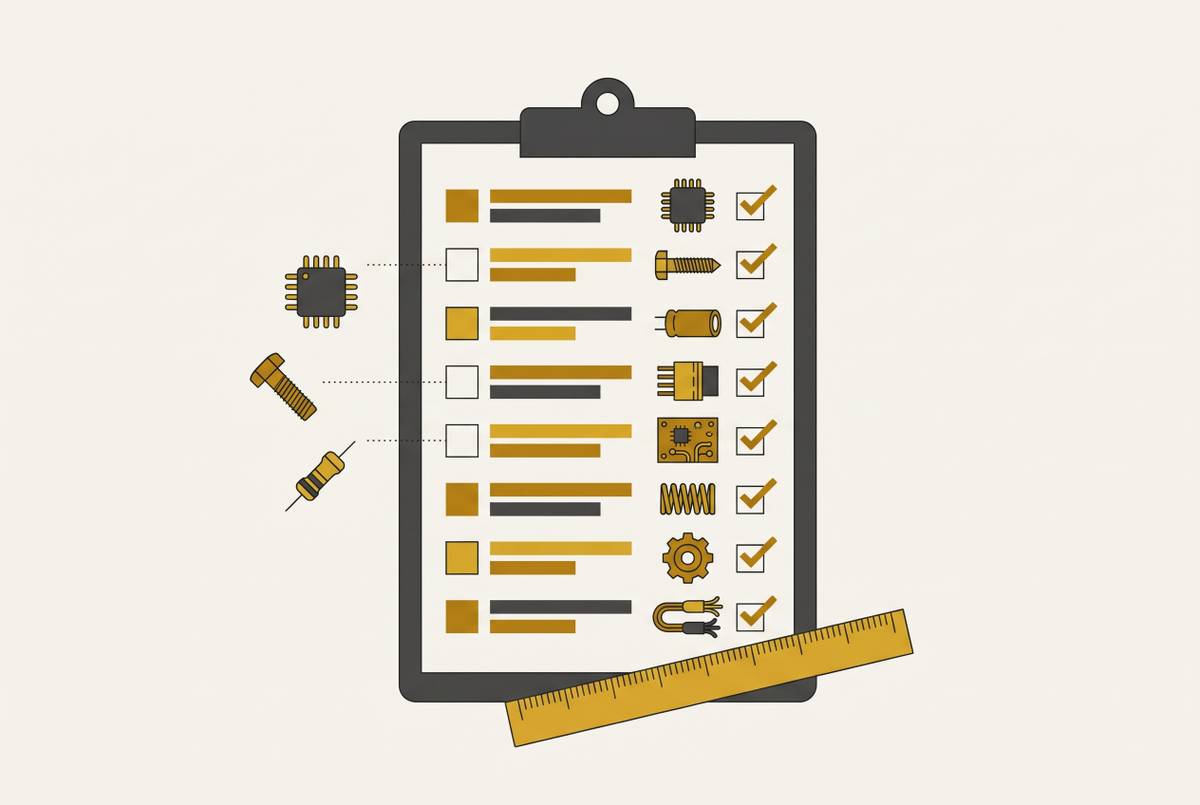
The evaluation should begin with the actual BOM. Ask whether every line item can be quoted in a single RFQ, explicitly including custom springs, tube bending, gaskets, weldments, and finishing where required. Then establish what happens to any item the platform cannot quote. An exclusion disclosed upfront is a known gap. One discovered after the purchase order is placed is an unresolved part of the build.
Look for one lead time and one accountable party. Ask who owns the tolerance stack and who releases drawing revisions to every factory simultaneously.
The DFM check concerns both scope and timing. Ask whether feedback arrives during quoting and whether it covers the assembly as a system, including conflicts between fabrication and assembly sequence. Part-level review alone is not the same service. Neither is assembly review deferred until after the quote is accepted.
Accountability needs equally direct questions before commitment. Establish who answers when the assembly fails, whether that party owns the machines or coordinates a network, and whether a remake-or-refund guarantee applies. Confirm whether pre-shipment inspection and same-day engineer support are included. For a consolidated arrangement, examine the exit plan, capacity commitments, business-continuity review, and quality metrics rather than treating a single contact as sufficient protection.
Ask if the full BOM ships together on one delivery date and if the quoted lead time allows for specialty processes. Any unresolved answer identifies coordination work that still belongs to the buyer, and that work belongs in the platform decision before the order is placed.