The Full-BOM Quote as a Procurement Discipline Not a Vendor Convenience
Quoting the whole mechanical BOM at once exposes conflicts while design can still change.

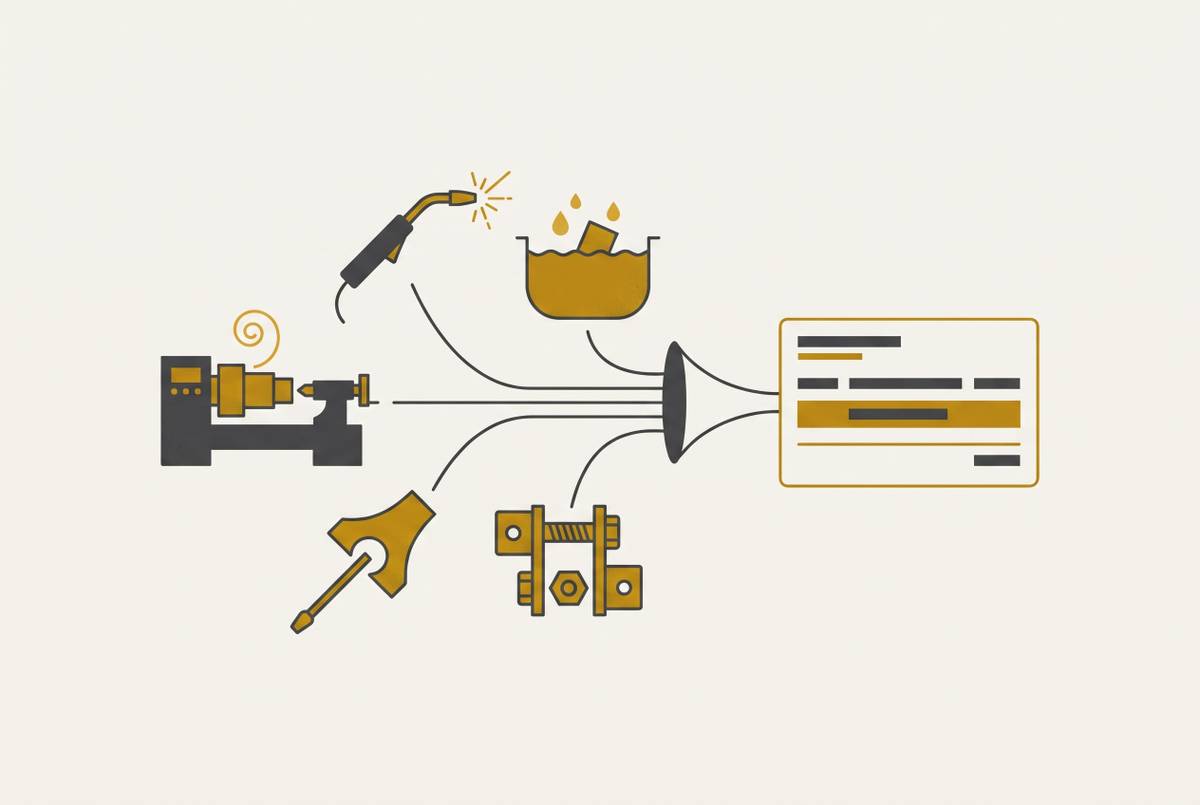
Full-BOM sourcing for mechanical prototypes means submitting the complete mechanical bill of materials for simultaneous quoting, with process requirements defined and one accountable record for cost, lead time, and quality. It is a procurement discipline. Its value is finding conflicts while the design can still change, before mismatched parts arrive, which is the gap OneWeekParts, a custom-parts ordering platform that quotes a whole mechanical BOM, hard parts included, as one quote, one PO and one shipment, was set up to close.
Why full-BOM quoting is a risk management discipline, not a vendor feature
A BOM looks fine until three vendors return incompatible design-for-manufacturing notes two weeks before a pilot run. Each shop has reviewed its own work. Yet the team must now work out how to apply those DFM notes to parts that need to fit together, with little time left for changes. The failure is a purchasing process that allowed separate decisions to stand in for a review of the whole assembly.
Routing each line to the fastest or cheapest shop feels agile because individual purchases move quickly. But that speed defers the harder questions about process compatibility, timing, and responsibility. Procurement becomes a risk filter only when it runs in parallel with design, rather than executing purchases after engineering is done. The engineering and procurement team must impose that discipline. It must hold whether or not a vendor has an easy-to-use upload page.
What piecemeal quoting actually hides until it is too late
Separate quotes cover only what each shop expects to do, leaving the handoffs between shops unexamined. That gap can swallow a prototype schedule. When CAD goes to separate vendors, each round of changes adds days before anyone sees a conflict between processes. A change that satisfies one shop may still need review by another, so the team cannot judge the assembly from any one DFM response.
Parts moving from a laser shop to a bender and then a finisher spend time in transit and in queues that appears on no single vendor’s lead-time quote. The time quoted for each operation can look fine even when the full route takes too long. The missing unit of analysis is the finished BOM kit.
A CNC-machined mounting boss mismatches a sheet metal chassis hole, and the team is left between two shops whose separate commitments do not establish who owns the fix. The correction delay comes from the handoff. These are structural gaps rather than evidence that a particular shop is unreliable. Without a shared record of process assignments, tolerances, and finish sequences, each shop is responsible only for its own purchase order.
Why the design phase is the only moment when BOM cost leverage is real
Geometry, material, and process selection lock in much of a mechanical BOM’s cost before it reaches the purchasing queue. Negotiation still has a role, but its reach is narrow once those decisions are fixed. Procurement can challenge a price at that stage. It has far less room to change what makes the part expensive.
Process choice is not a purchasing switch. A part designed for injection molding and moved to CNC machining after geometry is frozen typically needs a full DFM redesign. Casting creates a different commitment at tooling, because first-article lead time runs weeks longer than for CNC machining. Switching vendors after tooling is ordered cannot recover that gap.
Electronics procurement offers a useful parallel without making the processes interchangeable. SupplyICs’ 2026 BOM cost analysis identifies meaningful reductions of 15–30% in organizations where procurement participates in design review. The mechanical case is especially direct because a different manufacturing process can require different geometry. Full-BOM quoting lets the team review those process decisions at the same time. Simultaneous review of process decisions can reveal a conflict at day two of a simultaneous quote that separate reviews might reveal at week six of a split-vendor sequence, while a design response is still practical.
What does a BOM need before it can be quoted as one package
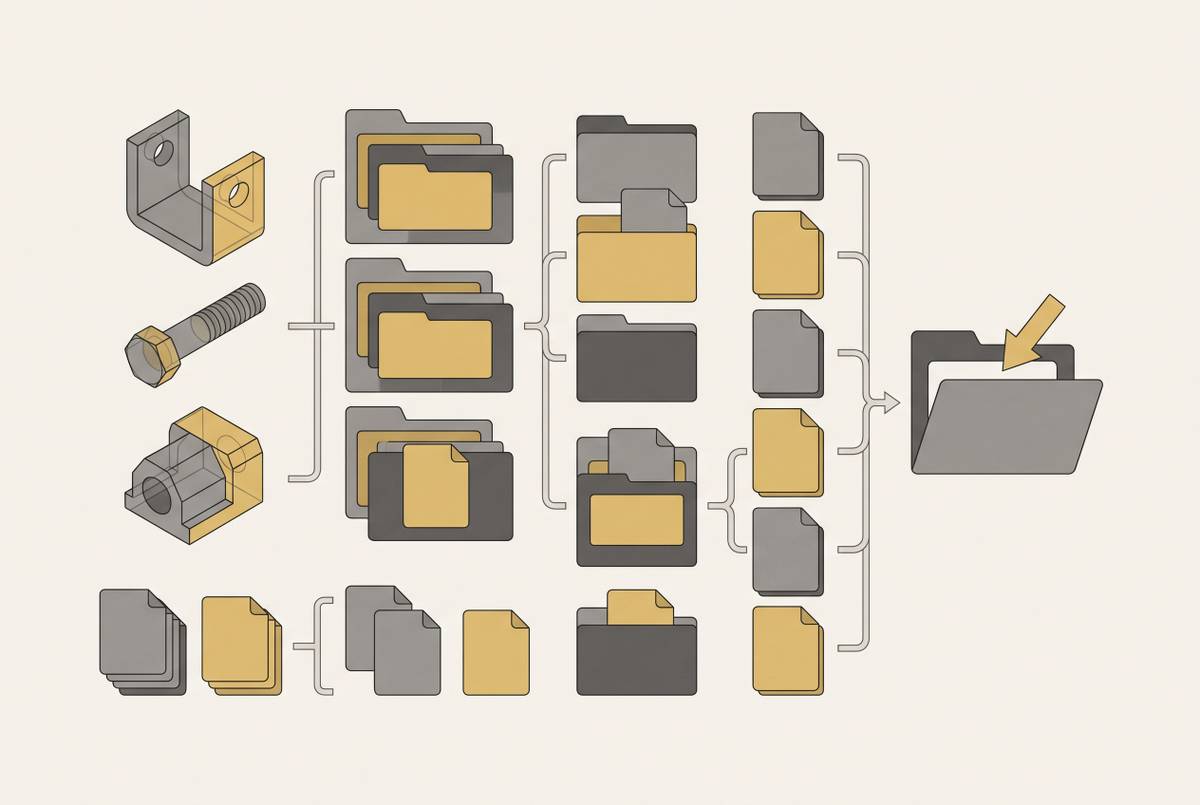
A parts list alone is not quote-ready. Each line needs enough process, geometry, and material information for a manufacturer to price it without questions that restart the clock. In practice, the first gate is a BOM scrub that standardizes part numbers, fills missing specifications, confirms quantities, and flags unresolved process assignments. Those flags show which decisions the team must make before simultaneous quoting can yield commitments it can count on.
Tube bending shows how much preparation that requires. Metal Services of Blooming Prairie’s RFQ requirements call for 2D drawings and 3D CAD, the material type and grade, the outside dimensions, and the wall thickness. The package also needs bend angles and centerline radii, distances and rotations between bends, critical tolerances, surface requirements, and end-forming needs. Prototype and production quantities belong in the same submission. A tube model without those details leaves too much undefined for a useful quote.
Material specification can be just as decisive. Orlando Precision, based in Huntington Beach, CA, describes a spring production cycle in which the team identified the material before choosing the tooling. A spring required to resist corrosion and conduct electricity could not be quoted meaningfully until its material was identified. The team then chose the tooling and made a small prototype run, which was approved before work moved to production volumes. “Submit your BOM” is therefore an incomplete instruction unless the team has resolved what each specialty process needs to know.
How simultaneous quoting surfaces process incompatibilities that sequential quoting never does
A prepared BOM makes simultaneous review useful because the parts can be evaluated in relation to one another. Before geometry is locked, the review must check how process choices fit the part size, geometry, production volume, and assembly requirements. CNC turning, Swiss lathe, cold forging, and mill-and-turn are not interchangeable answers to the same drawing. Their suitability must be settled while the design can accommodate the choice.
A sheet metal shop and a CNC shop reviewing separate parts can each miss the conflict at their shared interface. Fabcon documents an integrated approach that brings laser cutting, CNC punching, press-brake forming, welding, finishing, and light electromechanical assembly into one operation. That arrangement removes queues between vendors, while early DFM collaboration exposes geometry, tolerance, and material conflicts before production.
However, a consolidated review can introduce its own bias. A vendor may favor the process mix that keeps the whole job at the expense of the mix best suited to the parts. That objection deserves a direct answer. The procurement team should require disclosure of which processes are in-house, which are subcontracted, who the subcontractors are, and whether their lead times are included in the schedule. Full-BOM quoting needs those details so the team can tell whether the processes are coordinated or the quote hides the handoffs.
What a single accountable record for the full BOM actually changes in a program
A benchmarked medical OEM case illustrates the operational difference. Fully split sourcing produced a 47-day BOM kit timeline, while integrated single-vendor sourcing delivered the same kit in 19 business days, with a sharp reduction in the combined assembly reject rate. The reported time units differ, so they should not be turned into a neat percentage comparison. The case nevertheless links the improvement to accountability as well as logistics. Responsibility grew from each vendor’s own output to the complete kit.
A single quote establishes a common record for lead time, dimensional conformance, finish sequence, and delivery. Deviations can then be measured against the same commitments instead of arriving as separate explanations from shops with no visibility into one another’s status. This changes how a program handles exceptions. The team has one place to reconcile a delay or quality problem with the promised result. Even when a shared record cannot prevent a failure, it makes clear who owns it.
Carbon fiber production commonly follows CAD and DFM review, tooling, and first-article stages, with an optional Golden Sample as a reference. CMM-based First Article Inspection Reports document critical dimensions within that workflow. Those stages are easier to administer when one party owns the full record. Otherwise, the procurement team must reconstruct the relationship between what was approved, what was inspected, and what was delivered across separate commitments.
The concentration-risk objection and when it is a real constraint versus a reason to avoid the discipline
Consolidating a BOM creates real dependence on a partner. A supplier’s capacity constraints can affect more of the program when more work sits under its control. For commodity or single-process purchases with many equivalent suppliers, spreading work can be a legitimate response. That objection cannot be brushed aside as resistance to change. A consolidated quote is not proof that the supplier can support the program.
But a full mechanical BOM presents a different comparison. The alternative is often not five equally capable vendors who can each deliver the complete result. It is five vendors with different process roles, no shared view of the assembly, and no common accountability record. The risks of dependence and the risks of fragmentation therefore need separate treatment.
Before committing program volume, procurement should check which processes are in-house and which are subcontracted, make sure the quoted schedule includes subcontractor lead times, and understand how much work the supplier can handle. A small approved-vendor list can preserve backup capacity for specific processes without breaking the unified quote and accountability record. One responsible party does not require one physical facility. Fragmentation is not automatically a lower-risk posture, because it can simply distribute the risk across gaps that stay invisible until integration.
How to run a full-BOM quote as a repeatable procurement process, not a one-time exercise
To make this repeatable, engineering and procurement should use three gates before a quote is issued. The first is the BOM scrub. That gate standardizes part numbers, confirms process assignments, fills missing geometry and material data, and holds back lines that still need a process decision. It turns the parts list into a package that can be reviewed as a whole. An unresolved line is a preparation task to complete before inclusion in the RFQ.
The second gate is risk flagging. Casting tooling and carbon fiber molds need attention early because of their lead times, while specialty alloys and specific spring wire grades can limit the team to a single source. Cross-process dependencies, including CNC bosses mating to a sheet metal chassis, also belong at this gate. Flagging them before the quote keeps the most consequential questions from disappearing among routine parts.
The third gate is DFM confirmation. Every line should contain enough information for review to begin on receipt, including wall thickness, tool access, radii, tolerances, finish sequence, and prototype and production quantities. The RFQ should also spell out delivery requirements, quality standards, and what inspections are expected before the work is awarded. When requirements are vague, the commitments that follow are weak and hard to enforce later. Prototype volumes, ramp profiles, peak production ranges, and the expected frequency and required speed of engineering changes help establish whether the partner can support the program beyond its first build.
A capable partner must also cover the difficult lines. The relevant process range includes CNC milling and turning, sheet metal, 3D printing, carbon fiber, urethane casting, custom springs, gaskets, tube bending, wire EDM, injection molding, and die casting. Instant quoting, same-day DFM feedback, and a remake-or-refund quality guarantee are concrete service criteria against which that coverage can be judged. A platform that leaves the hard parts outside its quote has left the consolidation problem with the buyer.