When a Hardware Startup Needs Its Own Quality Engineer
Five signals show when a startup must hire dedicated quality ownership.

A hardware startup needs its own quality engineer when manufacturing complexity demands clear ownership. The decision rests on recognizable signals, including production scale, multiple processes, repeated drawing revisions, supplier gaps, and documentation demands. Those signals also show whether the right response is a full-time hire, a specialist contractor, or stronger quality support from a manufacturing partner.
Why hardware startups reach production without a quality engineer in place
The prototype phase rewards getting a design to work. Formal quality ownership rarely comes first. Design engineers review their own drawings because they know the product, but that arrangement has a built-in conflict. The person most invested in a design is also being asked to challenge its assumptions. A review can leave the design as intended without fully asking whether it is ready for repeatable production.
That is a structural gap. It takes time and money to hire a multi-process quality specialist, while the engineering team has prototype work to do right away. Quality tasks end up split among people who have other main jobs. As production approaches, the work expands without anyone clearly owning it.
What a quality engineer actually does in a hardware startup context
A hardware quality engineer is responsible for making sure the design intent can be met in manufacturing. The job starts before parts reach inspection. It spans product development, manufacturing, and supplier interfaces, catching mismatches before they become defects. Its main tools include design for manufacturing, or DFM, review before drawing release, disciplined tolerance callouts, incoming inspection criteria, supplier qualification, and failure analysis.
That work depends on the manufacturing process involved. Injection molding, CNC machining, sheet metal, and casting each impose different constraints, so the engineer needs working knowledge across the product’s process families. A tight tolerance on a non-critical surface can increase machining time by an order of magnitude. Sheet metal has physical limits on achievable tolerances, while casting commits the team to tooling before a part exists.
The role also challenges unnecessary part count. Every extra component is one more part to buy, inspect, and assemble, and one more part that could fail. A quality engineer asks whether a component already in the design can do the same job before the extra part becomes something the team must keep buying. That question connects design simplicity to the workload of building and checking the product.
The five signals that mean a startup genuinely needs this role
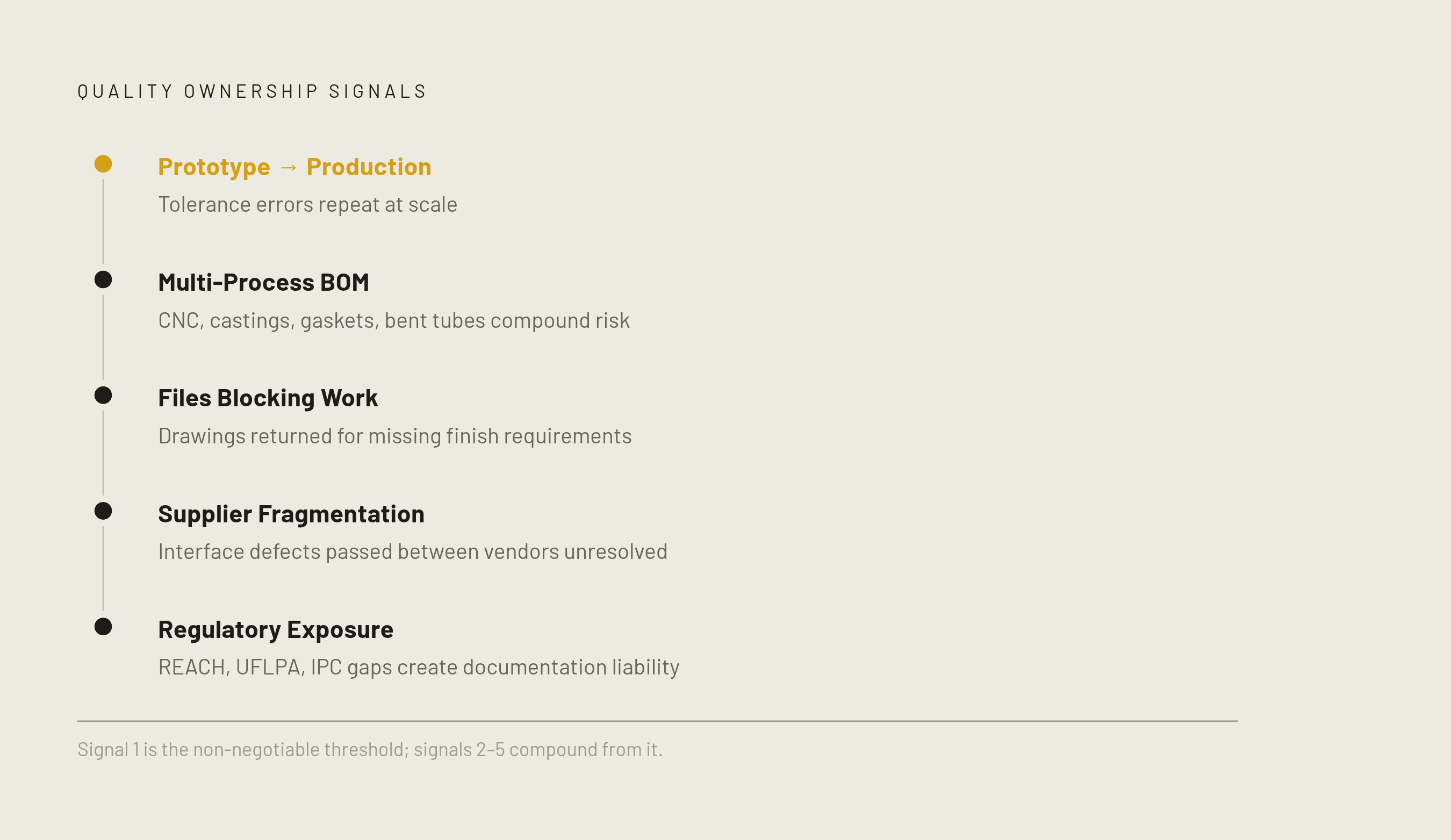
The first signal is the transition from prototype to production. A design decision that affects one prototype will soon affect hundreds or thousands of units. A tolerance error that was manageable during development then becomes expensive to repeat. This is the non-negotiable point for explicit quality ownership, even if a contractor provides that ownership before a full-time hire makes sense.
The second signal is a multi-process bill of materials, or BOM. A product combining CNC parts, sheet metal, castings, springs, gaskets, and bent tubes crosses several sets of manufacturing rules. No single specialist vendor owns all those interfaces. When a design depends on parts from those processes working together, the startup needs someone responsible for that relationship, rather than assuming each supplier’s review will cover it.
The third signal is that files and revisions keep holding up the work. If quoting keeps stopping because drawings are missing information or suppliers flag DFM errors, quality work is already taking up the engineering team’s time. It simply has no named owner yet. A drawing returned for missing finish requirements is not just an administrative delay. When drawings keep coming back, the release process needs someone in charge beyond whoever happens to answer the supplier’s email.
The fourth signal is supplier fragmentation with unclear accountability. Two suppliers can each be responsible for their own parts while neither owns how those parts fit together. An interface defect gets passed between vendors without anyone settling how to fix it. That gap needs a quality engineering owner who can look across the supplier base, rather than treating each purchase as a separate transaction.
The fifth signal is regulatory or documentation exposure. Updated REACH restrictions, UFLPA enforcement, and evolving IPC standards have raised demands for material traceability and quality records. A supplier mix that cannot consistently provide the required documentation leaves more than a purchasing problem. When material records are still missing information from one order to the next, the startup needs someone in charge of quality who can check supplier evidence against the product’s requirements.
Where specialty fabrication categories expose the gap most severely
It is especially easy for a startup to leave custom springs, tube bending, and gaskets out of its formal quality process. These categories do not fit neatly into instant-quote platforms, so teams often source them through less formal channels. Their documentation infrastructure can be weaker than that used for CNC or sheet metal orders.
Springs make the weakness of one-time inspection clear. Load testing is required at every production setup, including during first article inspection, or FAI. A five-piece FAI proves little about a process that makes large numbers of parts per shift. Initial acceptance and ongoing process control each answer a different question. Treating the first as a substitute for the second leaves production variation outside the quality process.
Tube bending also needs formal qualification at the volumes the team plans to produce. H&P Products lists ISO 9001:2015 certification, in-house inspection, PPAP Levels 1–4, and Faro 3D scanning among its quality provisions. Aerospace-grade bending can involve tight-radius geometry down to 0.8× tube diameter, where vendor trust alone is no substitute for process qualification. The startup must include those requirements in its quality work when it buys a bent tube.
Hiring a full-time quality engineer versus contracting versus leaning on a capable manufacturing partner
A full-time hire fits a continuing, cross-product responsibility. The strongest case appears when production spans multiple process families, documentation requirements are ongoing, and supplier qualification extends across a fragmented vendor base. A contractor engagement becomes a poor fit when the startup needs someone to keep owning those responsibilities between releases and orders.
Contracting or fractional quality engineering is a better fit for work with a clear end. A team may need a DFM review before a particular production release without having enough continuing work for a full-time role. Casting tooling sign-off or spring FAI documentation may also need specialist knowledge that the design team does not have. In those cases, the engagement has a defined purpose.
At the prototype and early small-batch stage, a capable manufacturing partner can provide much of the practical quality support. The minimum includes instant DFM feedback during quoting, pre-shipment inspection on every part, and a remake-or-refund guarantee. A partner that handles CNC, sheet metal, casting, springs, gaskets, and tube bending in one quote and shipment also takes responsibility for a larger share of the BOM. This reduces the number of interfaces the startup must manage itself.
The boundary of that support must remain explicit. A partner’s quality process covers the parts it makes, while qualification of other suppliers, incoming inspection for parts bought elsewhere, and regulatory documentation at assembly level remain the startup’s responsibility. A first production run across several processes may therefore need a fractional engineer even with a strong partner. When documentation becomes continuous and supplier management remains fragmented, the case shifts toward an internal hire.
What good DFM feedback looks like at the quoting stage and why it matters before a quality engineer exists
Good quoting starts with a complete file package. That means a 3D CAD file in STEP or IGES format plus a 2D drawing identifying critical dimensions, the precise material and grade, tolerances and GD&T callouts on functional features, and the required surface finish. Factories receiving complete packages can generate accurate quotes in 12–24 hours and move directly to production scheduling. When packages are incomplete, factories have to wait for answers, adding days before machining can be scheduled.
Useful DFM feedback questions the package by flagging tight tolerances on non-critical surfaces, missing finish callouts, and tolerance stacking before the order is placed. For a team without a quality engineer, the practical step is to assign someone ownership of drawing quality and submission discipline. A partner can identify a problem, but the startup still needs someone responsible for resolving it in the release package.
How to manage quality accountability across a fragmented supplier base in the interim
Until the hire is in place, supplier consolidation and explicit order requirements provide the practical defense. Fewer capable partners mean fewer boundaries for the startup to oversee. Replacing separate vendors for each process with a partner that quotes and ships the full BOM gives one organization responsibility for more of the work. One purchase order, one shipment, and pre-shipment inspection reduce the chance that two vendors each assume the other owns an interface. Consolidation reduces the quality workload at those boundaries, but it does not remove quality risk.
Written requirements make the remaining responsibility concrete. Even without a quality engineer, a startup can put incoming inspection criteria, material certification requirements, and first article requirements into its purchase orders. Someone still has to close the loop. The interim owner must follow up on those requirements rather than treating their inclusion in the order as proof they have been met. Otherwise, the team has documented its expectations without establishing accountability for the result.
The supply model also changes what consolidation provides. Integrated digital manufacturers own their machines and have automated ways to buy with fast turnaround, while managed networks cover more processes across regions. With factory-direct models, one site is responsible for the work, and costs are favorable at higher volumes after tooling. A broad process offering and a single point of contact should therefore be considered separately from the actual scope of inspection and documentation support.
What to look for when the hire finally makes sense
Once the role is justified, the search should reflect the work that needs an owner. Requiring an exact match across every process, tool, and industry background sharply narrows the applicant pool. That can turn a real coverage gap into a prolonged search for an ideal candidate. The useful distinction is between capabilities required on arrival and knowledge that can be developed. A candidate with DFM knowledge across two or three process families who can learn the others is more realistic than one already expert in all of them.
The core requirements follow directly from the role’s scope. The engineer needs multi-process DFM literacy, the ability to write and own inspection criteria, supplier qualification experience, and familiarity with the documentation relevant to the startup’s regulatory environment. Deep expertise in every specialty process is a different demand. Engineers at a manufacturing partner can help with spring FAI, tube bend qualification, or casting tooling sign-off while the new hire learns that work.
Contract-to-hire is another viable route to coverage. It lets the team test fit before committing to full-time headcount while getting quality work owned during the search period. The hiring decision should stay anchored to the unresolved responsibilities. A team that defines what it actually needs can find a suitable candidate faster and close the quality gap sooner.