First Manufacturing Hire at a Hardware Startup
This hire must architect how design, sourcing, and production actually work together.
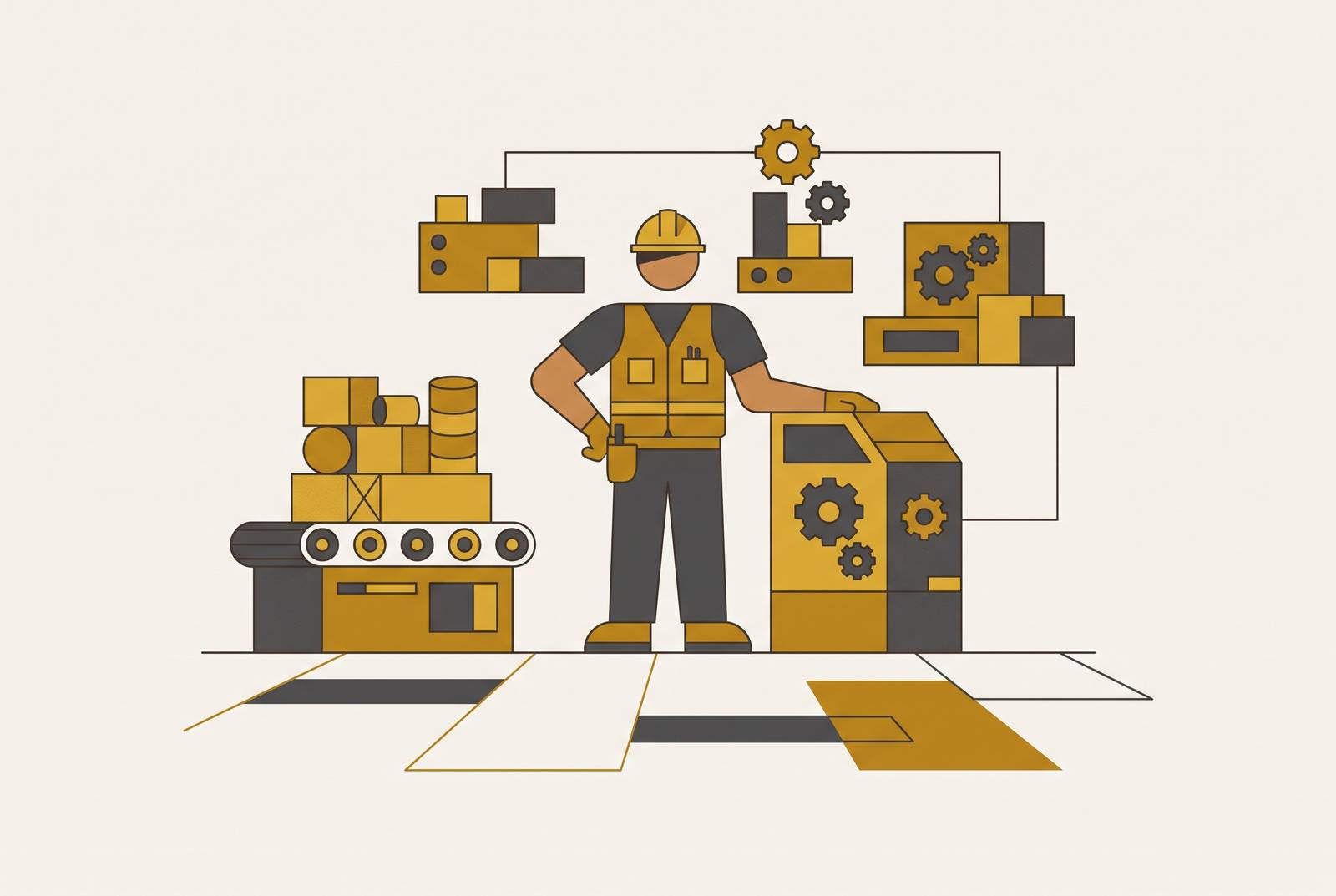
The first manufacturing hire at a hardware startup is the architect of its production system. To get this hire right, define the whole job before writing the job description. That means giving one person responsibility for connecting design, sourcing, tooling, assembly, and quality into an operation that can actually build the product.
Why the first manufacturing hire is not what most job descriptions say it is
A founder’s job description often focuses on managing vendors and buying parts, while work between departments is left undone. Engineering makes a design decision, sourcing chooses a supplier, and manufacturing inherits the result without enough visibility into either choice. Testing and certification can each be discussed on their own again. The product can fail even when the engineering itself is sound, because nobody connected those decisions.
The job is to close those gaps as well as keep orders moving. Its mandate reaches from assembly processes and fixtures to tooling, calibration, throughput, and the full supply chain. Those responsibilities belong together because each constrains what the others can deliver. A hire with responsibility for supplier follow-up but no authority over the production system cannot do the job the startup needs.
The supply chain problem is as much a sales problem as an operational one
At the prototype and early-production stage, finding suppliers is not usually the binding constraint. Getting them to prioritize a small customer is. The startup’s order competes with work from customers who have more money, so a purchase order alone will not get it to the front of the queue. The first manufacturing hire has to make the program worth a supplier’s attention.
That takes negotiation, technical translation, and program management as well as purchasing skills. This person must explain what the product needs and build a strong enough relationship to keep the work moving. Knowing the supplier landscape helps, but it does not replace the discipline needed to coordinate a constrained program.
Tesla’s 4680 facility illustrates that distinction. Its team hired from high-speed bottling plants and syringe manufacturing because the pursuit of volume and scale transferred across industries. A candidate from automotive or defense may bring useful domain knowledge, but that background is not the whole qualification. Domain expertise can be taught, while process discipline is hard to find.
DFM is the organizing principle of the role, not a task that belongs to engineering
Design for manufacturing, or DFM, connects the product the team wants to sell with the process that can reliably make it. That connection starts with choices about architecture that set the steps needed to make the product. It continues through detailed rules for geometry, tolerances, and material behavior. During production, it depends on feedback from the factory, yield monitoring, and care in handling engineering change orders.
A feature that customers like may still be too expensive to build or depend on a part that cannot be sourced consistently at scale. If that problem emerges only when manufacturing takes over, the team has to revisit decisions it thought were finished. The cost of change is structural because the design and the production process have already been built around each other.
The first manufacturing hire owns that connection by participating during design. Engineering still does engineering, but the limits of manufacturing help shape its choices while it can still change them. Feedback from production then comes back through the same loop, which keeps factory complaints tied to the design work. DFM is the organizing principle because it links decisions before and after a product reaches the line.
Process-specific DFM knowledge the hire must bring on day one
In injection molding, walls with uniform thickness help avoid sink marks and warpage, and draft angles let parts come out of the mold. Ribs must stay within a set proportion of the thickness of the wall next to them, and sharp corners create stress concentrations. These decisions belong in CAD, because once tooling locks them in, fixing them requires revisiting the tool.
CNC machining calls for a different eye. Rounded exterior corners on an aluminum housing may do nothing for how it works but still need multiple tool changes, specialized programming, and more time to machine. Sharp corners and chamfers can make the same part work just as well at a much lower cost. The hire should spot that during design review. In sheet metal, the corresponding discipline is to keep bend lines straight and parallel and lock bend geometry before tooling and material orders, because mid-cycle changes can add weeks.
Carbon fiber introduces another constraint, namely tool wear as a primary driver of cost and schedule. High-volume runs call for polycrystalline diamond cutters, while lower volumes use diamond-coated solid carbide. Safety-critical components also require ultrasonic or tap testing for internal delamination. Understanding the process therefore means understanding both how the part is cut and how its condition is assessed.
For specialty fabrication, including springs, gaskets, and tube bending, incomplete documentation is the biggest lead-time risk. A custom gasket RFQ needs a drawing or DXF, a material specification, estimated annual volume, and any regulatory callouts. Prototype and first-article parts usually ship within a few business days, but production with tooling that is already in place takes a few weeks. Tube bending has standard lead times of 4 to 12 weeks, with specialty materials and unique tooling adding time, but a complete specification can reduce quoting time from days to hours.
The common requirement is complete input before a fabricator can quote accurately or reserve capacity. Missing information costs time and money. When a mechanical BOM spans several processes, separate vendor relationships also multiply coordination work and risk. A sourcing partner that can quote the full multi-process BOM in one transaction removes handoffs, but the first manufacturing hire still owns the completeness of what goes into that quote.
BOM risk management before design freeze, not during a supply crunch
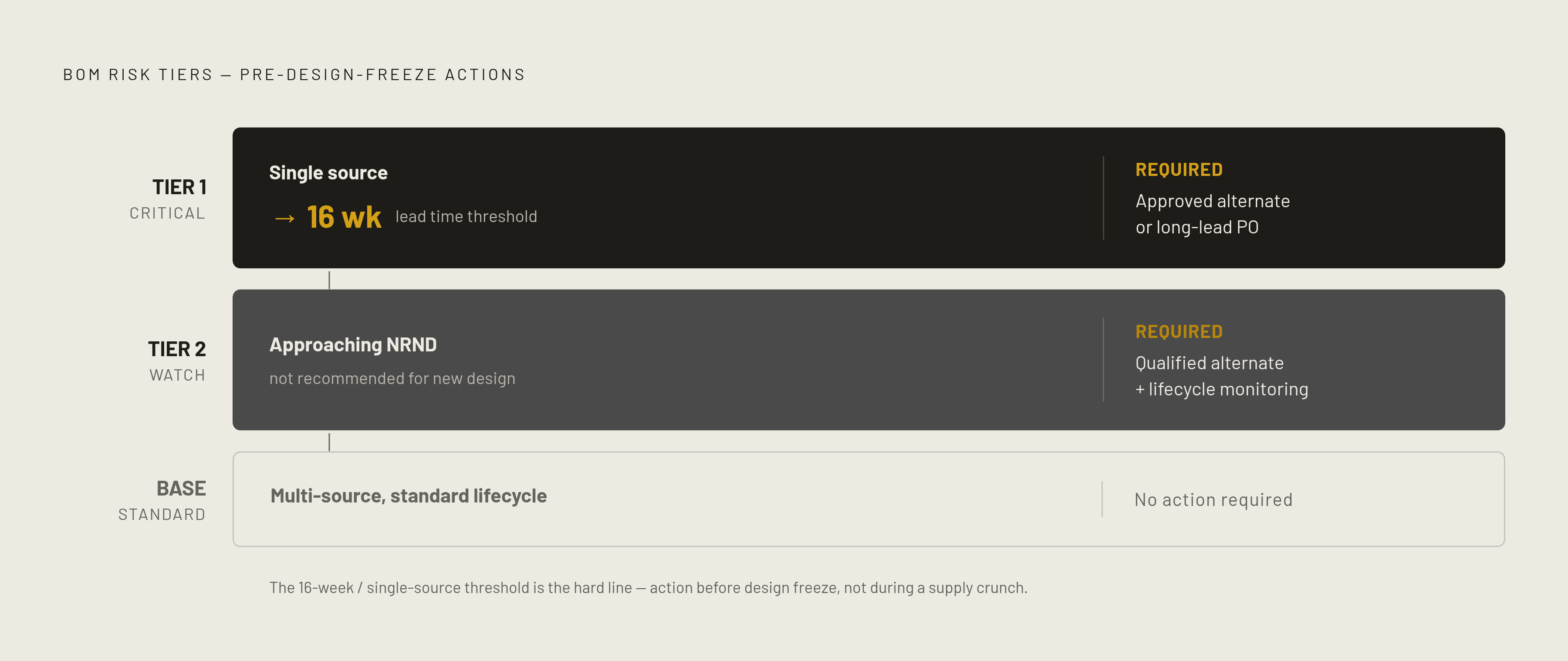
The bill of materials, or BOM, is another place where manufacturing work must begin before the design is finished. More complex connected products have more line items, and each line adds sourcing exposure. The job is to record those parts, classify their risks, and qualify alternatives while engineering still has the time to do the work.
An alternate component needs the same footprint and compatible electrical characteristics, and its firmware compatibility must be checked. Qualifying those conditions during development is dramatically less expensive than doing so under production pressure during an allocation event. The useful alternate is the one already qualified when the original becomes unavailable.
A part’s risk classification should guide what needs to be settled before design freeze. A part with a single manufacturer and a lead time over 16 weeks requires an approved alternate or a long-lead purchase order. A part approaching NRND status requires a qualified alternate and lifecycle monitoring. Tooling makes the deadline more consequential because injection mold, die casting, and stamping tooling lock in design choices. Changing a component afterward can require modifying or replacing the tool.
Software can support this discipline without substituting for it. Arena offers integrations with Altium and SOLIDWORKS and connects electrical, mechanical, and software teams through change management workflows. The important hiring requirement, however, is ownership of the review and its decisions. A shared BOM does not remove the need for someone to resolve its risks.
The NPI sequence and the mistake of treating the first run as a production run
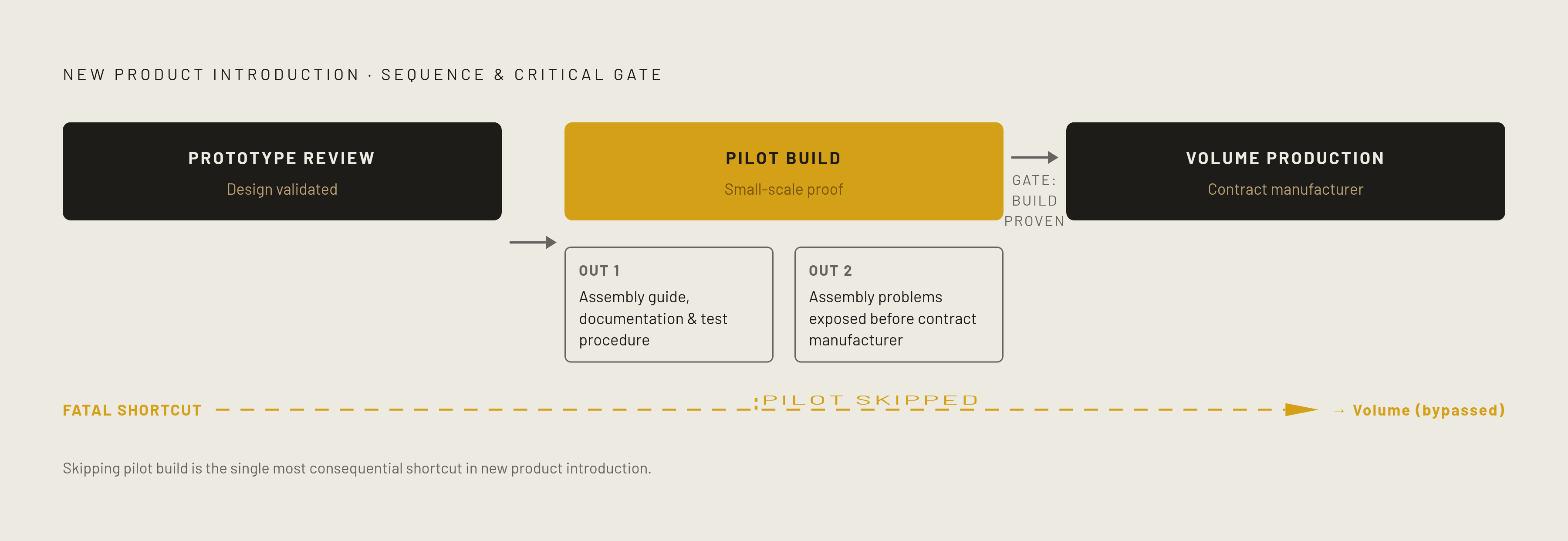
Once the design and supply risks are understood, the next test is whether the build process works. New product introduction, or NPI, moves through prototype review, pilot build, and volume production, with defined checkpoints between stages. The pilot proves the process at small scale before the startup commits to full volume. Running the full batch on the first build skips that proof.
Assembling the first units in-house is one way to establish what the handoff needs. That work creates the assembly guide, documentation, and testing procedure while exposing assembly problems before a contract manufacturer has to discover them. It also makes ownership explicit. The startup is transferring a defined process.
Contract manufacturer selection should support that sequence. Vetting begins with a survey covering processes, customers, volumes, and quality control before time goes into a quote. Requesting prices at both the base quantity and three times that quantity prepares for scaling without renegotiating from scratch. Domestic manufacturers tend to be more specialized and may require a separate assembly house, while overseas manufacturers, particularly in Shenzhen, offer more integrated supply chains at the cost of greater distance and communication overhead.
Outsourcing is not the only decision available. Owning particular fabrication capabilities in-house can be a competitive advantage. The first manufacturing hire should evaluate which processes to bring in first, choose the machines, and establish the capability.
Quality assurance as a system the hire builds, not a function they hand to someone else
Quality assurance must be designed before the first production build. Incoming inspection catches defective components before assembly. In-process inspection finds problems while they can still be fixed, and final inspection checks finished products against specifications before they ship.
The documentation requirements start with the initial production part. Many customers and regulated industries require a First Article Inspection, or FAI, report showing that it fully complies with engineering drawings. The first manufacturing hire needs to know when that report is required and how to produce it. Treating it as paperwork to obtain later separates acceptance requirements from the process meant to meet them.
Material traceability creates a similar obligation. A mill certificate traceable to the heat number, together with a certificate of conformance and a CMM inspection report, provides proof of material identity. For aerospace and medical applications, a usable part may require that traceability. Sample certificates should therefore be reviewed before the first order.
In-circuit testing, functional testing, and automated optical inspection provide production confidence and support tracing a field issue back to a specific build lot. The hire’s responsibility extends to the manufacturing partner’s contractual commitments as well. Inspection of every part before shipment, backed by a remake-or-refund guarantee, is a stronger standard than shipping first and waiting for complaints.
What to look for when writing the job description and evaluating candidates
The job description should name ownership of the production system, including DFM, tooling, NPI, supply chain risk, and quality architecture. Leading with vendor management and sourcing coordination attracts candidates for a narrower job. The interview must then test whether the candidate can connect those responsibilities as well as talk about each on its own.
A useful test is to ask about a project with half the time, half the budget, and half the people it needed. The candidate needs to explain how it might have been done or where the effort went wrong. That discussion exposes how they reason under the resource constraints that define startup manufacturing.
A candidate who understands how to build millions of a thing to a demanding specification brings an operational instinct that domain knowledge alone cannot supply. Recognition of the value of co-locating engineering and manufacturing is another signal. Someone who treats manufacturing as a downstream recipient of design will recreate the disconnect the role exists to fix.
DFM needs to happen before tooling, alternate qualification before design freeze, and inspection planning before production. Getting those decisions right early takes time and care. Getting them wrong can cost replacement tooling, delayed builds, and another design revision.