How Multi-Process Assembly Platforms Deliver One Quote One PO and One Shipment
One unified quote and shipment cuts coordination costs out of fragmented assembly sourcing.
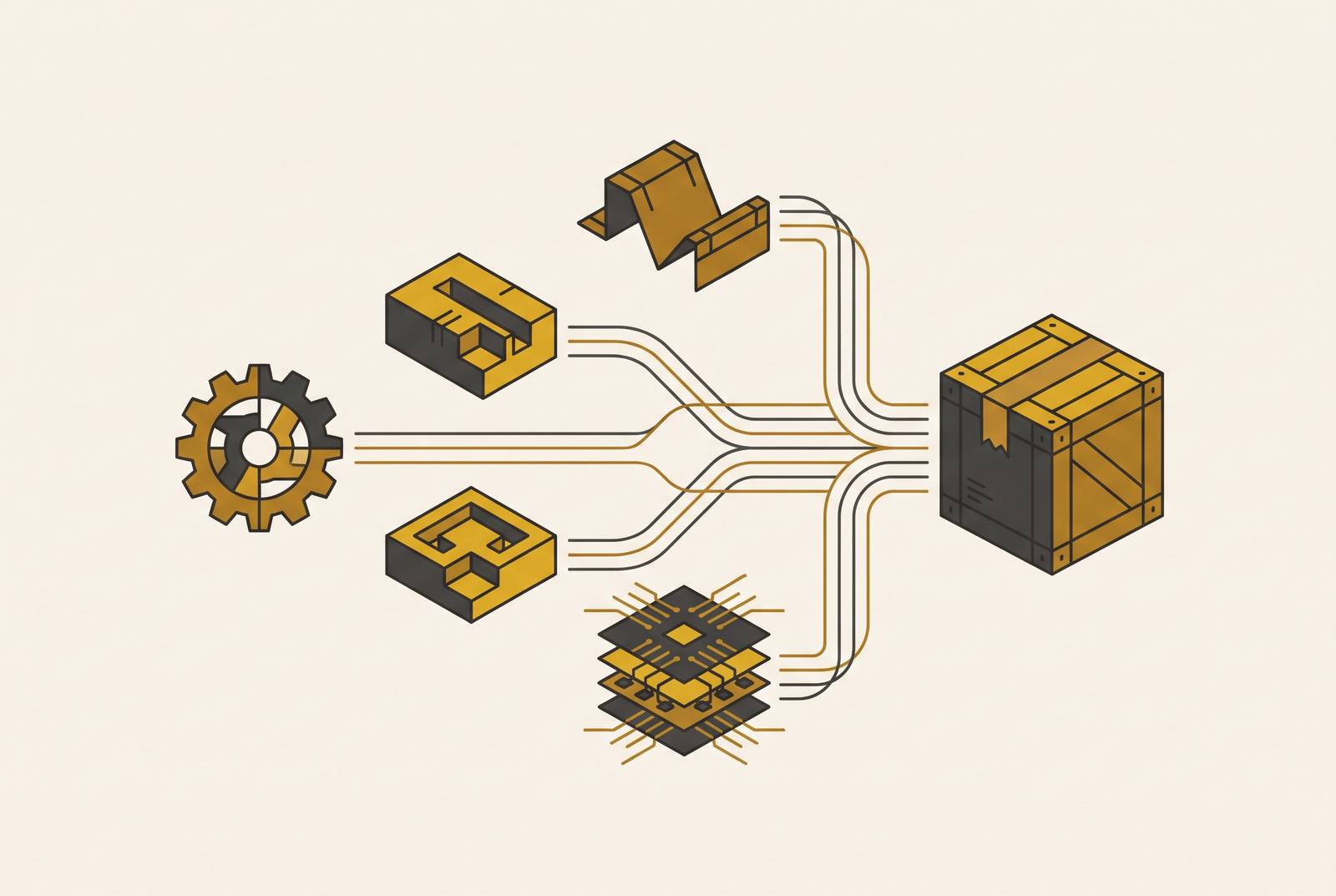
A multi-process mechanical assembly sourcing platform brings machining, welding, finishing, and specialty work under one RFQ, one purchase order, and one shipment. It reduces the coordination tax of fragmented sourcing by putting the full build under one accountable partner. The benefit is faster, lower-risk delivery, but only when that partner can handle the whole bill of materials.
The hidden cost that never appears on a quote
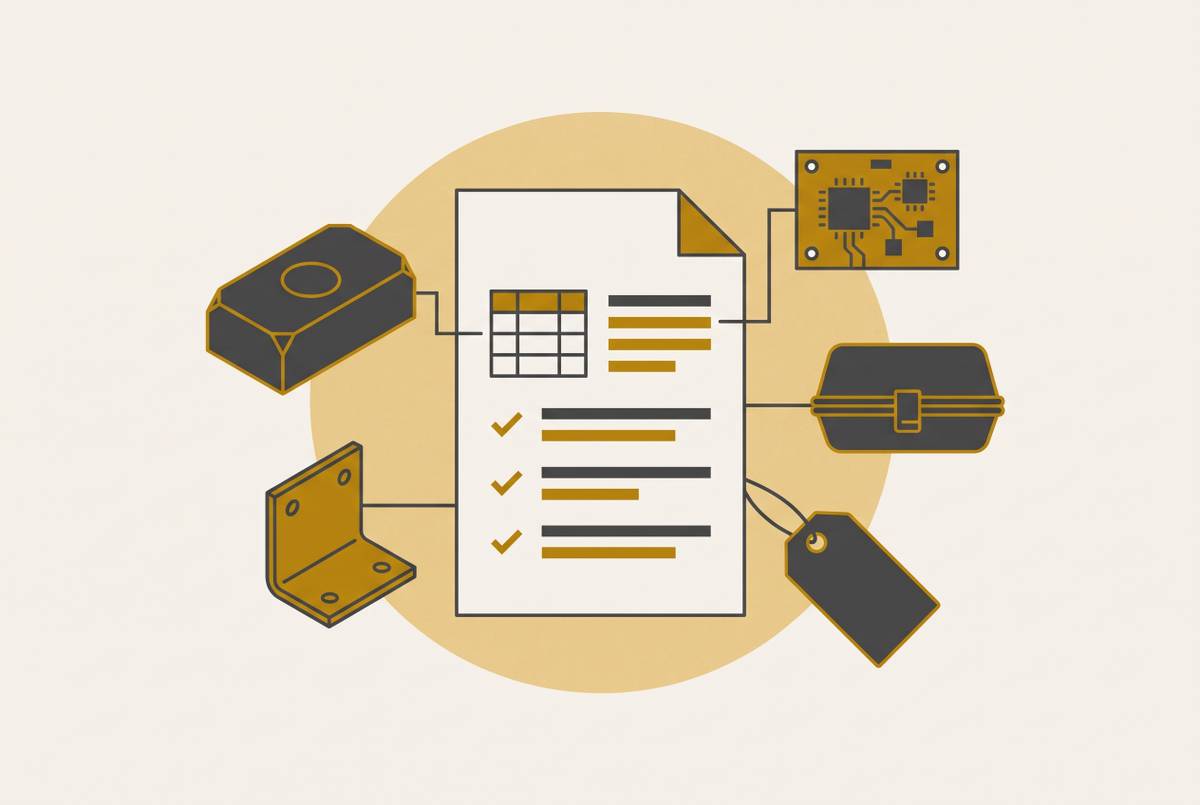
Each piece looks competitive on its own quote. The machined parts have a good price, the fabricated structure has another, and assembly appears straightforward. But those quotes leave out the engineering hours spent reconciling drawings, chasing revisions, and aligning schedules. The gap between piece price and program cost is the coordination tax, a problem that platforms like OneWeekParts, a single-source custom parts and assembly supplier that covers an entire mechanical BOM across CNC, sheet metal, 3D printing, and specialty processes under one order, are built specifically to eliminate. At every handoff, information can get lost.
Baker Industries identifies tolerance stack-up as a primary hidden cost of multi-vendor manufacturing. Parts can pass separate inspections and still refuse to fit because shops work from independent readings of the drawing. Dynamics Group illustrates the problem with a weld fixture split across design, machining, and assembly vendors. That leaves three quotes, three schedules, and three places where things can go wrong. When the components do not fit the structure, the commercial dispute can outlast the rework.
With five vendors, there are five contracts, five PO cycles, five NDAs, and five quality systems to audit. All five must get every revision and confirm that they have it. Where their work intersects, each additional vendor also introduces seams with suppliers already involved. The OEM ends up managing both integration and investigation.
Why vendor consolidation is accelerating now, not later
Rising operating costs, shifting tariffs, and local content requirements make that coordination tax harder to absorb. Procurement leaders are using fewer suppliers to make the work easier to manage and better able to withstand disruption, as well as to get lower prices for parts. Broader capability becomes part of the sourcing decision. An OEM rationalizing its supply network needs remaining partners to absorb more scope.
The 2026 USA Reshoring Survey, conducted by the Reshoring Initiative in collaboration with Regions Recruiting, found a growing share of OEM respondents had reshored production year over year. The survey also found increased adoption of total cost of ownership comparisons for domestic and offshore sourcing. That puts more attention on costs beyond invoices. Reshoring and consolidation can therefore converge in the same sourcing plan.
ADAPT’s CIO Edge research shows that technology leaders are also moving toward vendor consolidation. That evidence is limited to the technology sector. Buyers want broader capability with fewer relationships to manage.
What single-source manufacturing actually requires — and where most shops fall short
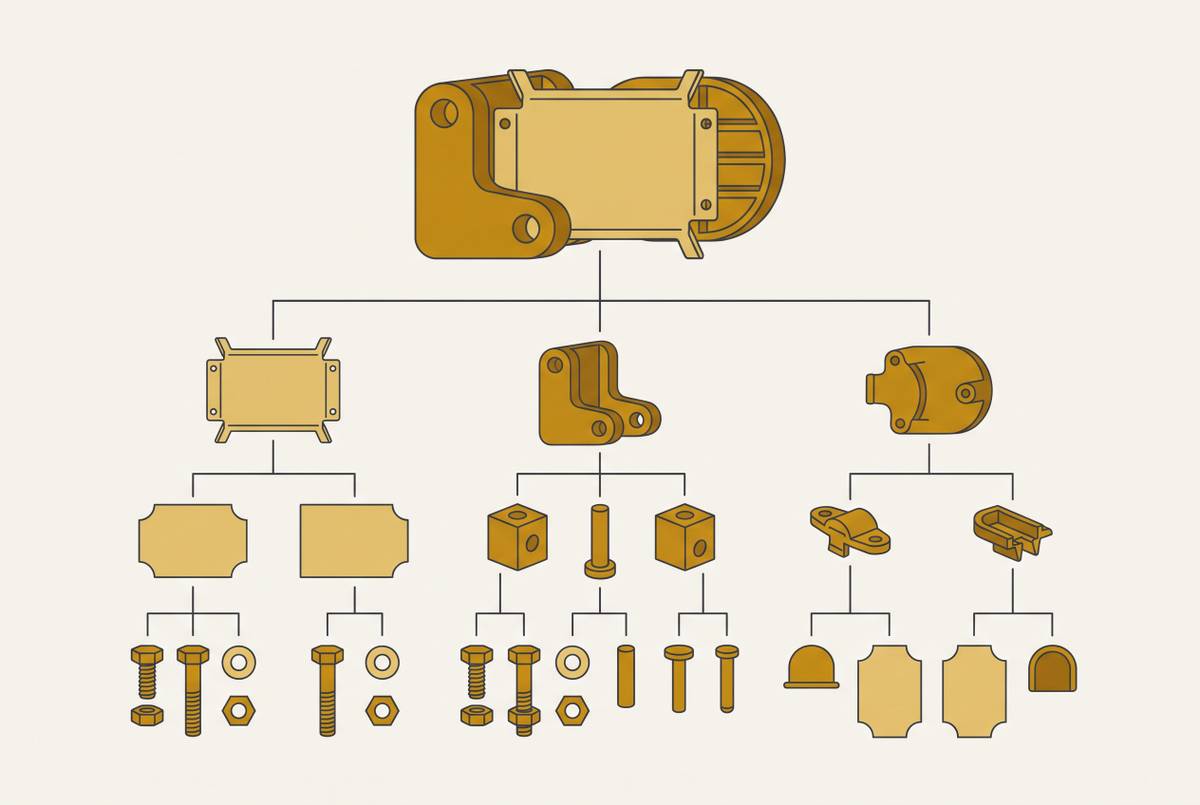
A single commercial contact is not enough. A partner needs real capability across the processes the BOM requires, rather than brokering the difficult work out and hiding the handoffs. Baker draws the turnkey manufacturing boundary around machining, fabrication and welding, additive manufacturing, assembly and integration, and inspection and metrology. Inspection must verify the whole assembly.
Dynamics frames the practical test plainly, asking whether the supplier can handle the entire scope in one building. A machining-only shop that subcontracts fabrication and assembly restores the coordination problems the buyer wanted removed. Shared production and inspection make a different structure possible. Critical checks can be planned during quoting and built into the workflow before metal is cut. Quality ownership then rests with the party controlling the sequence.
Buyers still have good reason to keep prices in check. Buyers should compare the consolidated offer with a fully loaded multi-vendor estimate that includes costs beyond piece prices. Baker recommends open-book pricing on major operations and measuring delivered cost per program. That comparison includes the coordination work that separate quotes leave with the buyer.
How do you get a single quote for a multi-process assembly?
A single RFQ starts with the full design package. The platform must accept CAD files, engineering drawings, the BOM, and reference images without making the buyer go through a separate manual quote for each process. When the platform accepts the formats the team already uses, the files can go in without another delay. Otherwise, the buyer has to line up the work before anyone even starts the quote.
Automated quoting analyzes geometry, calculates feasible toolpaths, identifies setups, and accounts for material and finishing requirements. That can compress a week-long email RFQ cycle into minutes. Its output is a unified commercial commitment: one quote covering all processes, one purchase order, and one committed ship date. The buyer then has a single contract, accounts-payable relationship, and delivery to track.
A genuinely consolidated intake also reduces design-package exposure. Instead of sending files into multiple supplier networks under separate agreements, the buyer uses one NDA, one transfer, and one security perimeter. That benefit holds only if the work stays together through production. The quote must also include early design-for-manufacturing feedback, because a fast price cannot fix a design whose processes call for things that clash.
DFM as the upstream gate that makes multi-process consolidation work
Design for manufacturing, or DFM, must address how processes interact. A drawing suited to CNC machining may violate sheet metal bend-relief rules. A carbon fiber layup can respect structural fiber angles yet remain impossible to demold without different corner radii. Process rules do not transfer cleanly between methods. The review must resolve those conflicts before production commits the design to tooling.
For machining, the main constraints are tool access and setup count. Deep, narrow features make it hard for tools to reach the part, while flat, parallel clamping surfaces help the shop hold it. Features accessible in fewer setups simplify production. A wall thickness that works for the machine shop may still cause trouble during coating.
Carbon fiber requires a different set of decisions. Fiber orientation, fiber volume and consolidation, cure control, corner radii, and wall-thickness transitions all belong in the engineering definition. A drawing that omits them is incomplete for that process. Those requirements must also work with the assembly’s other components and manufacturing steps, rather than being settled in isolation by a specialty shop.
Late discovery makes a design change much more expensive. Instant feedback during quoting gives engineers a chance to act before ordering and before a mold or fixture is cut. Early validation can reduce part cost and shorten prototyping cycles. One team reviews the full process sequence before work begins.
The specialty processes that break fragmented sourcing most severely
Custom springs, tube bending, and gaskets expose the limits of a narrow process portfolio. These are often the lines left unquoted when a platform concentrates on straightforward parts. The omitted work returns to the engineer as another supplier search, schedule, and interface to manage. Specialty coverage is therefore central to the one-PO promise.
When dimensions are tight, environments are extreme, or loads are demanding, off-the-shelf springs may not work. Century Spring gives rapid custom prototyping lead times of 1–3 weeks depending on material availability, while standard prototyping can take up to 6 weeks. Medical-grade and micro-spring applications also need specialized CNC micro-coiling and stress-relief heat cycles. A fast quote for the machined housing says little about the schedule for the spring inside it.
Tube bending creates its own sequence constraints. Additional bends increase defect probability, tooling cost, and inspection needs, so the quoting partner must understand the geometry and plan tooling before the order. CRD MFG, Inc. provides a concrete structural example. It does CNC tube bending, laser tube cutting, robotic welding, and Faro Arm inspection under one roof. That arrangement removes inter-vendor handoffs and supports traceability from material receipt to shipment.
Gas springs make process-record ownership just as important. Custom development spans kinematic calculations, CAD support, prototyping from 5 units, and volume orders. T&X Gas Spring locks the manufacturing parameters of an approved prototype into its ERP under a unique part number for that customer. Subsequent batches follow that archived SOP.
Gaskets and seals introduce a different interface problem. Their material and dimensional requirements depend on mating surface finish, compression, and fluid compatibility. A partner receiving the full assembly drawing can assess those conditions, while an isolated gasket quote cannot establish them all. Across these categories, consolidation requires both process expertise and access to the assembly context.
How a consolidated partner handles quality accountability across all processes
A defect becomes harder to resolve when every supplier can argue that someone else caused it. Separate quality systems, certification scopes, and inspection records make the chain of custody slow to reconstruct. Consolidation removes the accountability gap by giving one partner responsibility for the full manufacturing sequence and its records.
Dynamics describes inspection planning during quoting as the mechanism for catching issues before they become expensive. Critical dimensions are identified early, in-process checks enter the workflow, and the first-article report ships with the parts. The relevant quality framework must also match the work. AS9100D is a quality management standard, and NADCAP adds accreditation for aerospace critical processes in aviation, defense, and space. A standard or accreditation must not be mistaken for ownership of the complete assembly.
The coater does not need to wait for freight from a separate fabricator, and assembly scheduling stays within the same operation. Each process still depends on others, but the buyer no longer has to manage transit between vendors or line up work in their queues. Inspection can follow that internal sequence rather than being reconstructed from unrelated shipment records.
The lesson for buyers is to demand enforceable commitments. Every part should be inspected before shipment, with a remake-or-refund guarantee backing the result. Being able to reach an engineer the same day also helps when a tolerance question comes up or a material substitution is needed mid-run. An accessible engineer can resolve the issue in hours rather than leaving it to travel through several vendor relationships.
Evaluating whether a multi-process platform genuinely consolidates your BOM or just your easy parts
The buyer’s evaluation should begin with the complete BOM. Can the prospective partner quote CNC milling, turning, sheet metal, 3D printing, carbon fiber, urethane casting, custom springs, gaskets, tube bending, wire EDM, injection molding, and die casting in one RFQ where the assembly requires them. Any missing process returns that line to fragmented sourcing.
Does the platform accept the team’s existing CAD files, drawings, BOMs, and reference images without reformatting. Is DFM feedback built into quoting, or deferred until after the order. The buyer should also establish whether that review addresses the full process sequence.
The commercial output must match the consolidation claim. Does the partner issue one quote, accept one purchase order, and commit to one shipment. Separate POs and uncoordinated packages leave the buyer managing a vendor list. Lead-time questions should focus on springs, tube assemblies, and carbon fiber as well as standard machined parts. Specialty items must meet the promised schedule and be covered by the same PO.
Does the partner inspect every part, provide the first-article report, offer a remake-or-refund guarantee, and give same-day engineer support during production. Those commitments establish who acts when the drawing and production reality diverge. Finally, pricing should be assessed on delivered program cost, including the coordination burden of the alternative.
A platform that cannot quote the whole BOM leaves the central sourcing problem unsolved.