Lead Time Benchmarks for Common Custom Mechanical Processes
Each process demands its own lead time math, from three-day prints to twelve-week tooling builds.
Custom mechanical parts don't run on one clock. CNC machining, sheet metal, 3D printing, casting, and injection molding each carry their own lead time math, and mixing them up is how hardware teams blow their launch dates. Knowing the real ranges, and what pushes a job to the fast or slow end of each range, is the planning foundation that keeps a prototype schedule from turning into a guessing game.
Lead times for custom mechanical parts range from 1 to 3 days for 3D-printed prototypes up to 4 to 12 weeks just to build tooling for injection molding or die casting, before a single production part comes off the line. CNC machining sits in the 10 to 15 day range for low-volume runs, with rush prototypes possible in as little as 3 days; sheet metal fabrication runs 2 to 6 weeks; and urethane casting typically lands at 1 to 3 weeks. The spread within each process comes from a chain of dependent steps: design review, material sourcing, the production run itself, post-processing, quality checks, and shipping, where a delay at any early link pushes every subsequent step back. Material sourcing is currently the most visible driver of variation, since raw stock like seamless mechanical tubing can run 8 to 14 weeks domestically, a figure that sits entirely upstream of whatever turnaround a shop quotes on its own process.
Why do lead times vary so much between different manufacturing processes?
Lead time is a chain: design review and DFM feedback, material buying, the actual production run, post-processing, quality checks, then shipping. It's a chain: design review and DFM feedback, material buying, the actual production run, post-processing, quality checks, then shipping. Each link depends on the one before it, so a delay anywhere early on doesn't just cost its own days, it pushes every step after it back too.
Material sourcing is where delays are most visible right now. Raw material deliveries have stretched well beyond pre-pandemic norms, and that gap touches every process covered here, because nothing gets machined, formed, or molded until the material arrives.
Custom work makes the spread worse, not better. No two jobs share the same geometry, material, volume, finish, or regulatory sign-off, and each of those variables can shift a timeline by days or weeks on its own.
CNC machining lead times: the baseline most teams anchor their schedule to
For low-volume runs, CNC machining typically is in the 10 to 15 day range. Rush prototypes can come back in as little as 3 days, while full production runs usually take 2 to 3 weeks. That's already a five-fold gap between the fast end and the slow end, and a short list of levers accounts for it.
Material is the first one. Aluminum and standard steels machine fast and set the baseline. Exotic alloys and hardened steels add another 2 to 4 days on top of that, mostly from slower cutting speeds and more careful tool paths. Titanium, Inconel, and similar high-performance alloys add 5 to 7 days beyond standard aluminum, driven by tooling that wears out faster and raw stock that isn't sitting on a shelf ready to cut.
Shop queue is missing from the quote. A machine shop running near capacity can add 1 to 3 days before a part even gets loaded onto a machine. That queue time is invisible on paper but very real on the calendar.
Sheet metal fabrication lead times: how forming complexity and finish selection drive the range
Sheet metal runs 2 to 6 weeks for complex or high-volume formed parts. Metal stamping is 3 to 6 weeks pretty consistently, mostly because of the mold development work that has to happen before the first stamped part comes off the press.
Material availability sets the fork in the road early. Galvanized steel, common aluminum grades, and standard stainless sheet sit in stock at most suppliers, so jobs using them move fast. Rare alloys or odd thicknesses need secondary sourcing, and that can add delay that isn't captured in any published range because it depends entirely on who has what, when.
Post-processing is the bottleneck that catches people off guard. Almost every finish, anodizing, powder coating, plating, adds 3 to 5 business days on its own. That's the same structural delay CNC parts run into with secondary finishing, but sheet metal jobs call for these finishes far more often, so the tax gets paid more consistently.
3D printing lead times: the fastest path to a first part, with real constraints at scale
3D printing wins the speed contest. Industrial printers can turn out a prototype in 1 to 3 days, the fastest number anywhere in this guide. There's next to no physical setup. CNC needs 2 to 4 hours of CAM programming and fixturing before a spindle even turns; a printer can start the same day a file gets approved.
That speed comes with a tradeoff in tolerance. Printed parts typically hold ±0.010 to 0.030 inches or wider, the loosest range of any process here. That range is fine for a fit check or a form study, but it limits how often a printed part can stand in for a machined one in a functional assembly.
The speed advantage also has an expiration date. Past roughly 50 units, CNC machining catches up to and passes 3D printing on total turnaround, because CNC's setup cost gets spread across more parts and its per-part throughput takes over. And just like sheet metal, post-processing, sanding, painting, functional finishing, is a time cost that compounds the total turnaround beyond what the raw print time suggests.
Urethane casting lead times: the middle zone between printing and hard tooling
Urethane casting typically takes 1 to 3 weeks, well short of hard tooling timelines because it skips the tool-and-die build. The schedule breaks into three phases that run one after another: a master pattern (often 3D printed), a silicone mold built off that pattern, then the actual urethane casting and cure. Knowing those three phases matters, because delay in any one of them pushes the whole job back.
Volume is what decides which process actually wins:
- At 1 to 10 units, 3D printing or CNC usually beats casting, since there's no tooling to build.
- Between roughly 10 and 500 units, urethane casting tends to win on both cost and lead time.
- Past about 500 units, aluminum or steel hard tooling pays for itself fast enough to pull ahead of casting.
At 20 parts, casting runs about 55% cheaper than CNC and roughly 82% cheaper than quick-turn aluminum tooling.
Injection molding and die casting tooling lead times: the long runway that catches teams off guard
Building a steel mold for die casting or injection molding takes 4 to 12 weeks, and that's before a single production part comes off the line. Die casting tooling alone runs $20,000 to $100,000 or more for steel dies, a capital number big enough that committing to this process early in a program carries real financial weight, not just schedule weight.
Adding First Article qualification on top of the mold build can stretch the total timeline to several months. This isn't a process for a team that needs parts in a matter of weeks; it's a process for a team planning production months out. On the tolerance side, injection molding holds ±0.005 to 0.010 inches, tighter than 3D printing but looser than CNC, which matters directly when a molded housing has to mate with a machined bracket or fastener.
Specialty fabrication lead times: custom springs, tube bending, and gaskets
Custom springs split into clear tiers. A standard configuration built from stocked wire ships in a few days. Custom geometry, unusual cross-sections, or specialty materials push that out to three to six weeks, depending mostly on wire availability and how complex the coil configuration gets. Precision-critical work involving specialty wire, new tooling, and documented finishing steps can run six weeks or longer. Wire forms follow a similar pattern: simple shapes in one to three weeks, complex forms with tight tolerances or secondary operations in three to six weeks or more. Material matters as much as shape here, since compression, extension, and torsion springs in stainless or music wire each carry their own sourcing timeline.
Tube bending lead times vary considerably depending on shop workload, part complexity, and material availability, with standard custom work spanning a wide range from a few weeks to several months. Specialty materials stretch that further, and unique tooling can add several additional weeks on its own. The single most dangerous variable is a mid-cycle engineering change: altering geometry after tooling and material are already ordered can add substantial delay, on top of whatever the original schedule called for. Non-destructive examination, when the part needs it, adds meaningful time to the schedule. And incomplete RFQs are the most common delay driver of all, since a spec that's missing information turns what should be an hours-long quoting process into a days-long back-and-forth, so getting a fabricator involved early and giving them a complete spec can shave real weeks off the schedule. Process choice also plays a role: CNC mandrel bending, laser tube bending, roll bending, and induction bending all suit different jobs, with induction bending fitting thick-walled carbon steel, stainless, and alloy pipe where cold bending risks cracking or springback.
Custom gaskets show the clearest case for vertical integration. Standard multi-step manufacturing, form-in-place gaskets being the common example, can carry meaningful lead time depending on cutting method and material. A manufacturer that runs die cutting, waterjet cutting, and CNC cutting under one roof can deliver the same part considerably faster, simply because the part never has to travel between vendors. Material choice, EPDM, silicone, Santoprene, Viton, nitrile, drives which cutting method makes sense.
Carbon fiber deserves a caveat rather than a number. It brings processing steps, layup and cure cycles among them, that standard metal fabrication never has to deal with, and no single reliable lead time figure covers the category well enough to print here. Anyone weighing carbon fiber against aluminum or steel for its strength-to-weight advantage should get a lead time straight from the fabricator quoting the part, since layup method and cure cycle swing the schedule too much for a general range to mean much.
Raw material lead times as a hidden multiplier across every process
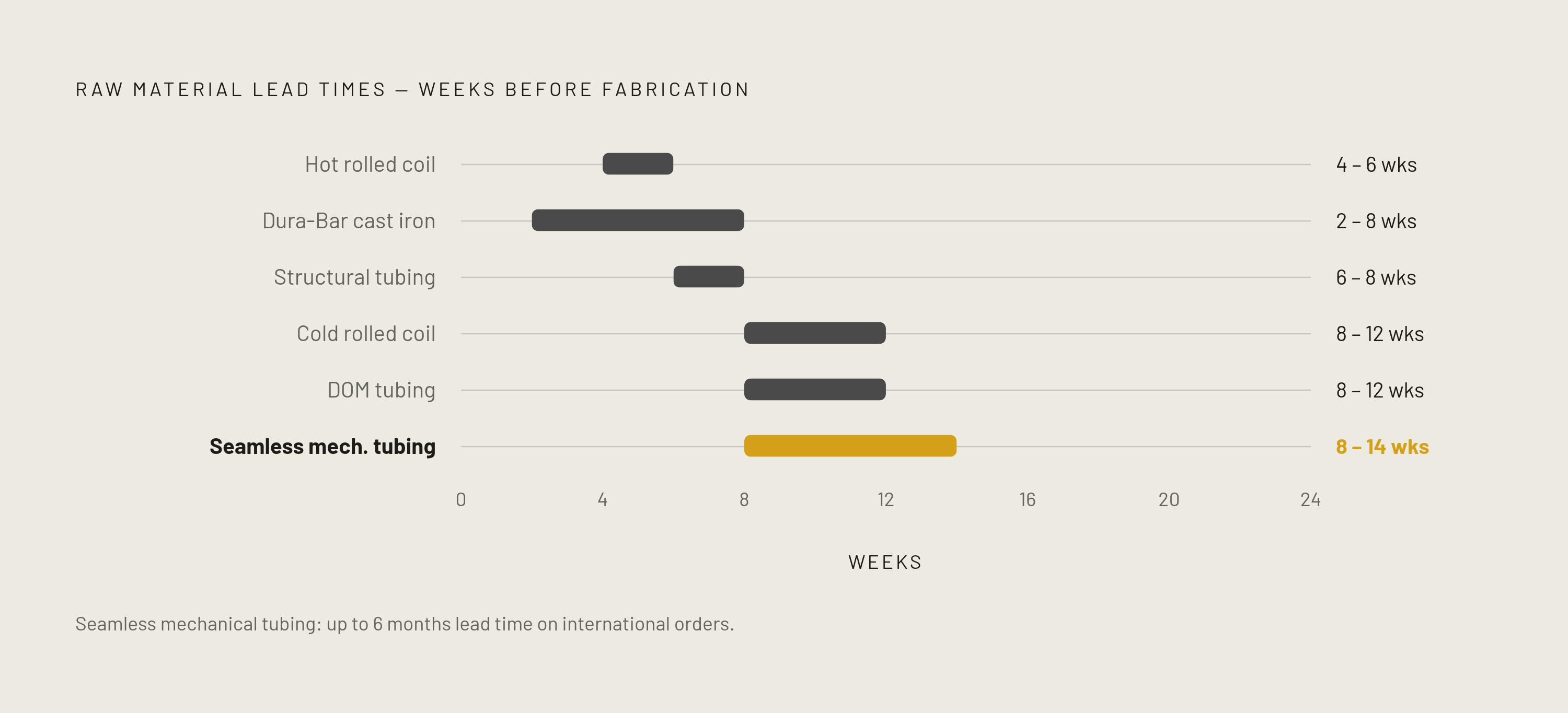
Data from the Industrial Tube and Steel Corporation, cited via Craftsmen Industries, gives the clearest picture of material lead times available. Hot rolled coil runs 4 to 6 weeks. Cold rolled coil runs 8 to 12 weeks, a sharp jump from the prior month at the time that data was collected. Structural tubing is 6 to 8 weeks, pushed up by demand and logistics. Seamless mechanical tubing runs 8 to 14 weeks domestically and 4 to 6 months if sourced internationally. Dura-Bar continuous cast iron runs 2 to 8 weeks, and Drawn Over Mandrel tubing runs 8 to 12 weeks.
All of those numbers sit upstream of anything a fabrication shop quotes. A shop can promise a 10-day CNC turnaround with total confidence in its own process, but if the billet needed to start the job is 8 weeks out, the part is 8-plus weeks out no matter what the shop's internal schedule says. Electronic components carry the same risk when suppliers move to allocation-based ordering, stretching well beyond typical lead times, a real concern for any build pairing mechanical parts with electronics on the same bill of materials.
How DFM decisions compound lead times across every process
Most of a part's manufacturing cost, and most of its schedule risk, gets locked in during design, long before anything reaches a shop floor. That's the core fact behind every lead time number in this piece, and it's the one most easily ignored during early development.
Design-for-manufacturability decisions made at the concept stage can dramatically increase both lead time and cost, with the effects compounding when multiple difficult features appear on the same part. Those effects stack when a single part carries more than one difficult feature, so a design with a deep pocket, a tight internal radius, and a non-standard thread can compound into a schedule problem that no single fix resolves.
The pattern repeats across every process already covered here. Poor DFM on a CNC part adds 3 to 7 days on its own. Tube bending punishes late changes hardest of all: locking geometry before tooling and material orders go out is the single highest-leverage DFM decision in this entire guide, since getting it wrong after the fact is what triggers the severe downstream delays described above. The lesson holds across every process in this piece: a design review done early is cheap, and the same review done after tooling or material commitment is one of the most expensive mistakes a hardware schedule can make.