Material Procurement Lead Times That Blow Hardware Schedules
AI demand and geopolitical tension are reshaping semiconductor supply for years, not quarters.

Material Procurement Lead Times That Blow Hardware Schedules
Long lead times for electronic components delay hardware projects because procurement sits on the critical path of every downstream activity: assembly cannot start until parts arrive, test cannot start until assembly is complete, and a pilot or production launch cannot happen until test clears. The failure pattern is almost always the same shape, one bottleneck part slips, which delays assembly, which delays test, which delays the customer pilot, which delays revenue. The cascade compounds further because lead times themselves are no longer stable commitments: a part can re-quote mid-project with a longer lead time than the original purchase order assumed, an allocation can be pulled from under a confirmed order, or a quote's validity window can close before the PO clears legal and finance. Even contracted customers aren't fully protected, with Micron confirming it could only fulfill around 55 to 60% of core customer demand, meaning a signed agreement doesn't guarantee the part arrives when the contract says it will.
Why hardware schedules slip before a single part is machined
The moment a bill of materials gets locked, every line item on it starts a race against the project schedule, and most hardware teams don't clock that the race has already started. Procurement gets treated as a downstream task, something that happens after the real engineering work is done. That assumption is what breaks schedules, because a single long-lead part discovered at tape-out can unravel months of design and validation work that everyone assumed was on track.
The failure pattern is almost always the same shape. One bottleneck part slips, which delays assembly, which delays test, which delays the customer pilot, which delays revenue. Nobody plans for the whole chain to move. They plan for the part.
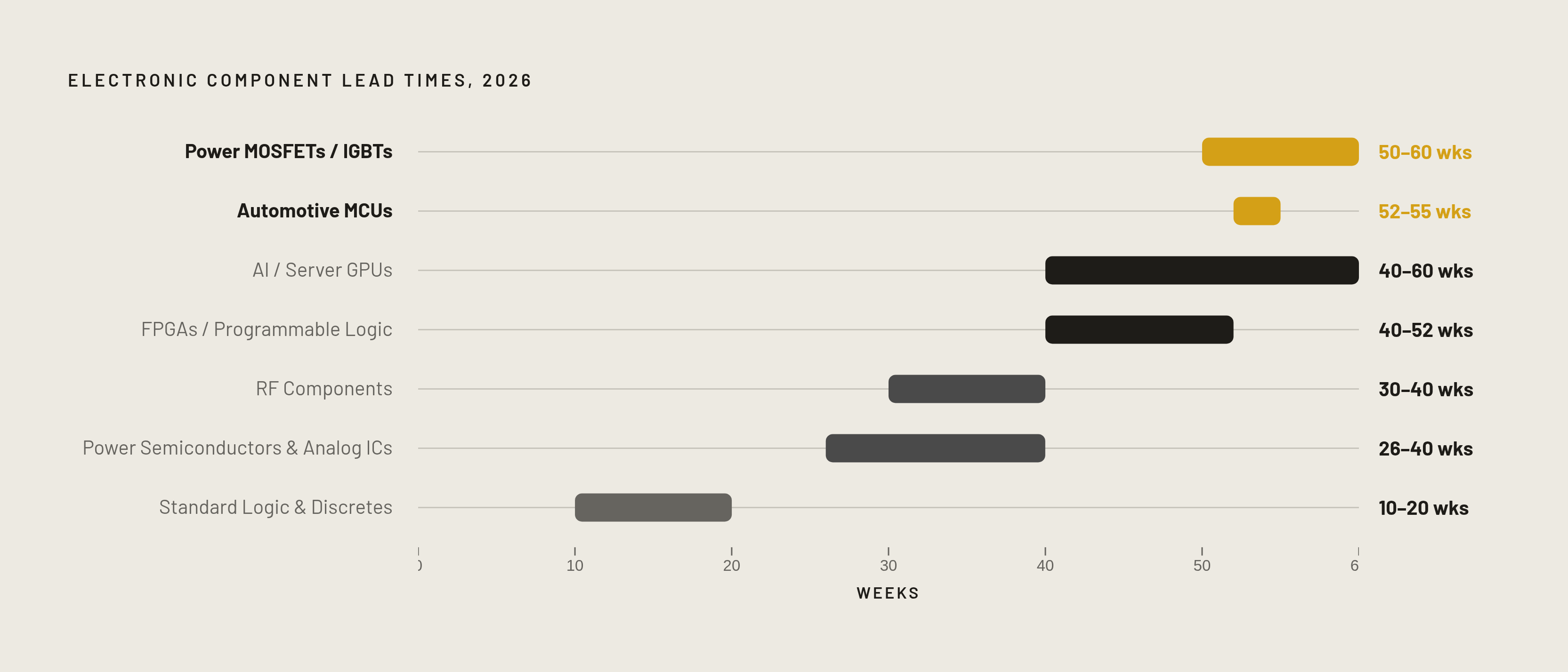
Some delays are visible from day one: power semiconductors and analog ICs quote lead times of 26–40 weeks, and everyone can plan around that number, however painful it is GlobX / Supply Chain Insight WellLink Chips / Electronic Component Lead Times. The dangerous ones are invisible until they aren't: a part re-quotes mid-project with a longer lead time than the original PO assumed, an allocation gets pulled from under a confirmed order, or a quote's validity window closes before the purchase order clears legal and finance. That second category is what actually wrecks schedules, because nobody sees it coming until the delivery date that was supposed to be locked turns out not to be.
This piece isn't trying to guess when the market normalizes. Nobody knows that with any precision, and treating a forecast as a plan is its own kind of risk. The more useful question is narrower: where in a mechanical and electronic BOM do the worst bottlenecks actually concentrate right now, and what can a design or procurement team do about it before the schedule is already broken.
The structural shift that made long lead times the new baseline
2026 is not a rerun of 2021 and 2022 GlobX / Supply Chain Insight WellLink Chips / Electronic Component Lead Times. That earlier shortage was broad and shallow, touching almost everything at once and easing more or less together GlobX / Supply Chain Insight WellLink Chips / Electronic Component Lead Times. What's happening now is narrower and, in some ways, harder to plan around, because the categories under the worst pressure are tied to the most structurally reshaped parts of the supply chain, not the ones that happened to get caught in a pandemic-era demand spike.
The root cause is straightforward to name, even if it's hard to route around. AI data center build-out is eating memory, packaging capacity, and advanced foundry capacity at a scale that crowds out anyone who isn't a hyperscale buyer. Global semiconductor revenue is projected around $975 billion in 2026, up 25% year over year, with AI chips accounting for roughly half of that entire figure, the largest single demand source in the industry, reshaping who gets served first GlobX / Supply Chain Insight WellLink Chips / Electronic Component Lead Times NextPCB / Shortage of Electronic Components 2026 Covenco / Enterprise Hardware Lead Times 2026.
The mechanical consequence of that demand is capacity utilization near 90% on mature nodes at the top foundries, and new fab tooling carries an 18 to 24 month lead time of its own GlobX / Supply Chain Insight NextPCB / Shortage of Electronic Components 2026. Capacity, in other words, cannot respond quickly even if everyone agreed tomorrow that more of it was needed. That lag is baked in for years, not quarters.
Layer a geopolitical shock on top of that. Two shocks, arriving within weeks of each other, have been compounding all year rather than canceling out GlobX / Supply Chain Insight WellLink Chips / Electronic Component Lead Times.
Memory suppliers changed their commercial model in response. Samsung, SK Hynix, and Micron all moved to allocation-only contracts starting in the fourth quarter of 2025, and that allocation favors Tier 1 hyperscale buyers by design GlobX / Supply Chain Insight WellLink Chips / Electronic Component Lead Times. Any hardware team outside that tier is, structurally, at the back of the line, regardless of how good its relationship with a distributor used to be.
None of this points toward a near-term fix. Analysts don't expect structural improvement before Q3 or Q4 of 2027 at the earliest, and a return to 2025 pricing looks unlikely before 2028 GlobX / Supply Chain Insight WellLink Chips / Electronic Component Lead Times. That has a specific implication for anyone tempted to just wait this out: the schedule waiting for you next year is not shorter than the one in front of you now. Second shock, geopolitical: China's export controls on Nexperia (Sept–Nov 2025) caused Volvo, Volkswagen, and Honda to warn of production stoppages; even after a partial truce in November 2025, lead times across MOSFETs, bipolar components, and protection devices remain elevated, per Sourceability's Lead Time Report GlobX / Supply Chain Insight WellLink Chips / Electronic Component Lead Times.
Which component categories are under pressure in 2026
This shortage is selective GlobX / Supply Chain Insight WellLink Chips / Electronic Component Lead Times. Teams that treat every line on the BOM as equally at risk end up panic-buying across the board, tying up cash and warehouse space on parts that were never actually constrained. Teams that audited line by line instead are having a measurably better year GlobX / Supply Chain Insight WellLink Chips / Electronic Component Lead Times.
So where does the actual pressure sit? Memory is close behind and arguably worse in dollar terms: DRAM contract prices rose 90 to 95% quarter over quarter in Q1 2026, then another 58 to 63% in Q2, and DRAM spot prices are up roughly 700% year over year as of mid-2026 GlobX / Supply Chain Insight Atlas PCB / Electronics Supply Chain Q2 2026 WellLink Chips / Electronic Component Lead Times NextPCB / Shortage of Electronic Components 2026 Covenco / Enterprise Hardware Lead Times 2026.
Programmable logic and FPGAs run 40 to 52 weeks, improving slightly but still tight GlobX / Supply Chain Insight. Power semiconductors and analog ICs run 26 to 40 weeks and are getting worse, because EV production and data center buildout are both drawing on the same constrained supply GlobX / Supply Chain Insight WellLink Chips / Electronic Component Lead Times.
Not everything is on fire, though. Standard logic and discretes remain close to normal at 10 to 20 weeks, and consumer-grade parts, sensors, connectors, and mature analog ICs are sourceable on more or less ordinary terms GlobX / Supply Chain Insight Covenco / Enterprise Hardware Lead Times 2026 GDF Engnuo / Compare Custom Fabrication Lead Times. That gap between the worst categories and the ordinary ones is why an undifferentiated response is the wrong one.
Passives deserve their own mention because the constraint there is capital. MLCC and ferrite production lines take 12 to 24 months to come online from the point someone decides to build one, so passive supply simply cannot respond to a spike in demand quickly, no matter how much money shows up NextPCB / Passive Component Shortage 2026. PCBs themselves have slid too: boards that used to ship in two weeks now take four, upstream copper foil supply is short by roughly 40% or more of demand, and fabricator utilization is running near full capacity, a structural rather than seasonal shift GlobX / Supply Chain Insight WellLink Chips / Electronic Component Lead Times.
The survey numbers back all of this up. In a survey, 53% of respondents said supplier lead times were longer in Q2 than Q1, and only 3% reported any improvement GlobX / Supply Chain Insight Atlas PCB / Electronics Supply Chain Q2 2026 WellLink Chips / Electronic Component Lead Times GDF Engnuo / Compare Custom Fabrication Lead Times. A 50-point spread like that is about as lopsided a reading as that kind of survey produces GlobX / Supply Chain Insight Atlas PCB / Electronics Supply Chain Q2 2026 WellLink Chips / Electronic Component Lead Times GDF Engnuo / Compare Custom Fabrication Lead Times. A BOM audit that separates the genuinely exposed lines from everything else is the first real line of defense a team has. Categories under severe pressure in 2026 are identified using figures from globx.eu's lead time analysis and welllinkchips.com's report. Automotive and critical industrial microcontrollers face lead times of 30–55+ weeks; automotive MCUs specifically are quoted at 52–55 weeks, making them the worst-hit category GlobX / Supply Chain Insight NextPCB / Shortage of Electronic Components 2026 Covenco / Enterprise Hardware Lead Times 2026. RF components carry lead times of 30–40+ weeks GlobX / Supply Chain Insight. AI/Server GPUs are surging, with lead times of 40–60 weeks GlobX / Supply Chain Insight. Power MOSFETs/IGBTs face lead times of 50–60 weeks, described as the "new bottleneck" per welllinkchips.com GDF Engnuo / Compare Custom Fabrication Lead Times.
How do long lead times for electronic components cause hardware project delays?
That's no longer true. A part that shipped in a matter of weeks a year ago can now sit on an allocation queue with no committed date at all GlobX / Supply Chain Insight WellLink Chips / Electronic Component Lead Times. The planning assumption itself has become unreliable, not just the number.
Quote validity is its own emerging problem. Lenovo cancelled all outstanding hardware quotes in January 2026 and reissued new pricing with 10 to 15% increases on servers and PCs GlobX / Supply Chain Insight WellLink Chips / Electronic Component Lead Times Covenco / Enterprise Hardware Lead Times 2026 GDF Engnuo / Compare Custom Fabrication Lead Times. A quote that used to hold steady for a full quarter can now expire before a purchase order even clears legal review. That's a process failure hiding inside what looks like a pricing story.
The concrete cases show the pattern clearly. One industrial automation manufacturer found a critical TI TMS320F28379D DSP carrying a 26-week lead time through authorized channels, with no guarantee of allocation even at the end of that wait, creating a genuine production shutdown risk GlobX / Supply Chain Insight WellLink Chips / Electronic Component Lead Times. That's a named part, a named lead time, and a real production line at risk.
The cascade doesn't stop at delay, either. It changes the whole shape of how teams have to operate. NXP now requires customers to hold a minimum 12-week on-hand inventory buffer and to share rolling full-year forecasts, which ties up working capital GlobX / Supply Chain Insight NextPCB / Passive Component Shortage 2026 WellLink Chips / Electronic Component Lead Times. Planning horizons compress too, since teams have to commit to designs earlier, which cuts into the ability to make late-stage DFM changes or respond to something that fails in test. Minimum order quantities climb as well, because suppliers allocating constrained parts push larger MOQs, forcing teams to either over-buy or lose their place in line.
Even contracted customers aren't fully protected. Micron confirmed it could only fulfill around 55 to 60% of core customer demand, so a signed agreement doesn't guarantee the part arrives when the contract says it will GlobX / Supply Chain Insight WellLink Chips / Electronic Component Lead Times NextPCB / Shortage of Electronic Components 2026 Covenco / Enterprise Hardware Lead Times 2026. The riskiest failure mode remains the invisible one: a long-lead part discovered after prototype validation, after design freeze, leaves a team with no good options, since substitution means re-qualification, and re-qualification eats up exactly the time the team was trying to save.
Understanding how the cascade works is useful context, but it only answers half the question. Engineering and procurement can actually do something differently, starting well before the point of failure.
Where mechanical BOM lead times add a second layer of risk
Most of the attention on lead times goes to electronic components, and understandably so given the numbers above. But hardware teams running multi-process mechanical BOMs often treat mechanical parts as interchangeable and easy to source, and that assumption doesn't hold up.
Steel and structural metal have their own lead time profile, and it's not trivial. Structural tubing is 6 to 8 weeks under current demand and logistical pressure, and seamless mechanical tubing runs roughly 8 to 14 weeks domestically, stretching to 4 to 6 months if sourced internationally. Aluminum tends to move faster on domestic timelines than specialty steel forms, but a high-demand period can compress that availability fast.
Tube bending adds another 4 to 12 weeks from RFQ to delivery for standard work, longer still for specialty materials NextPCB / Passive Component Shortage 2026. CNC machining itself typically runs 10 to 15 days for low-volume production, but that number is machining time only, and the material procurement lead time that sits upstream of it often doesn't make it into the estimate an engineer actually receives GlobX / Supply Chain Insight Covenco / Enterprise Hardware Lead Times 2026 GDF Engnuo / Compare Custom Fabrication Lead Times. Surface treatments like anodizing or powder coating add a fairly predictable 3 to 5 days across most subtractive and sheet metal processes, a small adder that gets ignored constantly.
Stacking those up compounds the risk fast. A mechanical BOM with CNC parts in aluminum, sheet metal in cold rolled steel, and custom tubing in a specialty alloy is running three separate material procurement queues in parallel, each with its own lead time, and each one capable of becoming the critical path on its own. Unlike electronic components, these mechanical lead times aren't widely published or easy to benchmark against, so teams often don't discover they have a problem until an RFQ comes back with a delivery date nobody expected.
The fix for that visibility gap is earlier engagement with manufacturing, bringing DFM discipline and process awareness into the design phase before materials get specified at all. Steel and structural metal lead times are drawn from Industrial Tube and Steel Corporation data cited in Craftsmenind.com. Hot rolled coil carries a lead time of 4–6 weeks. Cold rolled coil carries a lead time of 8–12 weeks NextPCB / Passive Component Shortage 2026.
Design decisions that shorten lead times before procurement begins
Most manufacturing cost, and most lead time exposure, gets locked in during design, not during production. Changing a design after material is already on order, or after parts are mid-process, is both expensive and slow.
DFM works best as a two-stage discipline GlobX / Supply Chain Insight WellLink Chips / Electronic Component Lead Times. Stage one is process selection: picking a manufacturing process that actually fits the required volume, material, and tolerance before the geometry gets finalized. Stage two is intra-process manufacturability, checking that the geometry actually works within the limits of whatever process got chosen. Skipping stage one is the more expensive mistake, because it means every later change is fighting the wrong process from the start.
Process choice and lead time are tightly linked. CNC machining needs 2 to 4 hours of upfront CAM programming and fixturing, then 10 to 15 days for low-volume production, and it overtakes 3D printing on total turnaround somewhere past roughly 50 units GlobX / Supply Chain Insight Covenco / Enterprise Hardware Lead Times 2026 GDF Engnuo / Compare Custom Fabrication Lead Times. Picking the wrong process for the volume isn't just a cost mistake. It determines whether the part exists when testing actually needs it.
Geometry choices carry their own weight here. Five-axis features deserve a hard look in design review: is the angled feature worth the manufacturing premium and the longer queue time, or does a slight modification get the same performance without it? Setup count matters just as much, since every added fixturing orientation multiplies machining time and scheduling complexity, and automated DFM tools can often reorient and group features to cut that number down.
Part consolidation is one of the more underrated levers available. Folding five separate parts into one can cut assembly time by up to 35% and remove the weak points that occur at joints GlobX / Supply Chain Insight WellLink Chips / Electronic Component Lead Times VPrint3D / Low-Volume Manufacturing Solutions. Fewer parts means fewer BOM lines, fewer procurement queues to track, and fewer chances for one part to become the critical path on its own GlobX / Supply Chain Insight WellLink Chips / Electronic Component Lead Times VPrint3D / Low-Volume Manufacturing Solutions.
Material choice needs the same scrutiny. Specifying a constrained material, seamless specialty tubing, say, for a feature where a more available alternative would do the job just as well, is a design decision with a real procurement consequence, and DFM review should catch it explicitly. Smaller details matter too: parts using Form-in-Place gaskets carry adhesion design choices that affect cost and time, and those are easy to miss at the design stage and hard to fix once tooling is already cut. In aerospace and other weight-constrained programs, complex geometry justified for weight savings often needs mechanical sign-off even for a small radius change made purely for manufacturing reasons, and that review step adds real time of its own in high-stakes programs. All of which is the argument for building DFM into the workflow from the start, rather than treating it as a check that happens right before launch. 3D printing takes 1 to 3 days for prototypes with near-zero setup time, making it the fastest option for early validation of form and fit and the fastest option for 1–10 parts GlobX / Supply Chain Insight Covenco / Enterprise Hardware Lead Times 2026 GDF Engnuo / Compare Custom Fabrication Lead Times.
Getting DFM feedback fast enough to matter
Knowing what good DFM looks like solves half the problem. Getting that feedback back fast enough to actually change the design is the harder problem.
When DFM doesn't happen early, the cost is not visible as a line item anyone can point to right away. It becomes visible weeks later, as a quote that comes back with a lead time nobody budgeted for, or a feature that needs a five-axis setup nobody flagged, or a material choice that quietly picked the slowest queue in the whole BOM GlobX / Supply Chain Insight WellLink Chips / Electronic Component Lead Times VPrint3D / Low-Volume Manufacturing Solutions. By the time that feedback arrives, the fix costs far more than it would have during the design review that should have caught it.
The teams that avoid blown schedules aren't the ones with the best forecasting. They're the ones who've built the habit of asking the manufacturability question before the drawing gets released, not after the quote comes back. Given how far lead times have moved this year, and how far they're expected to stay stretched into 2027, that habit is no longer optional discipline GlobX / Supply Chain Insight WellLink Chips / Electronic Component Lead Times. It's the actual difference between a schedule that holds and one that quietly comes apart, one long-lead part at a time.