Four-Day Custom Machined Parts for Hardware Startups in Pre-Production Crunch
Fast machining buys nothing if your slowest parts haven't shipped yet.

Four-day custom machined parts are a minimum viable lead time for hardware startups moving from EVT to DVT. That turnaround is achievable for simple-to-moderate aluminum parts with standard finishes, in-house machining and finishing, and domestic shipping. But keeping funding milestones within reach requires more than fast CNC work. An assembly needs complete files and early orders for the slowest parts on the mechanical bill of materials to reach testing on time.
Why the EVT-to-DVT window is the highest-stakes period in a hardware startup's life
Software can be patched after shipment in ways that hardware cannot. A wrong dimension or failed seal means remaking the physical object before the next test can begin. The delay cannot be coded away. Between engineering validation testing and design validation testing, each iteration follows a hard sequence of design, manufacture, receive, test, identify failure, and redesign. Every day lost in manufacturing subtracts from the time available for testing and analysis.
That makes lead time a strategic variable. A startup needs enough iterations to resolve failures before its funding milestones arrive, and a slower manufacturing cycle reduces those opportunities. OpenSpindle’s platform page explicitly names EVT and DVT gates as milestones driving one-off and low-volume prototype orders. These orders are tied to the next physical test and the decisions that depend on it.
What "four days" actually means in the three-phase lead time structure
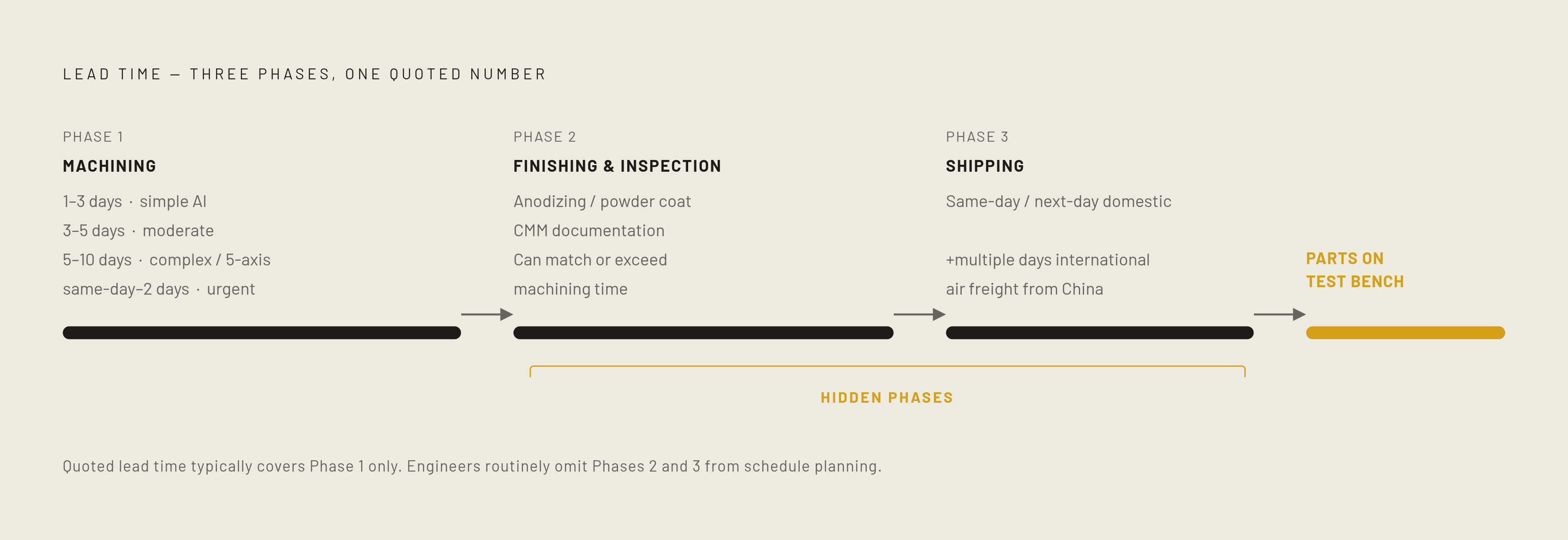
A useful four-day commitment identifies which of three sequential phases it covers, namely machining, post-machining finishing and inspection, and shipping. Each adds time independently. A quote for four days of machining is not a promise that finished parts will reach the test bench in four days. Planning requires knowing whether the quoted clock stops at the machine, at dispatch, or at delivery.
Machining time depends on the job itself. Small quantities of simple aluminum prototypes take 1–3 working days when the geometry and tolerances are standard. Parts of moderate complexity take 3–5 working days with 3–4 axis machining and standard material, which includes time for DFM review and first article. Parts with complex geometry, 5-axis work, and tight tolerances take 5–10 working days because they need time for programming and fixturing. Urgent prototypes can take the same day to 2 working days, but that service is limited to simple parts and comes at premium cost.
Finishing and inspection then add their own days. Anodizing and powder coating add time to both subtractive and sheet metal work, and a quote that gives just one figure can hide the time for CMM inspection and quality documentation. For regulated orders, this phase can match or exceed machining time. Shipping comes after both phases are complete. A domestic courier can deliver same-day or next-day, while international air freight from China adds days to the time from start to finish.
Protocase advertises fully finished machined parts in 2–3 days with no minimum order quantities, providing a useful benchmark for how in-house finishing can compress the production schedule. Four-day door-to-door planning still depends on the part, finish, inspection requirements, and shipping route. The engineer’s most controllable time sits before these phases, in the design choices and file preparation that let a supplier start without delay.
How material and geometry choices determine whether four days is possible before a file is ever submitted
For engineers protecting that window, the first rule is to choose material for the test rather than specify a harder-to-machine alloy without a functional reason. It takes roughly three to eight times less time to machine 6061 aluminum than titanium. Stainless steel requires slower feeds, generates more heat, and increases tool wear compared with aluminum. The raw material for Titanium and Inconel also takes longer to get. Aerospace-grade certified stock is not on the shelf the way aluminum is.
CNC cutters are round, so perfectly sharp internal corners require secondary operations or EDM. Increase internal radii where the design allows larger cutters, and avoid deep pockets beyond standard tool reach when they would require special tooling or multiple setups. At prototype scale, consider decomposing suitable 5-axis features into 3-axis setups to reach a faster queue. A shorter cutting time alone does not settle the choice if the job waits longer to start.
Choose as-machined or bead-blast finishes for functional prototypes where they meet the test requirements, because most shops send anodizing and powder coating to a secondary supplier. Where anodizing is needed only for appearance, limiting it to exterior cosmetic surfaces can reduce finishing scope. Process selection also depends on what the prototype must prove. 3D printing is faster for early concept models, but small quantities of CNC-machined aluminum at standard tolerances have mechanical properties that reflect those of production parts. That difference matters when EVT tests seals, fits, and structural loads as well as shape.
What a complete technical package looks like and why incomplete files are the most controllable source of delay
Consider an engineer who uploads a file Monday morning and gets an email Tuesday afternoon asking for the material grade. Two days disappear before machining even begins. The supplier cannot schedule an unambiguous job from an ambiguous package, so the part never enters the queue as planned. Incomplete technical packages are the most common avoidable source of lead time delays. Paying for fast machining cannot recover time spent waiting for an answer that should have been in the original request.
To prevent that pause, submit a 3D STEP file and a matching 2D PDF drawing. STEP / ISO 10303 preserves precise solid geometry for quoting, design-for-manufacturing review, and CAM programming. The drawing needs tolerances, GD&T callouts, and marked critical-to-quality dimensions. Specify the material grade and temper, such as 6061-T6 rather than “aluminum,” together with exact quantity tiers, detailed surface finishing specifications, and quality and inspection requirements.
Use general tolerances such as ISO 2768 for non-critical dimensions and reserve tight tolerances for fits, alignments, seals, and functional interfaces. Tight global tolerances force the shop to treat every feature as critical to quality, adding time and cost. For sheet metal, check that the flat-pattern K-factor is right for the material, because the defaults in CAD may not match stainless steel or 6061-T6 aluminum. Holes near bend lines can crack or distort, a lack of bend relief can cause tearing, and chain dimensioning across bends lets variation add up. Dimensioning critical holes from same-plane references keeps that variation from adding up as much.
When a quoting system flags a geometry issue within hours of upload, the engineer can correct it the same day and re-queue, provided the rest of the file is complete. RivCut describes 3-to-7-day part turnaround as a way to keep sprint schedules on track and separately offers instant AI pricing and DFM feedback.
Why the specialty parts on a mechanical BOM — springs, gaskets, tube bends — determine the actual delivery date even when CNC parts arrive in four days
An assembly’s delivery date is determined by its slowest part. CNC parts that arrive in four days do little to help the schedule if the rest of the parts take weeks to arrive. The mechanical BOM therefore needs a process-by-process view, starting with the fastest specialty parts and working toward the longest lead time.
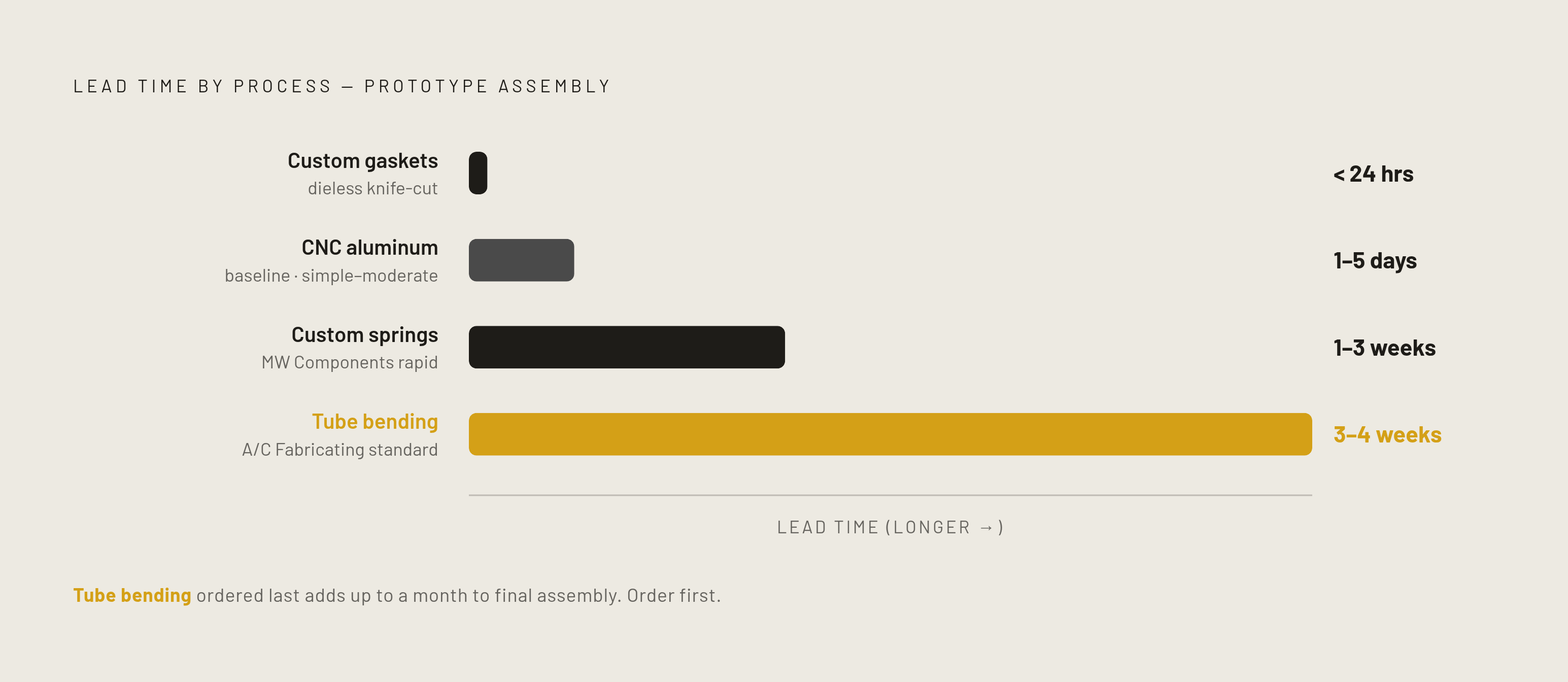
Custom gaskets can be the quickest specialty component. Custom Fabricating & Supplies states that dieless knife cutting from a customer-supplied CAD file can produce a prototype in under 24 hours. Correctly sourced, that makes gaskets an unlikely bottleneck. They become one when the team orders them last or fails to supply the CAD file needed to make them.
Standard configurations in stocked materials can ship in days to a couple of weeks, while complex, precision-critical work requiring specialty wire, new tooling, and documented finishing takes six weeks or longer. MW Components offers rapid prototypes in 1–3 weeks, with the time depending on the part type, geometry, and material. That service is only for certain components made from materials that are easy to get. Moving from standard carbon steel to higher-grade alloys or exotic materials can also multiply cost dramatically.
Tube bending is usually the specialty process that takes the longest. Standard schedules run weeks from RFQ to delivery, with specialty materials and unique tooling extending them further. A/C Fabricating in Goshen, Indiana, lists typical turnaround times of 3–4 weeks for custom tube fabrication, with rush/emergency services available. Incomplete RFQs are the top delay driver, while clear specifications can reduce quoting time from days to hours. A startup that waits until CNC parts arrive to order tube bends may add a month to assembly. Specialty parts need to be initiated first, in parallel with CNC design finalization.
Why sourcing a fragmented BOM across multiple vendors multiplies schedule risk even when each vendor is fast
Separate suppliers for metal fabrication, finishing, springs, gaskets, and tube bending create failure modes that no individual vendor’s speed can prevent. One late or incorrect component delays the entire assembly even if every other order arrives on time. A hole pattern can also pass one supplier’s inspection yet fail to align with a mating part from another. That mismatch may become visible only at assembly, after all the individual lead times have elapsed.
Every vendor requires an RFQ, NDA, purchase order, receiving inspection, and channel for expediting the job. When something arrives wrong, the engineer must identify the responsible supplier, negotiate a remake, and wait through another lead time while the other parts sit idle. This is not merely administrative inconvenience. It places another sequence of decisions between the failed part and the next test.
OpenSpindle’s hardware startup sourcing page presents consolidated BOM sourcing as an alternative to the cold-email hunt, with a CAD file or sketch used to obtain a best-match quote from qualified independent shops. The broader technical value depends on how much responsibility the partner accepts. A partner able to quote CNC parts, sheet metal, springs, gaskets, and tube bending under one purchase order removes the engineer’s inter-vendor coordination layer. Consolidation allows the full assembly schedule to be planned together, with a weeks-long process still taking more than four days.
What should hardware startups look for in a fast-turn manufacturing partner?
For a startup buying against an assembly deadline, the first requirement is coverage of the full mechanical BOM. The partner needs CNC milling and turning, sheet metal fabrication, and access to springs, gaskets, and tube bending. Quoting only the easy geometries leaves the difficult parts unsolved. A useful comparison therefore starts with process coverage and responsibility for the complete order.
Quote-stage review is the next requirement because it catches correctable problems before they disrupt the machining queue. RivCut offers AI pricing and DFM feedback when a file is uploaded, which helps when a machining decision needs to be made quickly. Protocase combines instant online quoting with expert review and advertises its 2–3 day fully finished lead time. OpenSpindle addresses the broader sourcing problem through consolidated BOM quoting, while MW Components and A/C Fabricating provide named specialty-process options with longer published schedules.
Inspection must be part of the promised process. CMM verification of critical dimensions and a documented inspection report should ship with the parts as standard. RivCut lists CMM inspection with every order and a dimensional inspection report as standard. Batch terms should also fit the work being ordered, because EVT and DVT runs are low-volume. Protocase and RivCut both remove minimum order quantities as a constraint.
A remake-or-refund guarantee is the minimum standard for a partner responsible for an assembly’s delivery date. Credit toward a future order does not resolve wrong parts blocking the current test. The strongest fast-turn choice is therefore not simply the shop that cuts aluminum quickest, but the partner whose process coverage, review, inspection, and remedy fit the deadline the startup actually has.