When Expediting a Part Is Worth the Premium
Expediting costs less than the production downtime and penalties it prevents.
A critical part is stuck in transit, or a shipment delay is about to blow through a hard delivery date. The standard lead time, the one everyone planned around, is suddenly not good enough. This is the moment procurement teams reach for the phone and engineers start asking what a rush order costs. Treat that reflex as the wrong frame. Expediting is not an emergency response: it's a premium paid to move the risk of delay off your shoulders and onto a supplier or a carrier. You pay a known, fixed cost now to avoid an uncertain, possibly much larger loss later. That is how insurance works: the surcharge is never the question. Whether the loss you're avoiding is bigger than the premium you're paying is the question. The rest of this piece builds out a workable answer.
What the cost of not expediting looks like
Before anyone can judge whether an expedite premium is worth paying, they need an honest number for what happens if they don't pay it. A stopped production line is a hard dollar figure, not a soft inconvenience measured in frustration, and it needs to be calculated the same way every time: Cost of Downtime equals Lost Revenue per Hour, plus the Cost of Idle Labor, plus Recovery and Penalty Costs. Each of those three pieces has to be measured on its own. Lost revenue is what the line would have produced if it kept running. Idle labor is every operator, technician, and supervisor standing around a stopped machine, still on the clock. Recovery and penalty costs cover what it takes to restart complex equipment safely, plus any contractual penalty triggered by a missed delivery date.
Omitting that piece understates the formula, because a missed shipment to a customer with a penalty clause doesn't just cost you the internal downtime. It converts an internal problem into a direct cash payment out the door, on top of whatever the stopped line already cost. Add that payment to the formula, or the number understates the real exposure.
Run a plausible example. Say a mechanical sub-assembly line depends on one machined bracket, and that bracket is the constraint. If the line produces revenue and that revenue stops, if the crew of ten people keeps getting paid while they wait, and if a customer contract has a penalty clause for a late shipment, those three numbers stack. A single missing three-dollar bracket can hold up a six-figure assembly, and the arithmetic makes that obvious the moment you write it down. Compare that total to a rush surcharge on the bracket itself, usually in the range of a few hundred to a few thousand dollars, and the surcharge looks small by comparison. The same logic holds at the repair level. A repair planned in advance costs a fraction of the same repair done as an emergency, because the identical physical work carries a dramatically different price tag depending on whether anyone saw it coming. Downtime costs vary by industry and by plant, so the specific dollar figure is never the point. The method is the point: build your own number before you decide whether the premium is worth paying.
What the expedite premium buys (and what it does not)
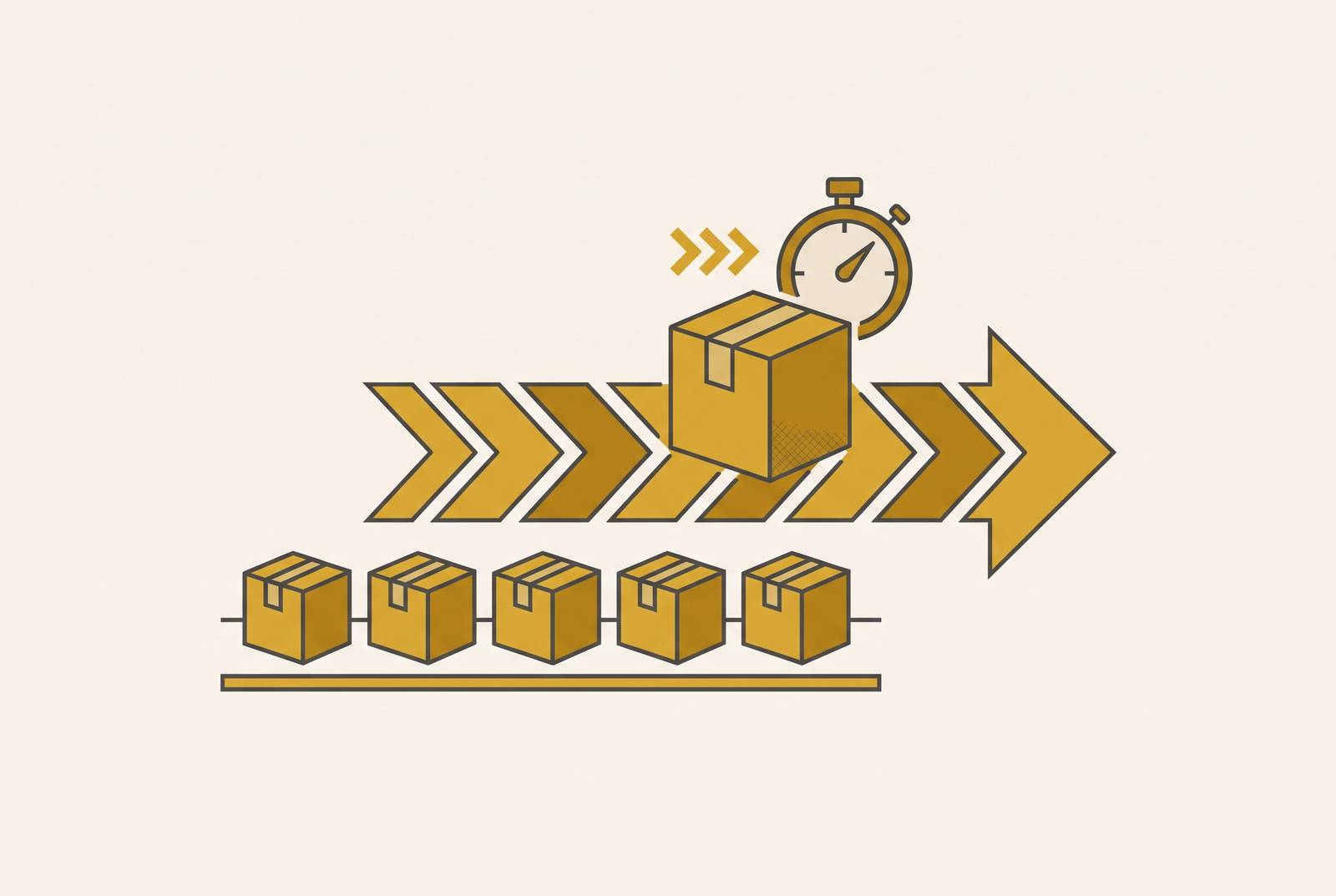
Expediting does not buy a faster manufacturing process. It buys queue position and dedicated capacity. Knowing that difference changes how an engineer sets expectations before authorizing a rush order.
In freight, speed doesn't come from a faster truck. It comes from how the shipment moves. Standard freight goes through a network: a terminal, a consolidation point, a hub, another truck, each handoff adding time. Expedited freight strips out most of those steps. The truck is dedicated to one shipment instead of waiting to fill up with other freight. The route runs direct, origin to destination, with no terminal stops. On long hauls, two drivers trade off so the truck keeps moving around the clock instead of stopping for required rest. None of that is physics-defying. It's logistics, rearranged to remove friction.
The same logic applies inside a shop. An expedited part doesn't get machined faster because someone paid more. It jumps to the front of the queue, it gets dedicated machine time instead of sharing a schedule with other jobs, and setup gets prioritized instead of waiting its turn. The surcharge buys priority, a position in the queue, rather than a shortcut around the physical steps the part still has to go through. Segmented pricing for delivery speed, standard lead time at a base rate and expedited delivery at a stated premium, works because that cost driver is visible and the structure is applied the same way every time. Customers accept it because they can see what they're paying for.
That matters for the decision in front of you. If a part is late because of a material shortage or a design-for-manufacturing problem, paying extra for queue position doesn't fix either of those. Before approving the surcharge, confirm that what you're buying actually closes the schedule gap you're worried about.
The structural triggers that create expedite situations in the first place
Most expedite situations are downstream results of a small, repeatable set of upstream failures, so a useful decision framework starts by naming the trigger rather than jumping straight to the cost comparison.
The pattern repeats across industries: late design changes that blow up an established timeline, engineering change orders that drag on longer than planned, component shortages nobody saw coming, single-sourced parts caught in a demand spike, a surprise end-of-life notice from a supplier, a quality issue that forces a rush replacement shipment, or a production line getting reprioritized to hit someone else's deadline. Single-sourced components deserve particular attention here. When a part comes from exactly one vendor, a demand spike turns a routine reorder into an emergency with no backup supplier to call. There's no competitive alternative to lean on, so the schedule absorbs the full hit.
The category of the trigger changes how you should think about the expense. An expedite forced by a genuine external shock, a supplier going dark with no warning, a quality escape discovered late, is a legitimate insurance event. You didn't cause it, you couldn't have planned around it, and paying the premium is the correct response. An expedite forced by a late design change or a missed end-of-life notice is something else entirely: a tax on a process failure. Paying that tax once is a reasonable reaction to a bad week. Paying it repeatedly, without ever fixing the process that keeps generating it, is no longer risk management but a subsidy for dysfunction. There are also costs that never appear on the expedite invoice itself. Rushed processes carry more quality risk, and every hour spent firefighting a rush order is an hour not spent on the next design or the next sourcing improvement. Those costs land on the income statement eventually, even when nobody books them against the rush order directly.
The decision framework: when the premium clears the bar
The question of whether to expedite comes down to a short sequence that an engineer or buyer can run through before authorizing the spend. Start by quantifying the delay cost honestly, using the downtime formula, lost revenue plus idle labor plus penalties, applied to a realistic delay window rather than a best case or a worst case dressed up to make the decision easy. Then price the expedite the same way: get the full surcharge, including any premium for jumping the queue, for expedited shipping, and for faster setup, beyond the difference in price on the part itself. With both numbers in hand, check what the premium actually buys. If the real constraint is a material shortage or a design problem the expedite can't touch, the surcharge won't close the gap, so confirm the rush order genuinely compresses the timeline before anyone signs off on it. Finally, identify the trigger behind the delay. If it traces back to a fixable upstream failure, approve the expedite to solve today's problem, then schedule the process fix so the same trigger doesn't fire again next quarter. If it traces back to a genuine external shock, approve the expedite and move on, because there's no process fix to chase.
Organizations that handle this well don't treat every rush order as an unplanned crisis. They budget for expediting as a calculated program risk, the same way they budget for any other line item they know will recur at some rate. The framework also has to produce a "no" answer sometimes, or it isn't a framework but a justification machine. If the delay cost comes out low, the surcharge comes out high, and the trigger traces back to a preventable planning gap, the right call is to absorb the delay and fix the process instead. Paying the premium in that situation doesn't manage risk. It rewards the dysfunction that created the need for the rush order.
How DFM failures upstream generate expedite costs downstream
Most expedites look like supply-chain events on the day they happen, but they're really delayed consequences of design decisions made weeks or months earlier, decisions made without anyone checking what they'd cost to manufacture. Geometry that needs special tooling, tolerances held tighter than the function actually requires, a material choice that stretches lead time or adds sourcing risk: each of these quietly builds schedule pressure that eventually comes out the other end as a rush order. By the time someone is placing that order, the design decision that caused the problem is long finished and long forgotten.
Building supply chain thinking into the design process, checking lead time the same way you'd check tolerance or material cost, cuts the need to expedite directly, because the part gets designed to run on a standard schedule from day one instead of fighting the schedule later. Incomplete file packages cause a related, and completely preventable, version of the same problem. A quote request with unclear specifications turns into a back-and-forth clarification cycle, and every round of that cycle burns a day or more before the part is even scheduled to start. Clean CAD files with complete drawings cut quoting time from several days down to roughly one, and that single change removes the scheduling bottleneck that so often turns into a rush order later.
The strongest fix sits even earlier than the file package: DFM feedback built into the quoting process itself, feedback that's specific to the actual manufacturing path rather than generic advice. An engineer who learns at quote time that a tolerance is tighter than it needs to be, or that a material choice is going to run long on lead time, can fix it on the spot, at zero cost, instead of discovering it three weeks later as a schedule emergency.
How vendor fragmentation multiplies expedite risk across a BOM
A bill of materials spread across several vendors doesn't carry one expedite risk. It carries one expedite risk per handoff, and the odds that at least one of those handoffs fails go up every time another supplier gets added to the list. Mechanical assemblies commonly span CNC machining, sheet metal fabrication, and specialty processes like custom springs, tube bending, or urethane casting. When each of those processes sits with a different vendor, a schedule slip anywhere in that chain has nothing to absorb it. It runs straight through to the assembly timeline with no buffer in between.
Fragmentation creates a second kind of risk beyond scheduling: disagreement. When a part fails incoming inspection and the machining vendor and the finishing vendor each blame the other's process for the defect, the dispute itself burns days while the assembly line sits waiting for a part that technically already shipped. Coordination gaps between vendors and skipped DFM during design tend to show up together, and they make each other worse: the lack of manufacturability review drives expensive tooling changes and late production, and fragmented supplier relationships mean nobody owns the fix.
Consolidating a mechanical BOM with a single capable partner shrinks the number of places a handoff can fail. One quote, one purchase order, one shipment, one point of accountability: when a schedule problem occurs, it is visible earlier and has exactly one owner responsible for fixing it instead of three vendors pointing at each other, which directly reduces the number of places an expedite can originate and ties back to the insurance logic this piece opened with, since fewer handoffs means fewer chances for the delay event you're trying to avoid.
Quality assurance as a cost that prevents a different kind of expedite
Cutting inspection short to save a few days on the schedule is a false economy. A part that clears a rushed inspection but fails later at assembly doesn't just cost the original delay. It triggers a second expedite, this one under worse time pressure, with the added cost of taking the assembly apart, figuring out what actually went wrong, and arguing with a vendor about whose process caused it. An expedited parts order already costs a steep premium over standard shipping. A second emergency event for the same underlying failure doubles that exposure on top of whatever the original delay already cost.
First Article Inspection exists to prevent exactly this. Catching a process error before the full production run begins costs a fraction of catching the same error after non-conforming parts have already been built into an assembly. It's cheap insurance against an expensive second failure. A remake-or-refund guarantee from a manufacturing partner works the same way: it shifts the financial exposure for a quality escape off the buyer's expedite budget and onto the supplier's cost base, which is the right place for that risk to sit, since the supplier is the one who controls the process that created it. Inspection and a quality guarantee amount to a second layer of insurance stacked on top of the first. Together they lower the odds of ever filing that second, more expensive claim.
Treating expediting as exception management rather than default strategy
None of this argues for eliminating expediting. The most capable hardware teams don't try to get to zero rush orders. They use expediting deliberately, they budget for it as a calculated program risk the same way they budget for scrap rate or warranty claims, and they treat every instance as a data point that feeds back into the next design review or sourcing decision. The best-run supply chains use expedited freight as exception management: solve the immediate problem in front of you, then trace back to find out why the emergency happened so the same trigger doesn't fire again next quarter. The expedite is the treatment for a specific, isolated problem. It was never meant to be the cure for a process that keeps generating the same problem on repeat.