Two-Week Delivery Windows for CNC and Sheet Metal Prototype Kits
Hit two-week prototype delivery by choosing the right process and in-stock materials.

Two weeks, ten business days, is not some magic ceiling or floor for prototype delivery. It sits at the upper edge of what counts as aggressive rapid prototyping, and the lower edge of what counts as standard custom fabrication. That positioning matters because it means the window is achievable, but only if the engineer treats it as a target to hit through specific choices, not a number a vendor promises on a landing page.
The processes involved don't move at the same speed. Each one eats a different slice of the calendar. Prototypes overall typically ship in 3 to 10 days, while full production runs stretch to 4 to 6 weeks, so the two-week target is structurally realistic for a prototype kit. It just doesn't happen by accident.
Injection molding is where that logic breaks down fastest. Rapid tooling usually runs 1 to 4 weeks, and even the fastest expedited aluminum tooling options run 5 to 15 days. It's the single riskiest inclusion an engineer can make.
None of this is really about a vendor's marketing promise. Each section below breaks down one of those levers, and each one either buys back days or quietly burns them. Prototype lead times vary sharply by process, with sheet metal prototypes commonly delivering in 2–5 business days, CNC machined parts within one week, and 3D printing in 1–3 business days, each process occupying a different slice of the window Approved Sheet Metal.
How process lead times stack inside a two-week kit
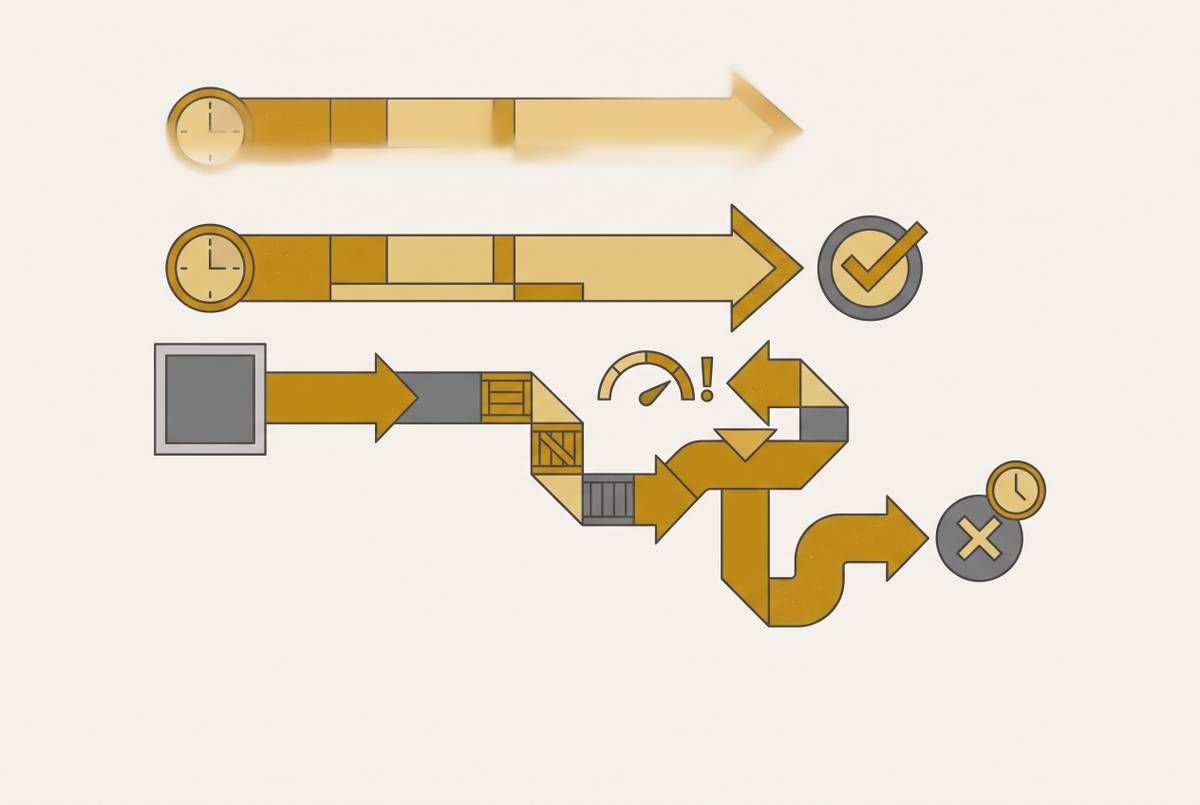
A kit made of mixed processes only moves as fast as its slowest part. That's the sequencing trap engineers keep falling into: they'll hit every deadline on the machined bracket and still miss the ship date because the sheet metal enclosure or the cast fitting was never mapped against the same clock.
Sheet metal usually moves fastest. Laser cutting and forming can wrap in 2 to 5 days when the fabricator is working from in-stock material Approved Sheet Metal Fabcon. Welding is where shops start cutting corners, literally excluding it from quick-turn quotes, though some providers build it into the same window rather than treating it as a separate line item Approved Sheet Metal Fabcon.
CNC machining runs a notch slower, and that's built into the process itself. Extra setup and run time make it inherently slower than 3D printing. Parts in final material can still ship within a week with expedited service, but that assumption falls apart the moment a part needs 5-axis fixturing.
3D printing remains the fastest bridge, landing in 1 to 3 business days, and it's the right call for form-and-fit checks where the prototype doesn't need to behave like final material yet. The tradeoff is material fidelity, not dimensional accuracy, so it works for early validation, not for anything load-bearing or thermally sensitive.
Specialty processes deserve the same scrutiny before they ever make it into the BOM. Tube bending, wire EDM, and other niche fabrication methods each carry their own baseline lead time, and that number needs to be on the table while the kit is still being planned, not discovered afterward. When a CNC or sheet metal part would push the schedule past two weeks, 3D printing at $5–$50 per part can hold the BOM together for early validation, a substitution whose tradeoff is material fidelity, not dimensional accuracy.
Raw material availability and the schedule before fabrication starts
Material can eat the whole two-week window before a single cut happens, and this is the constraint most engineers don't see coming. Everyone budgets time for machining and forming. Almost nobody budgets time for the steel to show up.
The numbers make the case on their own. Structural tubing runs 6 to 8 weeks because of demand and logistics pressure. Any one of those, sourced from scratch, wipes out a two-week target on its own. A kit that includes structural tube only survives if the fabricator already has it on hand, or the engineer commits to the material weeks ahead of the fabrication date.
So the practical rule is simple: pick materials the fabricator already stocks. That single decision, in-stock versus sourced, does more to protect the schedule than almost anything else on this list.
There's a wider backdrop here too. Tariffs on Chinese materials now exceed 100% in some categories, and rare earth export restrictions are opening up availability gaps in material families that used to be a non-issue Promwad. Picking domestic stock material isn't just the fast option anymore, it's the resilient one. Memory lead times exceeding 58 weeks in automotive categories show how tight sourcing has gotten across manufacturing broadly Promwad. Even a purely mechanical prototype program is operating inside a supply chain that's under more pressure than it looks.
The action item is blunt. Confirm the material against the fabricator's actual in-stock list at the moment of quoting, not against a datasheet that assumes availability. Material confirmation is step one of the schedule. Selecting in-stock materials at a fabricator with proactive inventory management is one of the highest-leverage decisions for hitting the window, as exemplified by Approved Sheet Metal, which proactively stocks popular gauges of steel and aluminum to enable 2–5 day turnaround.
What DFM readiness does to the actual fabrication clock
Every DFM issue caught after a file is submitted restarts the clock. The back-and-forth that follows, an email flagging a problem, a redesign, a resubmission, eats days or weeks that a two-week window has no room to absorb.
The scale of the damage is significant. DFM decisions made at the concept phase can push manufacturing lead times up by 25% to as much as 1,480%, and costs by 15% to 800% Modus Advanced. Even the low end of that range is enough to break a two-week target on its own.
For CNC parts, a handful of rules do most of the work. Sharp internal corners can't be machined without a radius feature, so specifying a 0.030 inch minimum internal corner radius keeps the part on standard tooling and avoids a re-programming delay Design for Manufacturability: CNC Machined Metal Parts - Complete Eng…. Deep narrow pockets, thin walls, tolerances tighter than the part actually needs, each one forces a slower feed rate, a specialty tool, or an extra setup, and every extra setup is a scheduling increment, not just a line on an invoice.
Sheet metal runs on a different, less obvious rule. Most engineers assume sending a clean flat pattern speeds things along. In practice, a fabricator will rarely use the flat pattern a designer hands over. Sending the CAD model early and letting the shop generate its own flat pattern is faster than iterating on one built somewhere else. The common failure points are predictable: bend radii tighter than the tooling can support, holes placed too close to a bend line, wall thickness that drifts across a part family.
An organizational problem underlies all of it. Automated DFM checks catch the obvious stuff, but complex geometry still needs an engineer talking to an engineer. The earlier that conversation happens in the design cycle, the cheaper it is in time, which is the real argument for picking a fabricator that folds DFM review into the quoting process instead of selling it as a separate service.
Why process selection precedes every other DFM consideration
DFM isn't one step, it's two, and they happen in order. First comes picking the right manufacturing process for the part. Only after that does it make sense to check that the part meets that process's specific constraints. Skipping the first step wastes the second one.
For most prototype kits, the defaults hold up. Enclosures, panels, and brackets belong in sheet metal, cut flat and formed on a press brake. Thick or geometrically complex parts belong in CNC, where 5-axis capability separates the parts that can be machined from the parts that just sit in a queue. Anything meant purely for form-and-fit checks, where final material properties don't matter yet, belongs in 3D printing.
Mismatch a part to the wrong process and the schedule doesn't slow down, it stops. A part drawn for 5-axis milling that lands on a 3-axis shop's desk goes into a rework loop. A sheet metal part with a feature that actually needs EDM, submitted to a standard fab shop, stalls the moment someone opens the file.
Use the same materials and the same fabrication method in prototype and in volume production, a continuity rule that holds past the prototype stage too. Picking a prototype process that can't scale means running the entire DFM process again before production starts, which roughly doubles the schedule cost. Prototyping is supposed to skip hard tooling. That's the whole point, but the process behind it still has to be the one production will actually use, or none of the DFM learning carries forward. Finishing decisions belong in this same conversation. Anodizing, powder coating, and passivation all affect dimensional allowances and adhesion, so they need to get locked in before geometry is finalized.
How BOM fragmentation across vendors multiplies schedule risk
A kit's schedule isn't set by the slowest individual part. It's set by how many vendors are touching the BOM, because coordination overhead compounds in ways that per-part lead times never show.
Every additional supplier brings its own quoting cycle, its own material sourcing, its own quality hold, its own shipping schedule. Any single one of those can push a kit past two weeks even when every part, taken alone, is right on time.
The market doesn't offer a clean default here either. Job shops handle basic sheet metal fine but often lack finishing and assembly capability, while large contract manufacturers impose high minimums and rigid onboarding. Neither is really built for a fast-turn prototype kit with a shifting BOM. Split the parts across vendors and DFM feedback arrives late at each one, after the design is already locked, which compounds cost and schedule risk as the part moves from concept through prototype into tooling.
Prototype work is inherently high-mix, low-volume: short lead times, shifting BOMs, and strict compliance requirements layered on top. That combination needs a sourcing approach that can adapt in real time.
Some of the fix is procedural. Standardizing hardware across an assembly, settling on one connector or fastener family where the design allows it, and using automated BOM revision tools that give internal teams and outside suppliers the same real-time view of the current build, all reduce the number of places where something can quietly go wrong.
But the biggest lever is structural. A vertically integrated partner running laser cutting, forming, welding, finishing, and assembly under one roof removes the handoffs that cause multi-vendor kits to slip in the first place Fabcon. One documented case: a data center enclosure program got functional prototypes back in 3 days once it moved to that single-PO model Fabcon. It is what happens when nobody's waiting on someone else's shipping department.
The kit audit before submitting files
The two-week window gets won or lost before a single file reaches a fabricator. Here is the audit to run before hitting submit.
Start with geometry. Every internal CNC corner needs a minimum 0.030 inch radius, or expect a re-programming delay Design for Manufacturability: CNC Machined Metal Parts - Complete Eng…. Sheet metal bend radii need to match the fabricator's standard tooling, and holes need to sit clear of bend lines, since proximity to a bend causes distortion. Wall thickness should stay consistent and sit within the process minimum for whatever material is specified. And if any part needs 5-axis machining, that needs to be confirmed before submission, because sending it to a 3-axis shop just means the part re-queues somewhere else.
Then check material. Confirm the specified material actually sits on the fabricator's in-stock list at the time of quoting, rather than assuming it. If sourcing is required, the schedule needs a realistic number attached to it, and Cold Rolled Coil alone can run 8 to 12 weeks. When the timeline is tight, get the fabricator to confirm stock before the quote is accepted.
Map the process mix next. Every part should be tied to a process, and the longest-lead item on that list is the one that actually sets the kit's delivery date. Anything assigned to injection molding deserves a hard look, since its 2 to 3 week baseline will likely break the window on its own, and 3D printing or CNC machining might substitute for that part in this cycle. Specialty processes, tube bending, wire EDM, urethane casting, need their lead times confirmed before the schedule gets locked in, not after.
Tolerance and finish come last but they're not minor. Only call the tolerances the part actually needs, since over-tolerancing triggers inspection overhead with no functional payoff, and tolerances around ±0.005 inch are achievable in fast-turn sheet metal, but only with confirmation from the shop Fabcon. Surface treatment should be specified before geometry is locked, to avoid a dimensional rework loop.
Finally, count vendors. Every additional supplier required to close out the BOM is a multiplier on schedule risk, so it's worth checking whether one capable partner can cover CNC, sheet metal, finishing, and assembly under a single purchase order, since that consolidation compresses the timeline directly.
Choosing a sourcing partner whose structure supports the two-week target
Picking a fabrication partner is a scheduling decision. The internal structure of the shop either enables the two-week window or blocks it, no matter how clean the engineer's files are.
A few things separate the shops that hit the window from the ones that don't. Vertical integration matters most: laser cutting, forming, welding, finishing, and assembly under one roof cuts out the handoffs that a non-integrated shop forces onto the customer instead. In-house material inventory matters just as much: a shop that stocks common gauges can start fabricating the day a quote gets accepted, while one that sources material to order can't move until the material arrives.
Quote turnaround shapes the front end of the schedule in a way that's easy to underweight. A shop that responds in hours, Approved Sheet Metal commits to 4 hours or less, keeps days from disappearing before fabrication even begins. And DFM feedback should live inside the quoting process itself, catching file issues before they ever hit the shop floor, because that's the actual difference between a fabricator that starts on time and one that starts and finishes on time.
Expedite capability is the recovery mechanism when something goes sideways, a late design change, a material delay, whatever it is. A shop that can move an order to the front of its queue is the one that absorbs the surprise without blowing the whole schedule. And for regulated programs, certification isn't optional: ISO 9001:2015 and AS9100D are the baseline expected for aerospace and defense prototype work.
Sources
- Rapid Sheet Metal Prototyping With Fast US Turnaround
- Sheet Metal Prototypes in 2-5 Days (Updated for 2026) | ASM
- Prototype Sheet Metal Parts in 2–5 Days | Fast Quotes, DFM Help
- Design for Manufacturability: CNC Machined Metal Parts - Complete Engineering Guide
- From BOM to Box | Managing the End-to-End Hardware Product Lifecycle in 2026