Supplier Lead Time Promises Versus Actual On-Time Delivery Rates
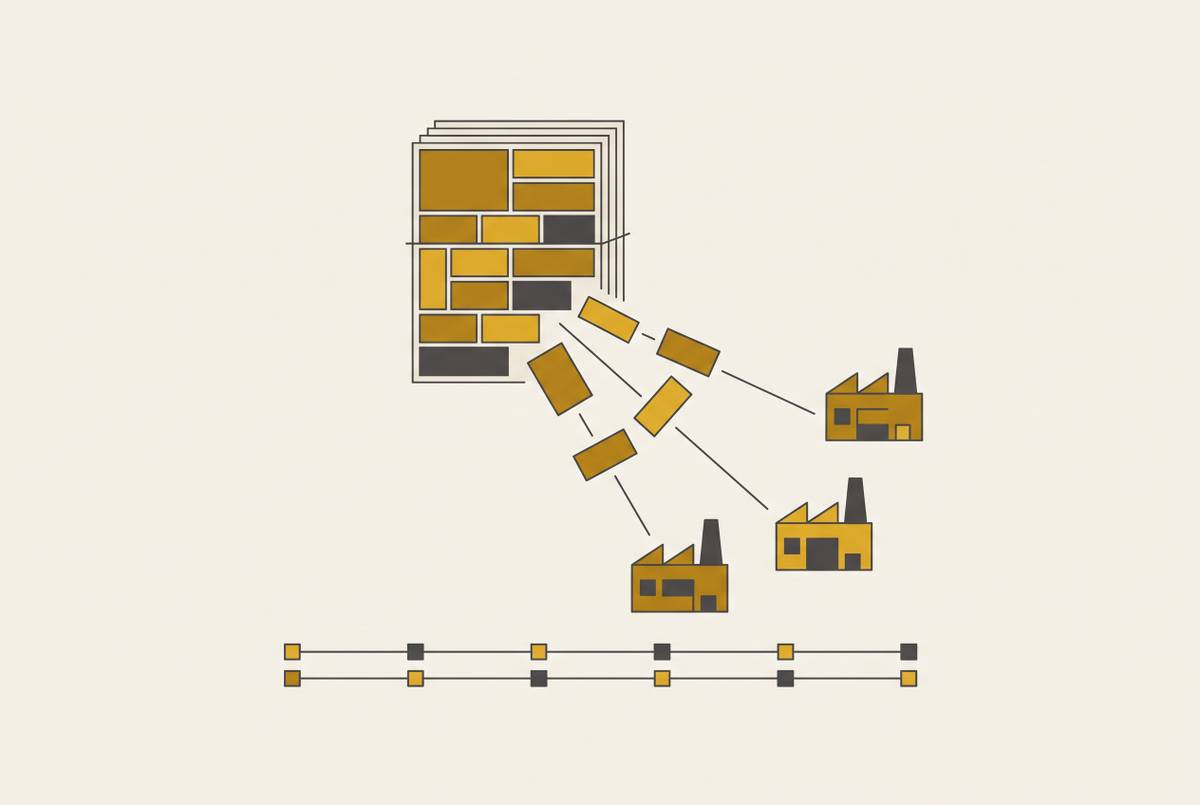
Sales quotes and production schedules live in separate systems with no way to talk.
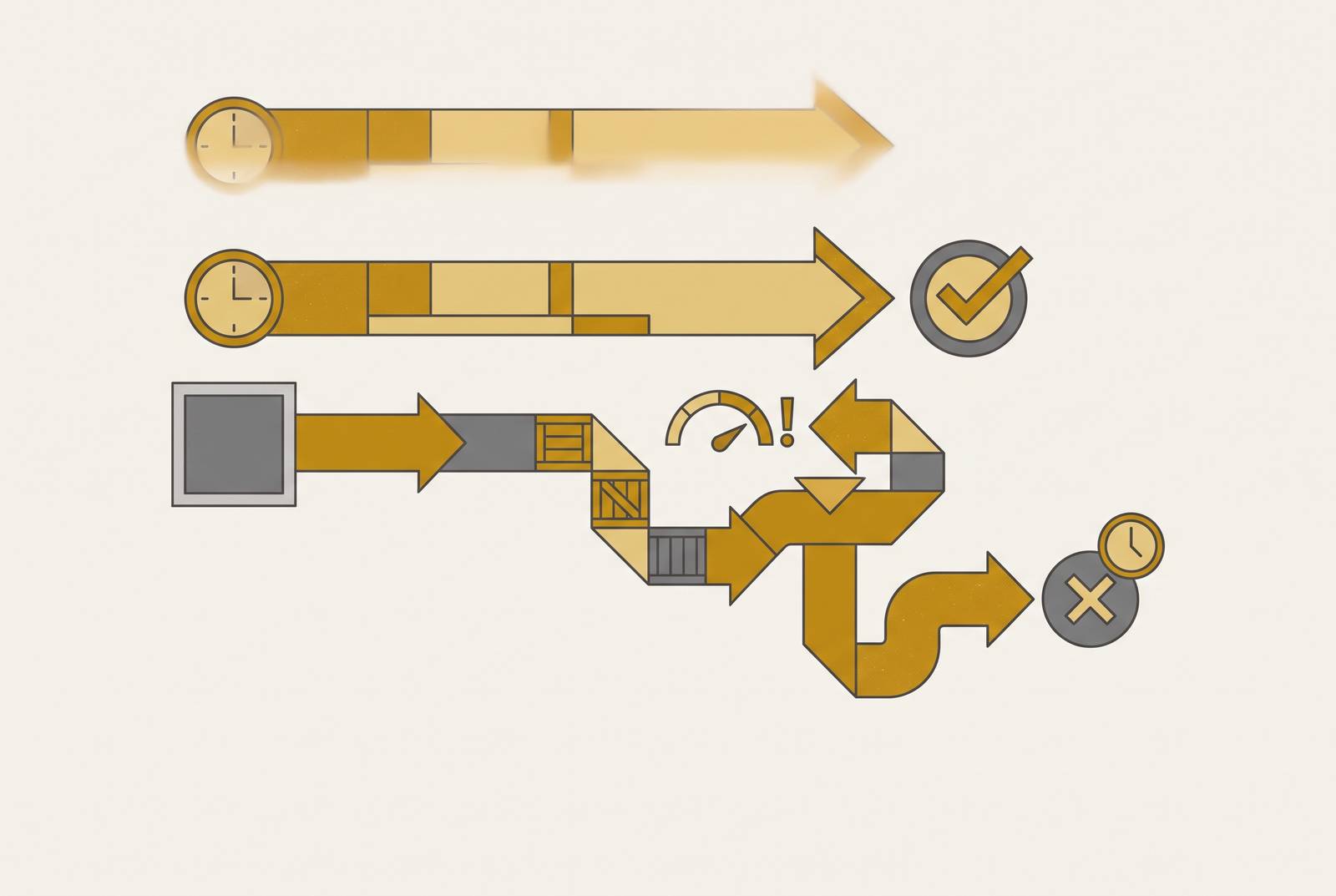
An ERP system might tell a planner that a supplier delivers in 30 days. In practice, the part arrives in 45. That gap is not a random hiccup or a sign of a dishonest vendor. The quote's assumptions about capacity, made at the point the quote gets built, are what create the gap. A sales quote reflects one set of assumptions about capacity, and the production floor runs on a completely different set, and nobody forces the two to agree before a delivery date gets written down and sent to a customer.
Two separate failure modes create this outcome, and they look identical from the outside even though the fix for each is different. In the first, sales quotes a lead time that production was never capable of hitting, a broken promising process. In the second, production accepts a workable promise and then simply doesn't execute the plan that would have kept it, a broken execution process. Either way, the customer sees the same thing: a late part.
The reason this keeps happening across the industry, rather than getting fixed shop by shop, is organizational. Supplier scorecards, the data that tracks who delivers on time and who doesn't, live inside the procurement system. Production schedules live inside a separate scheduling system. The two rarely exchange information. A purchasing manager can know a supplier has been drifting later for three months running, and the scheduler building next week's production plan may never see that data at all. The quote made at the front door and the plan built on the shop floor are, in a real sense, two different documents written by two different teams working from two different sets of facts.
The rest of this piece walks through where that optimism enters, what it costs by process, and what an engineer can do about it before a purchase order is ever cut.
How lead time is built (and where optimism enters each stage)
A quoted lead time is a sum of several stages stacked end to end, and each one carries its own chance of running long. Order processing, supplier confirmation, production time, transit time, and receiving and inspection each add days, and a quote can look confident on paper while quietly ignoring risk in any one of them.
A clearer way to see this is in three phases, each with its own delay pattern. Preprocessing covers order handling and material procurement, and it is often the longest phase in custom work, especially once a job calls for specialized alloys or stock sizes a supplier doesn't keep on hand. Processing covers the actual machining, assembly, and in-process inspection, and in many shops a part spends more time sitting in a queue between operations than it spends actually being cut or formed. Postprocessing covers final inspection, packaging, and freight, and secondary steps like anodizing or powder coating tack on days that a quote frequently treats as a flat, built-in assumption rather than a real, confirmed slot on another shop's calendar.
For custom mechanical parts, preprocessing is where quotes are most likely to be wrong. A standard alloy in a common thickness might ship from a metal supplier within a few days. A non-standard thickness or a specialty alloy can take several weeks of material lead time on its own, and a fast-quoting system may confirm a delivery date without ever checking whether that material is actually sitting in a warehouse somewhere or needs to be produced first.
A supplier quoting in working days and a customer planning in calendar days will disagree by several days without either side noticing, since units are a quieter source of mismatch and "two weeks" means something different to each of them. That gap sits invisible in the quote until the ship date arrives and the part isn't there.
Process-specific lead time realities for custom mechanical parts
The gap between a quoted number and a real delivery date opens widest in processes where tooling, material sourcing, or a secondary shop's schedule adds time that nobody accounts for at the moment of quoting. Below is what that looks like process by process.
For CNC machining, whether on 3-axis or 5-axis equipment, prototype runs quote faster than production runs, and that benchmark assumes standard, in-stock material. Every additional setup, every time the part has to be flipped and re-fixtured, adds programming time, load and unload time, and a fresh round of per-operation inspection.
For sheet metal fabrication, prototype turns are also faster than production turns, but turret punching depends entirely on tooling that already exists. A design that calls for a hole pattern or feature needing custom punch tooling incurs cost and time that frequently doesn't surface until after the order is already confirmed.
Surface treatments like anodizing and powder coating add several days on top of both subtractive and sheet metal work, and that time is commonly folded into the base quoted lead time as an assumption rather than a confirmed date on the finishing shop's own calendar.
Custom machined and engineered parts benchmark at 4 to 8 weeks under normal conditions, and jobs that require complex tooling run 8 to 16 weeks.
Custom tube bending runs 4 to 12 weeks from RFQ to delivery, with the shop's current workload and the part's complexity driving where in that range a given job lands. Specialty materials add another 8 to 16 weeks on top of that, and unique tooling adds 4 to 6 weeks more. The single biggest driver of delay in tube bending is an incomplete RFQ: an ambiguous spec forces a re-quote, and a re-quote resets the clock from the start.
Custom gaskets look fast by comparison: 2 to 3 weeks from approved drawings at leading U.S. manufacturers. The phrase "from approved drawings" carries the whole risk, because the drawing approval cycle itself sits entirely outside that quoted window.
For process equipment, long-lead items like custom pump housings, engineered valve assemblies, and plate heat exchangers still run 8 to 16 weeks or more, and specialty alloys, stainless steel, and elastomers continue to cause delays specifically in the gasket and pump sectors.
Multi-process assemblies carry a compounding risk that none of these single-process numbers capture on their own. A delay at any one shop in the chain causes every downstream vendor to lose its scheduled window, and that slippage cascades across the whole build path rather than staying contained to the step where it started.
Why lead time variability is a bigger planning problem than average lead time
Engineers naturally plan around the average lead time a supplier quotes, and that habit is a mistake. A supplier that averages a short lead time but swings wildly around that average, sometimes early, sometimes weeks late, is a worse planning partner than a supplier that averages a longer lead time but delivers within a tight, predictable band around it. The reliable-but-slower supplier is easier to build a schedule around than the fast-but-erratic one.
That unreliability has a direct cost. An engineer working with the unreliable-fast supplier ends up carrying extra safety stock, paying for expedited shipping, and padding the schedule, and all three of those responses quietly erase whatever advantage that shorter average lead time was supposed to offer.
One standard way to measure this is the coefficient of variation, calculated as standard deviation divided by the mean. A supplier with a low coefficient of variation is easy to plan around even if their average lead time runs longer than a competitor's. Alongside that, it helps to track P80 and P95 lead times, the delivery time by which the large majority of orders arrive and the delivery time by which 95% of orders arrive, together with the mean, median, and standard deviation. Planning off the mean alone systematically underestimates how often a delivery actually arrives late.
The practical version of this for an engineer sourcing a custom part: ask a supplier for their P80 or P95 number, not just their average. That single question tells you more about whether your schedule is safe than the quoted lead time ever will.
What on-time delivery rates look like across the supplier landscape
Most engineers take a supplier's claimed on-time delivery rate at face value, with no sense of whether that number is good, average, or a warning sign. Knowing where the real bar sits is what turns a claimed number into something you can actually judge.
Industries with tightly controlled supply chains set that bar high. Automotive OEM supply expects on-time delivery in the 98 to 99% range, with a formal improvement plan triggered for any supplier that falls below it. Aerospace and pharmaceutical supply chains hold their perfect order rates to similarly demanding levels. Retail distribution centers run on-time-in-full delivery in the low-to-mid nineties, with contractual penalty clauses kicking in below a defined floor.
Custom fabrication and job shop work sits in a much harder category, and this is the category where most hardware engineers are actually sourcing. Every order in a job shop runs its own unique routing, its own processing time, and its own material requirements, and that variability makes hitting a tight on-time delivery number far harder than it is for a supplier running the same part over and over.
It's a calibration tool for setting your own planning assumptions before you commit to a schedule. A supplier running a subpar on-time delivery rate calls for an explicit lead-time multiplier built into the plan, and a supplier running significantly below industry norms calls for a larger multiplier plus active work toward qualifying a second source. If a supplier's on-time rate is weak, a meaningful share of every ten delivery commitments they make will turn into a planning problem on your end, not a statistic on theirs.
How design decisions made before quoting set the actual delivery date
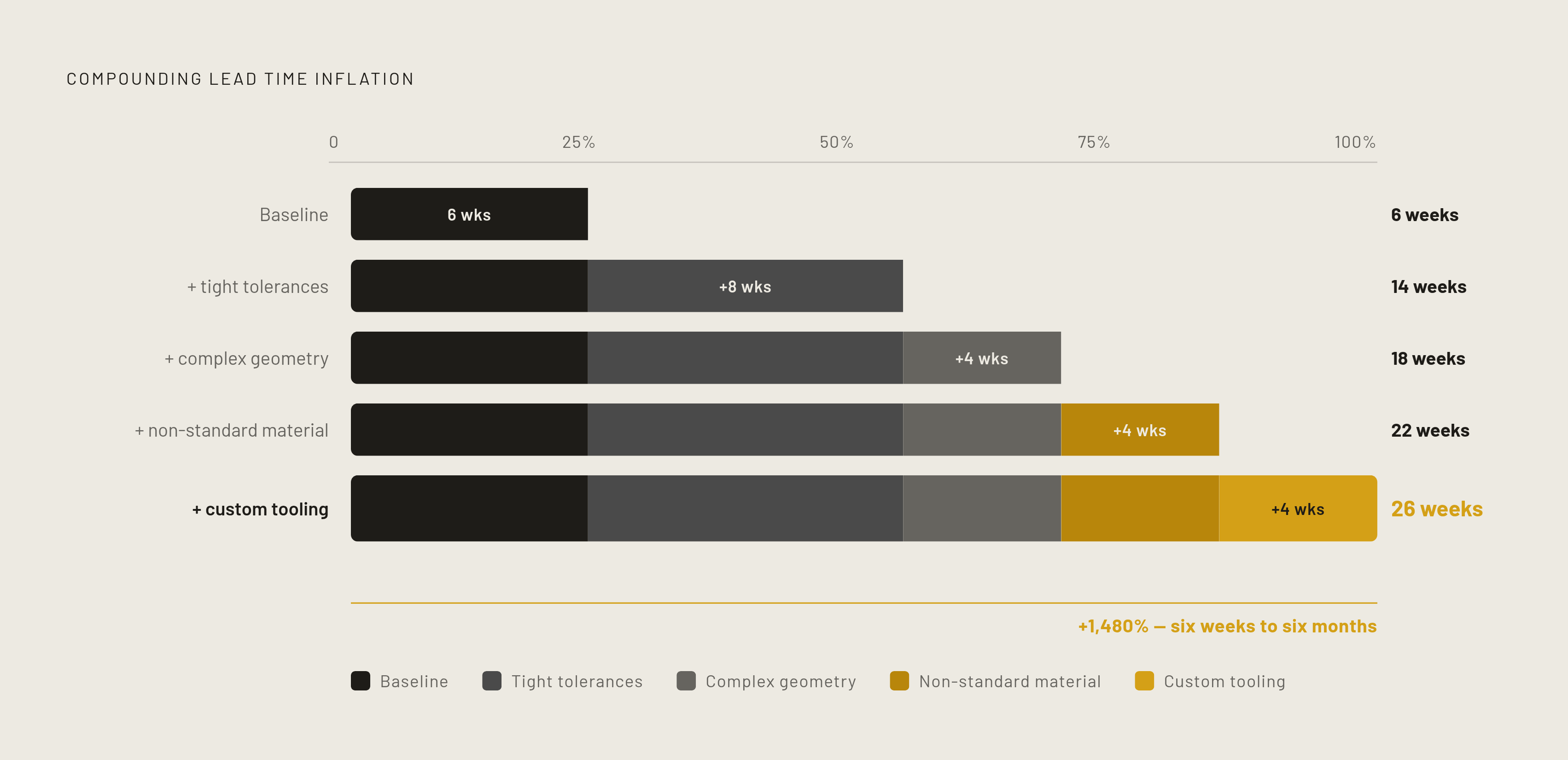
The real delivery date for a custom part gets set weeks before anyone issues a purchase order. It gets set at the design table, not on the shop floor.
The scale of this is easy to underestimate. Decisions made during the concept phase, tolerances tighter than the part actually needs, geometry more complex than the function requires, materials that aren't standard stock, can stack together and increase total manufacturing lead time by up to 1,480% when several of those choices compound at once. Each one individually might cost a few extra days. Together, they can turn a six-week part into a six-month part, and the engineer who drew the part rarely sees that connection until the quote comes back.
A few concrete places this occurs: in CNC work, every added flip, every extra setup needed to reach a new face of the part, adds programming time, load and unload time, and another round of inspection, so a four-sided part can take meaningfully longer than a two-sided one even when the actual cutting time is nearly the same. In tube bending, locking the geometry before tooling and material get ordered is critical, because a mid-cycle design change can trigger 8 to 16 additional weeks of delay, since the tooling lead time has to start over from zero. And a design that specifies a feature requiring custom tooling for a normally fast process, like turret punching, quietly converts that process into a long-lead item the moment the design leaves the drawing board.
Design for manufacturability, DFM, is the lever engineers control entirely, before a single supplier is ever chosen. In fragmented vendor environments, that lever tends to arrive too late to matter. No single vendor owns the whole build path, so DFM feedback arrives only after the design is already committed, and the engineer ends up paying that lead-time penalty on every order that follows. Where DFM feedback does arrive early, before the design is finalized rather than after the first article is built, it can cut lead times significantly compared to a design that went unreviewed. The lever only works if it's pulled early.
Why fragmented vendor sourcing structurally amplifies every delay
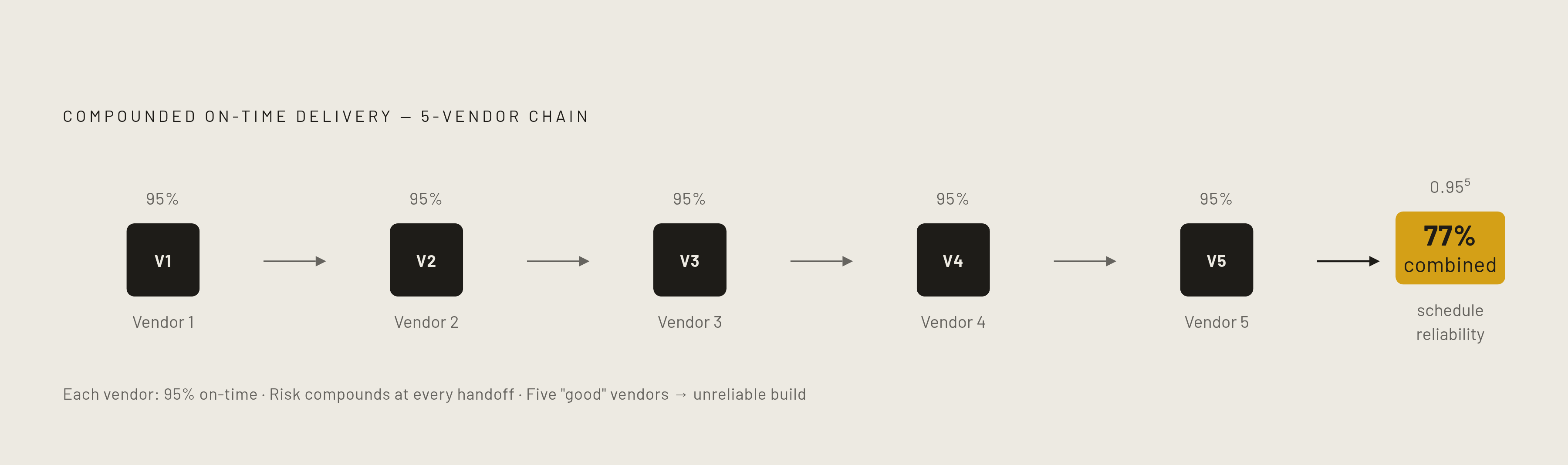
A single multi-process assembly, one that needs laser cutting, welding, machining, inspection, and coating, typically means a separate purchase order for each step, placed with a separate vendor. A delay at any one of those shops causes every vendor downstream to lose its scheduled production window, and that slippage cascades through the rest of the build.
Every handoff between vendors is a place where quality, timing, or communication can break down on its own, independent of how well any single vendor is actually performing. Run the math on that: a build that passes through five vendors, each individually hitting 95% on-time delivery, ends up with combined schedule reliability well below 95%, because the risk at each handoff stacks rather than cancels out.
There's a cost here that never appears on any individual supplier's scorecard. Buyers managing several vendors for one assembly spend real time following up, reconciling status reports that contradict each other, and re-sequencing downstream work to absorb whatever just slipped. None of that appears as a number a supplier reports on themselves. All of it lands on the engineer's own schedule.
SourceDay's case data on BraunAbility shows that better supplier coordination produced substantial gains in on-time delivery and a meaningful cut in inventory, simply by aligning delivery commitments with the actual production schedule. Reducing the number of vendors handling closely related work removes the handoffs where delay compounds. The Component Solutions Group and TRANE Technologies consolidation is a clear example: folding a large number of fastener suppliers into a single vendor-managed inventory program produced a meaningful drop in procurement cost alongside better schedule reliability. Partners that keep laser cutting, CNC, forming, welding, finishing, and assembly under one roof and one quality system remove the inter-vendor cascade entirely. The delay risk becomes one vendor's delivery date, rather than the product of five separate schedules multiplying against each other.
Handling the concentration risk objection to vendor consolidation honestly
Consolidating suppliers doesn't make supply risk disappear. It changes its shape, trading distributed coordination risk for concentrated dependency risk, and that trade needs to be modeled explicitly rather than assumed away.
A supplier can carry an excellent quality history, a strong on-time delivery record, and no open corrective actions, and still represent real exposure if it's the only qualified source for a critical component. Past performance says nothing about what happens if a geopolitical event, a fire at a facility, or a sudden capacity constraint takes that one supplier offline. That's the honest version of the risk, and it deserves a plan rather than a shrug.
The mitigation isn't complicated. Qualify a second source for the highest-criticality components, even when a primary partner handles the rest of the bill of materials. Concentration risk gets managed by keeping a qualified backup ready, not by refusing to consolidate in the first place. Mills-Winfield's 2026 purchasing guidance points toward a tiered supplier list, preferred, secondary, and emergency, as the structure for this. That tiering does double duty: it protects against a single point of failure, and it strengthens negotiating leverage, improves visibility into the supply base, and gives every supplier on the list a reason to keep its performance up.
One more objection deserves a straight answer: scorecard gaming. Measuring on-time delivery against a revised promise date, rather than the date originally quoted, makes a supplier's performance look better on paper while hiding the delays an engineer actually lived through. The fix is a specific question, not a general one: ask whether the on-time number being reported is measured against the original promise date or against whatever date got renegotiated along the way. That single question separates a scorecard that reflects reality from one that's been quietly cleaned up.