Schedule Risk From Splitting a BOM Across Multiple Vendors
Every vendor boundary compounds the risk that one missed deadline derails the entire schedule.
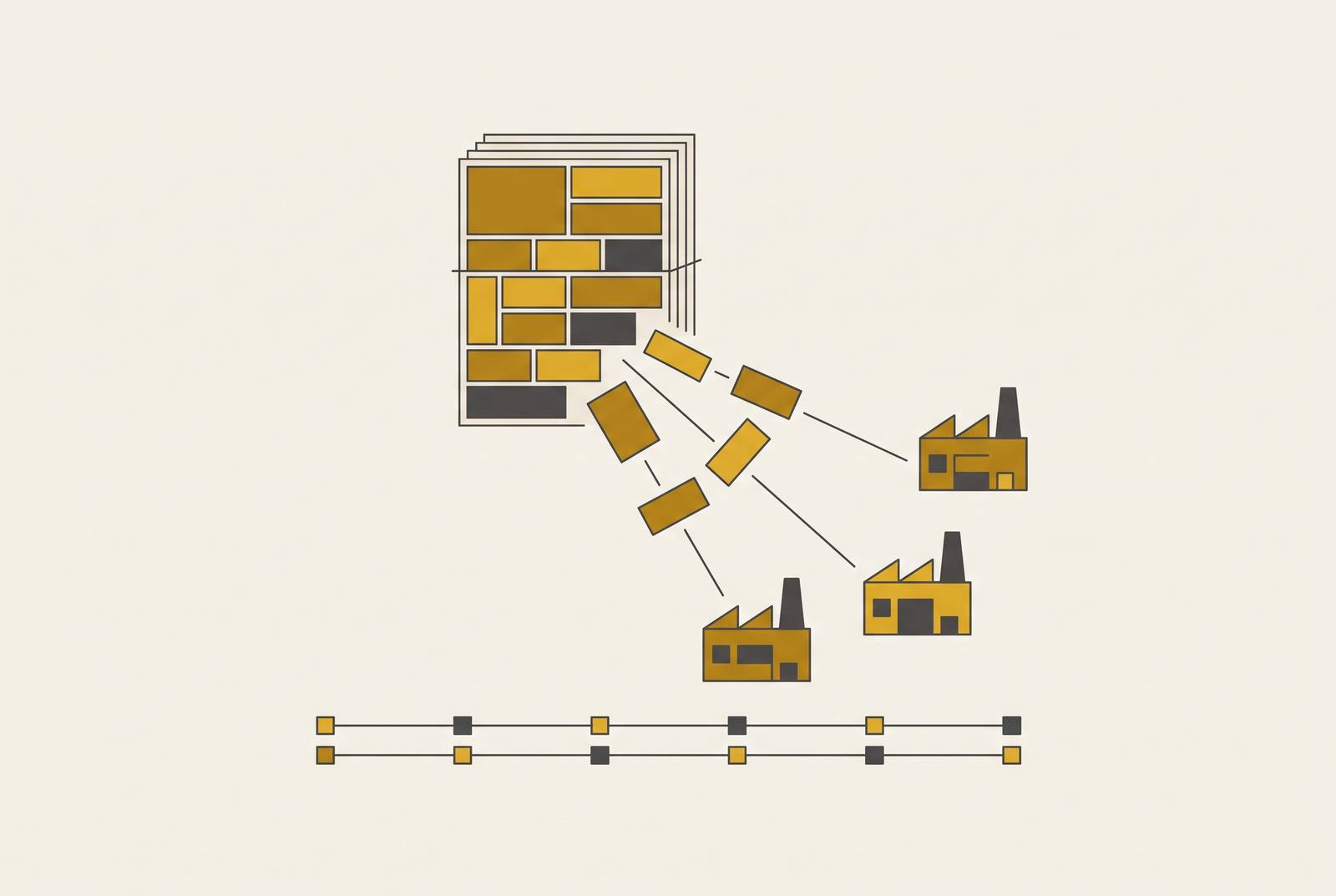
A BOM that looks clean on a spreadsheet can fall apart the moment it hits five different shop floors. Splitting a bill of materials across multiple vendors feels like good practice: spread the risk, hire the specialist for each process, keep options open in case one supplier flakes. None of that reasoning is wrong on its own terms. But the effect it produces in practice runs the opposite direction from the intent, because every vendor boundary is a handoff, and every handoff is a place where the schedule can quietly break.
Those failures don't stay contained to the vendor where they start. A missed revision at the sheet metal shop doesn't just cost the sheet metal shop time, it ripples into whatever downstream part was supposed to mate with it, and from there into assembly, inspection, and shipping. Teams that hit their dates consistently treat the BOM as a living risk model that gets checked and re-checked throughout the program. Fragmentation makes that kind of live tracking almost impossible, because no single party can see the whole picture at once, and everyone downstream is working off whatever version of the truth their vendor happened to receive.
Supply chain resilience is a design problem, and the sourcing decision is where that fact gets decided. It's a design problem, and the choices made while assembling the BOM decide how exposed the whole program ends up being. That exposure shows up in revision mismatches, lead times that stack instead of adding, accountability gaps when a part fails, and delays that cascade through an entire build; what follows also covers what changes when the BOM sits with one capable partner instead of ten.
Why each vendor boundary is a revision mismatch waiting to happen
Inside one engineering team, a design change is easy. Someone updates the model, pushes the revision, and everyone on the floor works off the new file by the next morning. Across a fragmented vendor list, that same change turns into a coordination job nobody signed up for.
Each vendor gets the drawing set as it existed the day they quoted the job. Whatever changes after that point may or may not reach them, and there's no system forcing an update to actually land in their hands. So vendor A machines to rev C while vendor B bends sheet metal to rev B, and when the parts show up, they don't assemble. Nobody did anything wrong in isolation. The documentation just diverged.
This occurs constantly in EMS relationships, where a partner onboards from an incomplete package and delivers a first build that doesn't match design intent at all, a failure that traces straight back to fragmented BOM and documentation handling rather than any single vendor's competence. And the deeper issue is that a BOM is never really finished until the product ships. It keeps shifting from design iterations, compliance changes, or a part going out of stock somewhere upstream. A static per-vendor drawing set can't be trusted to stay current on its own.
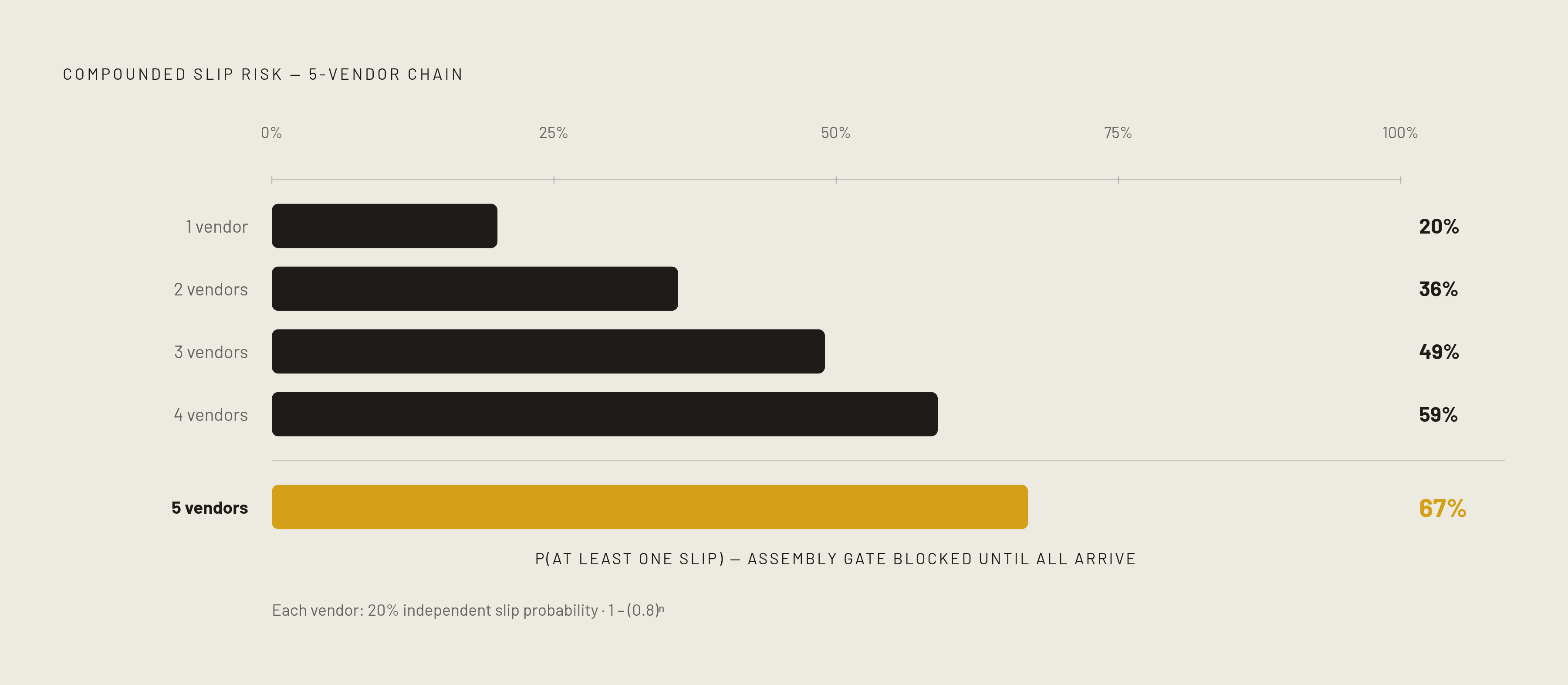
A consolidated partner gets one revision update and acts on it across every process at once. When five vendors each carry a meaningful chance of a one-week slip, the probability that at least one slips is far higher than any single vendor's number suggests, since it is the compounded product of independent risks, and the assembly cannot complete until the last part arrives.
How uncoordinated lead times stack into a longer total schedule than any single vendor's number suggests
Most schedules get built the easy way: take the longest single vendor's quoted lead time, call that the program's constraint, and plan around it. It feels reasonable. It feels reasonable, but it's also wrong.
The real constraint isn't any one vendor's number. It's the latest finish time across every part needed for final assembly, and that number has to account for the real chance that at least one vendor runs behind. Lead times vary enough by process that this stacking effect is easy to underestimate. Anodizing or powder coating, almost always handled by a separate vendor from the machine shop, adds another 3 to 5 days on its own.
Specialty items blow the range wide open. Custom springs run two to four weeks for a standard configuration, structural tubing runs 6 to 8 weeks, and raw material itself now averages 81 days to arrive, up from 65 days before the pandemic, a hidden variable that pushes a vendor's real lead time out without the vendor ever announcing a change.
Now put five vendors on the same program, each one carrying a real, if modest, chance of slipping a week. The odds that at least one of them slips are much higher than any single vendor's quoted number would suggest, because that risk compounds across every vendor in the chain, and the assembly can't move until the very last part appears. Fragmentation turns a lead time that looked manageable on paper into a probability problem stacked against the schedule. Consolidation turns it back into one number, managed by one party who actually owns the sequence.
The accountability gap: what happens when a part is wrong and no single vendor owns the outcome
With one vendor, a bad part has one obvious owner. With five vendors, every out-of-spec part triggers a negotiation over whose process caused it.
The patterns repeat often enough to be predictable. A machined part checks out in spec, but the finishing vendor swears it arrived scratched, and the machining vendor swears it didn't. An assembled weldment doesn't fit, and the fabricator blames the drawing. But the drawing was accurate; it's just that the fabricator's read on it differed from how the machining vendor interpreted the same file, and neither one has any visibility into what the other actually built.
None of this is a fluke or a run of bad luck. When fabrication, finishing, assembly, and inspection get split across separate suppliers, unclear accountability is a structural outcome of that setup, not an exception to it, and every dispute that follows takes time the schedule was never built to absorb.
Vertical integration removes the ambiguity by removing the boundary. One partner owns every step from raw material through inspection and shipment, so a dispute about an interface becomes an internal problem that partner resolves on their own floor, not a delay the engineer has to referee. Providers built this way keep laser cutting, CNC punching, forming, welding, finishing including powder coating, and light electromechanical assembly under one roof and one quality system, and that structure is precisely what closes the gap between vendors that fragmentation opens up in the first place.
Cascading delays: how a single late part holds the entire assembly
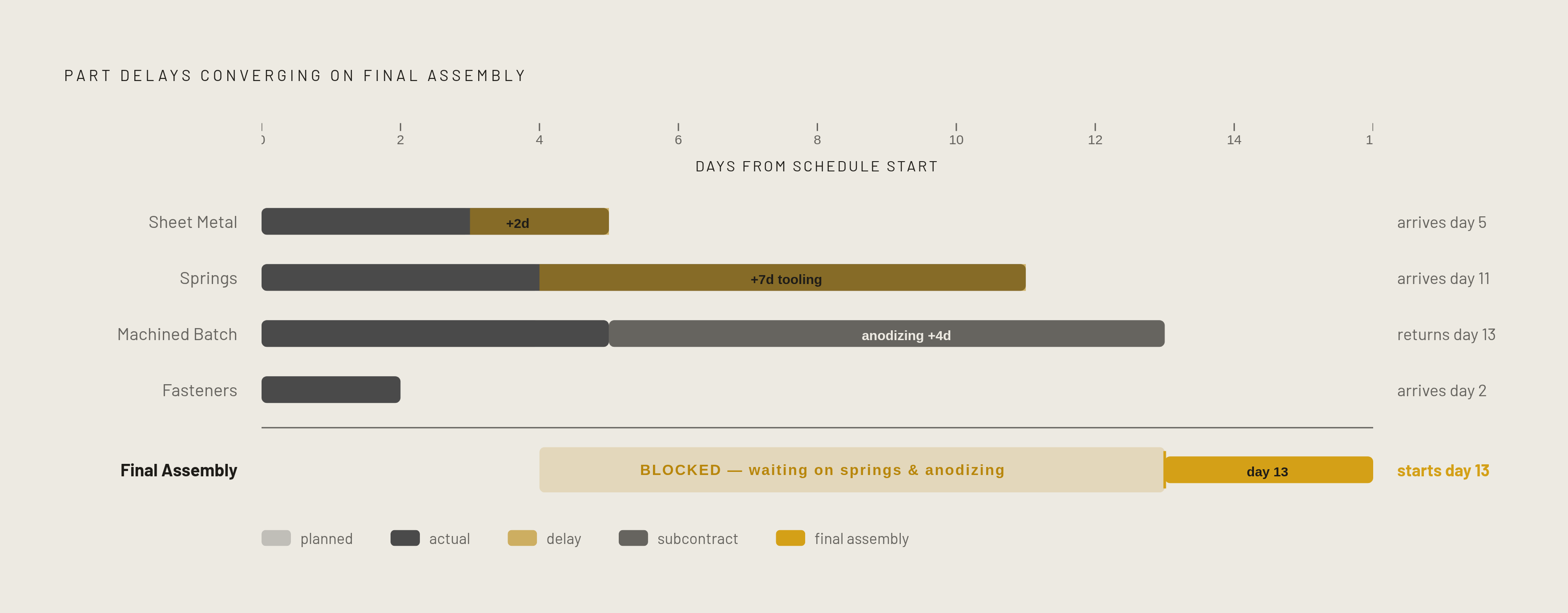
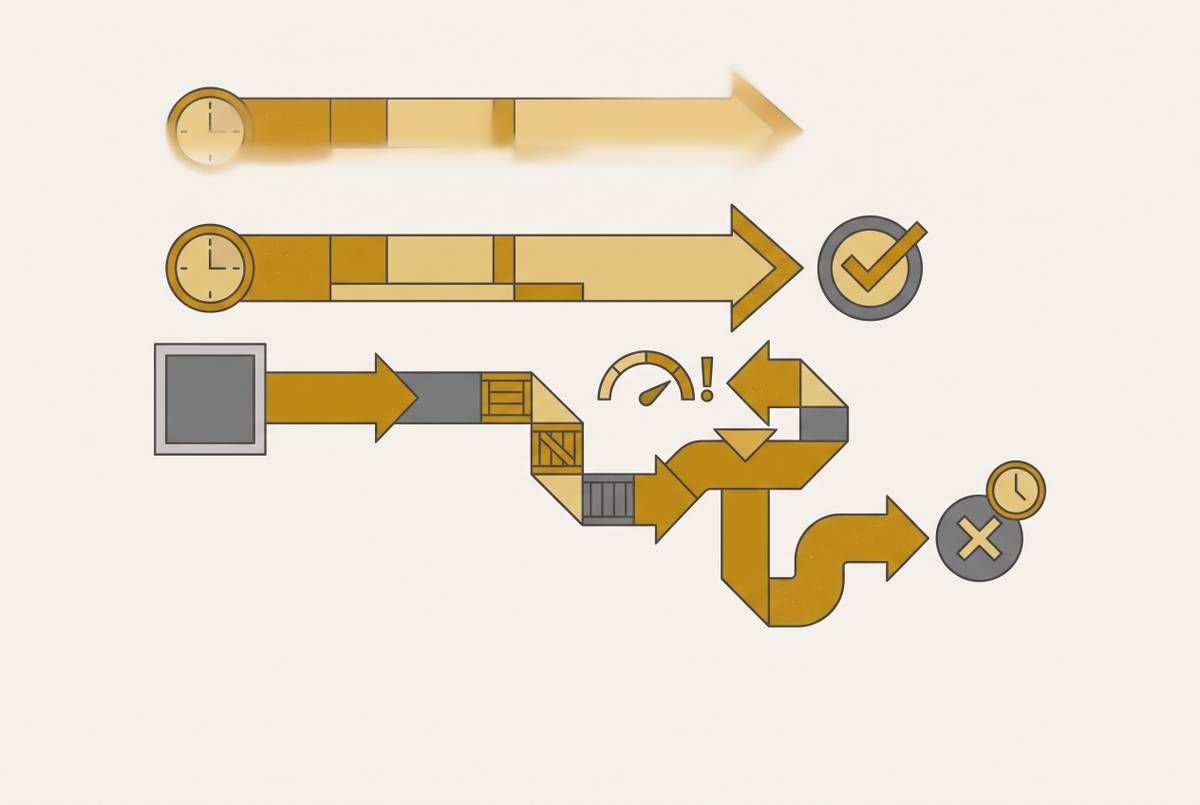
An assembly can't ship with four out of five parts. It needs all five, conforming, on the same day. The real schedule is set by the slowest and most troubled vendor in the chain, not by an average of everyone's quoted date.
Picture how that plays out in practice. The sheet metal parts come in two days late because the vendor's forming queue backed up. The spring order, meanwhile, has been sitting on a tooling approval nobody flagged until the vendor called to ask about it, adding a week nobody budgeted. Then the anodizing vendor, subcontracted separately from the machining, cannot receive parts until the machined batch is complete and shipped to them, then ships back, so the 3-to-5-day anodizing window starts late and ends later. Final assembly can't begin until every one of those parts is in hand, so the entire program sits and waits on whichever piece happens to be last.
This is where the cost of fragmentation stops being abstract. A single part shortage can trigger weeks of redesign churn and real volatility across the whole manufacturing plan, and it's why growing companies end up panic-buying reserve stock just to cushion against procurement delays that shouldn't have been delays at all. Design decisions made early on already determine 70 to 80 percent of a product's final manufacturing cost. The late-stage redesign a cascade failure forces is disproportionately expensive next to whatever savings the original vendor split was supposed to deliver.
Cascade risk doesn't scale with how many parts are on the BOM. It scales with how many independent handoffs sit between those parts and final assembly. Cut the handoffs, and the cascade has nowhere to start.
Why DFM feedback arrives too late when vendors are siloed
Split the BOM across vendors, and each one only ever sees their slice of it. The machine shop reviews the machined parts. The sheet metal shop reviews the sheet metal. Nobody reviews the assembly as a whole, because nobody has the whole thing in front of them.
That means nobody's positioned to catch the problems that live between processes: a machined feature that's a nightmare to align with a bent sheet metal mating part, a tolerance stack that only becomes visible once both parts are considered side by side. Those are the ordinary failure modes, not exotic ones. They're the ordinary ones, and they get missed constantly because the review structure guarantees nobody's looking at the seam.
Timing makes this worse than it sounds. Most of a part's manufacturing cost gets locked in during the CAD phase, and a multi-vendor setup delays DFM feedback until well after that design is already frozen, so whatever the feedback costs to act on multiplies at every stage between concept and production. The electronics side of manufacturing has a matching failure: a schematic error caught during prototype bring-up forces a board spin, a setback that costs about the same as a tolerance or geometry problem discovered after mechanical parts have already been cut. Same lesson either way. Catch it early or pay a multiplier later.
The specific gaps are these. On the CNC side: tool accessibility conflicts, non-standard radii that call for special tooling, a setup count that quietly inflates cost and cycle time, the kind of thing a consolidated vendor flags at quote and a siloed one never sees coming. On the sheet metal side: bend radius inconsistencies, hardware insertion and welding treated as separate routing steps that add time a vendor handling both processes would flag at DFM review instead of at final assembly. And there's a real number behind process consolidation itself: folding several sheet metal parts into a single CNC-machined part can save more than 15 to 30 percent on material cost and cut machine tool processing time by over 20 percent, a savings that's only visible to a partner who can actually see both processes side by side. A single-source partner quoting the full BOM returns DFM feedback across every process at once. A fragmented model can't do that by design.
Specialty parts (springs, gaskets, tube bending) as the highest-risk line items in a fragmented BOM
Specialty fabrication, custom springs, gaskets, tube bends, wire EDM, urethane castings, is exactly the category most quoting platforms decline to touch, which pushes engineers to source it separately and bolts another handoff onto a BOM that's already fragmented enough.
Springs are a good place to start. A standard configuration runs two to four weeks once design review, tooling setup, first-article inspection, and post-processing are all accounted for. Complex wire forms with tight tolerances, secondary operations, or specialty coatings run three to six weeks or longer. Custom spring work takes engineering collaboration, prototype validation, and quality inspection; it's not a catalog part you drop into a cart, and that timeline doesn't compress just because the rest of the schedule needs it to. When the spring is the last part to arrive, and it arrives three weeks after everything else, the entire assembly waits.
Gaskets carry a quieter version of the same risk. A reputable supplier runs ISO 9001 with documented inspection, calibrated measurement, and full lot traceability, real quality deliverables that take coordination to produce, and a separate gasket vendor adds a fresh documentation exchange to every single revision cycle. Material choice alone spans rubber, plastic, foam, PTFE, fiber, cork, graphite, EMI/RFI shielding, and PSA-backed composites, and picking the right one takes engineering judgment that gets lost the moment the gasket vendor sits isolated from the rest of the assembly.
Raw material is the cascade trigger nobody sees until it's too late. Steel and specialty metal lead times range from 4 weeks to 6 months depending on grade and sourcing region, a spread wide enough that planning a schedule without real material visibility is close to guesswork. A vendor who doesn't flag their material lead time at quote time will flag it eventually, just later, after the program date is already locked in.
The pattern across all of it is consistent: specialty parts get sourced last, from the smallest pool of capable vendors, with the least schedule cushion left to absorb a problem, which is exactly the setup where a cascade failure does the most damage.
What consolidating the full BOM with one capable partner changes
Consolidating the BOM doesn't mean settling for less capability. It means finding one partner whose capability actually spans the full BOM, so the fragmentation gets eliminated at the source instead of managed around after the fact.
Run it back against each failure mode. Revision control is not a distribution problem: one partner gets one update, and the drawing set stays current across every process at once, with no version drifting out of sync at some vendor who missed the memo. Lead time coordination stops being a guessing game, because a partner quoting the full BOM schedules all processes in sequence internally (CNC, sheet metal, finishing, specialty parts) and returns one delivery date that accounts for the actual critical path, not a wishful average.
Accountability stops requiring an engineer to referee. When one partner inspects every part before it ships, responsibility for fit and function is in one place, and there's no inter-vendor argument to resolve while the schedule keeps bleeding days. DFM feedback stops arriving after the design is already frozen, because a partner who can see the whole assembly can flag a cross-process conflict at quote time instead of at final assembly, when it's far too late and far more expensive to fix.
None of this erases the underlying complexity of a mechanical BOM. Springs still take weeks to tool. Anodizing still takes days. Material still has to arrive before it can be cut. What changes is where that complexity gets managed, inside one partner's operation with full visibility across every process, instead of scattered across a vendor list where nobody owns the whole picture and every handoff is one more place for the schedule to quietly come apart.
Sources
- Top 10 supply chain risks managing multiple contract electronics manufacturing partners | VentureOutsource.com
- From BOM to Box | Managing the End-to-End Hardware Product Lifecycle in 2026
- The Hidden Cost of Too Many Suppliers: How Handoffs Create Risk in Manufacturing Projects
- Modern BOM Management: From Parts List to Living Risk Model
- What Affects Custom Fabrication Lead Times and How Can You Plan Your Build Timeline?
- Vendor Consolidation in Metal Fabrication for OEMs - Fabcon
- The Hidden Cost of Redesigning PCBs Around Missing Electronic Components