The Line Items That Reveal Whether a Sourcing Platform Is Actually Full-Service or Just Easy-Parts-Service
Four test lines show whether a platform quotes your whole BOM.
Full BOM sourcing for mechanical prototypes requires a partner that can quote off-the-shelf parts, engineered custom parts, long-lead items, and specialty fabrication together, then answer for the result. The test is whether difficult lines stay in the quote, receive process-specific review, and remain covered by the platform’s quality commitment.
Why getting one quote for an entire prototype BOM depends on each line’s quoting path
An engineer submits a bill of materials and gets back a quote that looks complete. Prices fill the page, and the quote comes back fast. But apparent completeness can hide unresolved sourcing decisions. A custom part may have been treated as a standard item, or a difficult line may have been priced through the wrong process. A price beside a part number is not proof that the platform can supply it.
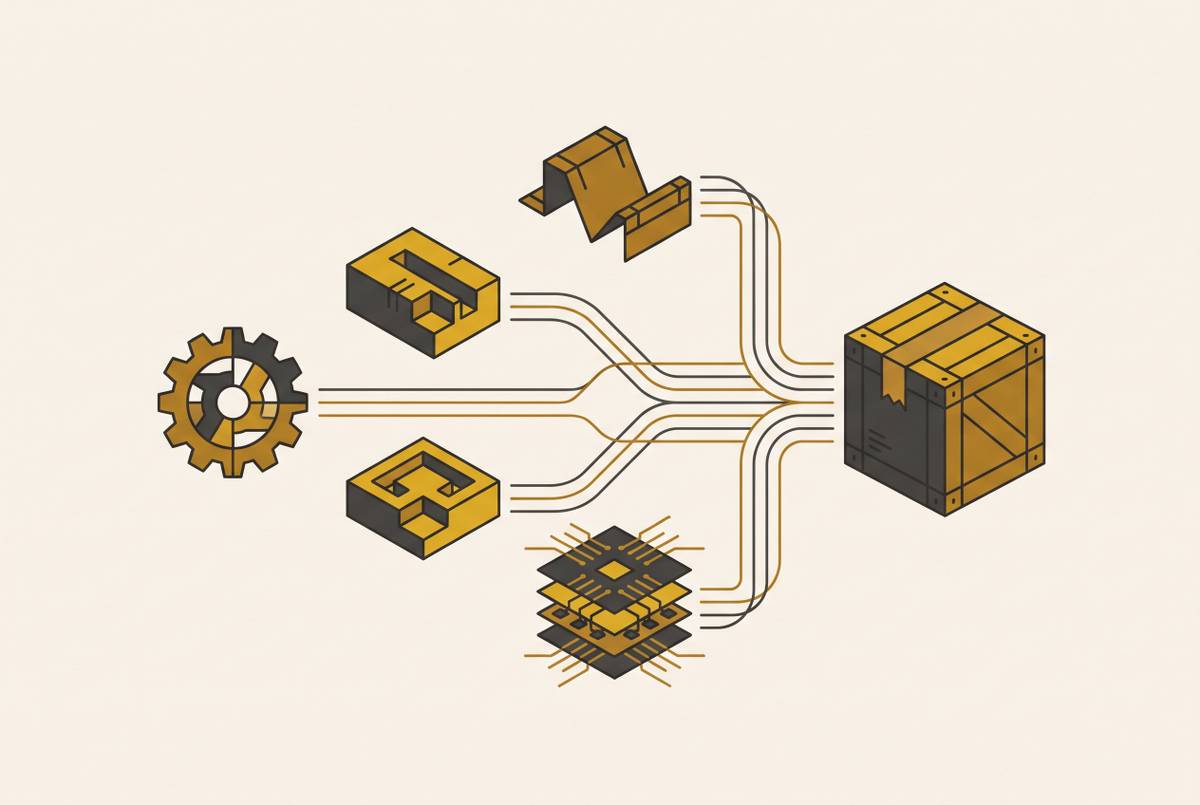
MechanicalBOM’s quoting-path framework identifies four distinct paths, which are commodity, engineered custom, long-lead, and specialty fabrication. Each needs different details, time, and skills from the supplier before it can be priced for the work it needs. Commodity lines are the lane that easy-parts platforms handle reliably. The other three reveal the limits. Full-service sourcing needs a path that works for each line as well as a quote form that takes the whole BOM.
If a request for quotation goes out before those distinctions are made, the platform has to make them. Its response then becomes an early capability signal. It can flag missing decisions and establish a workable route, or it can silently default to an interpretation that makes quoting easy.
What BOM line classification actually requires before a quote request goes out
Classification links how a part must be made to how it will be sourced. It comes before vendor contact. The framework treats the reverse order as a sequencing error because the team has asked for a price before deciding what it needs the vendor to do. That leaves a basic question unanswered. Is the platform pricing the intended part or merely a plausible reading of it?
The information needed follows the quoting path. Commodity lines need clear specifications that say which item is wanted. Engineered custom lines need the drawing, tolerances, and process information needed to judge whether they can be made. Long-lead lines require attention to the material or casting that sets the schedule. Specialty fabrication needs an explicit capability decision before the price request can go anywhere useful.
Material grade is a common blocker across those decisions. Two alloys with a common name are not interchangeable when their grades change process selection, supplier routing, or cost. The missing word can change the sourcing route. Without a grade, a manufacturer can default to the cheapest interpretation that satisfies the drawing, even if that is not what the engineer intended.
Tube bending, custom springs, gaskets, wire EDM, and carbon fiber cannot simply be pushed through standard CNC or sheet metal routing. A platform that accepts these lines without resolving missing specifications has not removed the work. It has deferred that work into production, where correction costs more.
How DFM feedback at the quote stage separates platforms that absorb complexity from those that return it
Once a line has a suitable sourcing route, the next question is whether its design can survive that route. Design for manufacturing, or DFM, addresses that question before a price becomes an order. Autodesk’s DFM guide establishes that this work is most effective during concept and early design. Changes become more expensive when made later in the design and manufacturing process. At the quote stage, a platform still has a chance to catch a problem before manufacturing begins.
For a CNC-machined bracket, relevant checks include hole depth-to-diameter ratio, internal radii, and thin walls. For an injection-molded housing, the review needs to check draft angles, wall thickness, and rib geometry. A sheet-metal weldment calls for checks on bend radii, flange geometry, and feature clearances. CNC-only feedback does not cover a mixed-process BOM.
When a design fails a DFM gate, it goes back to be fixed before it is quoted. A missed issue can instead produce a misquote, a redesign request after order, or an out-of-tolerance part at delivery. Feedback at the quote stage can therefore help show whether the price will hold when the part is made. Silence may mean the relevant process was never reviewed.
The objection is that review slows the quote. Yet a DFM flag caught at quoting costs minutes, while the same issue caught after tooling or machining begins costs days and sometimes the part. Instant, integrated feedback also removes a separate review cycle. The useful speed measure is therefore not the time to the first number, but the time to a quote that can be acted on.
The specialty fabrication lines that most reliably expose a platform’s true limits
A custom spring tests whether the platform can tell a design that must be made from a part that can be bought from a catalog. Its documentation needs detailed CAD or precise sketches with critical linear and angular dimensions, tolerances, material grade, certifications, and finish specifications. A catalog reference does not answer that request. If the response substitutes a standard spring for the custom design, the line has failed even though something appears in the price column.
A multi-bend tube tests a different capability. The documentation must define bend locations, angles, radii, overall dimensions, and the relationships between bend planes. A 3D model is particularly helpful for multi-bend parts. A blank line or a request to “contact us separately” shows that the tube has not made it through the same quoting path as the rest of the BOM.
Gaskets, cable glands, grommets, and seals need explicit specifications for the assembler. They first need to appear in the BOM. Once specified, a response that labels them “out of scope” or “buyer-supplied” leaves the engineer with procurement work that the full-service claim was supposed to cover.
Wire EDM and carbon fiber each test access to a distinct process. Both require a capability decision before routing, rather than an assumption that a standard machining or composite path will do. A platform without suitable in-network access may decline the line, mis-route it, or return an inflated lead time that undermines consolidated sourcing. The signal is in the response.
Why quality gaps in multi-process BOMs emerge at hand-off boundaries, not inside individual shops
Who owns the work between the processes? When casting passes to machining, or welding passes to surface treatment, the part crosses a boundary between suppliers with their own schedules, quality standards, and delivery rules. Each shop can perform its own operation competently without anyone answering for the whole sequence. That gap creates both a quality risk and an administrative burden.
A minor delay from one vendor can hold up the whole production line. Material traceability must also remain unbroken as the part moves from raw stock through final inspection. The record cannot stop at the shop door. If the platform cannot document that chain-of-custody, the buyer faces a structural gap that no individual supplier can close on its own.
Consolidation addresses this only when it includes engineering coordination. In the strongest model, one partner controls the drawings, coordinates the factories, and answers for the finished assembly. An established network of qualified factories can also compress the many months that independently qualifying a new overseas supplier can take. Access alone is not enough, however. Someone must remain responsible when the work crosses from one factory to another.
Specialists may be better at their individual processes than a generalist. That is compatible with consolidation. The best model uses those specialists while removing the engineer from the job of coordinating them. The distinction is between a partner that manages the hand-offs and a service that merely introduces the buyer to more vendors.
How CAD file quality and pre-submission decisions determine whether a platform can quote a full BOM at speed
Engineers can shorten the delays they control before testing the platform’s speed. Complete documentation removes the largest category of recoverable delay. File quality, drawing clarity, and submitted specifications affect lead times, cost, manufacturability assessment, and repeatability. Preparation is part of the quoting process. A capable platform still needs a clear definition of what it is being asked to make.
A clean STEP file with defined material, tolerances, and finishes can accelerate engineering review, CAM programming, and production from first contact. Send clean STEP and PDF files so that missing geometry or details in the drawing do not mean another round of changes. Specify in-stock material where it fits the prototype’s needs, because material availability is the next significant source of recoverable delay. Cosmetic finishes can also be deferred on prototypes to save time.
Automated instant quoting that uses AI geometric analysis can quickly give a firm price for single-process parts when their specifications are clear. Multi-process parts that an online configurator cannot reliably price need engineering review instead. Neither path replaces the other in a full BOM. A coordinating partner also catches assembly failures that parallel automated quoting can miss, so an instant price on each separate part is not the same as a reviewed assembly.
What quality assurance standards actually mean for a multi-process BOM, and why a remake-or-refund policy matters more than a certification
Certification tells an engineer that a supplier has a quality management system. It does not promise that the finished assembly will be right, particularly when several processes and suppliers contribute to it. Certifications are necessary but not sufficient for that judgment. Engineers still need to establish what the platform inspects and what it commits to do when delivered parts fail.
For a multi-process BOM, the traceability requirement tests both the platform and its suppliers. The chain-of-custody described earlier has to cover the entire route through final inspection. Separate shop credentials cannot stand in for that record. The buyer needs evidence that quality control follows the part across the hand-offs.
Without a remake-or-refund guarantee, the engineer is left negotiating with a vendor that has already been paid. A guarantee shifts the responsibility to a platform that must deliver the agreed result or provide the remedy. Its commitment is no longer merely implied. The practical test is inspection plus a remake-or-refund policy, because that combination aligns the platform’s incentives with the engineer’s outcome.
A practical test engineers can run before committing a full BOM to any platform
Submit a test BOM with one line from each quoting path. Include a standard CNC machined part for the commodity path, an engineered custom part with a tight tolerance stack-up, and a long-lead material or casting. Add at least one specialty line, such as a custom spring, multi-bend tube, gasket, or wire EDM part. Keep the difficult line in the test.
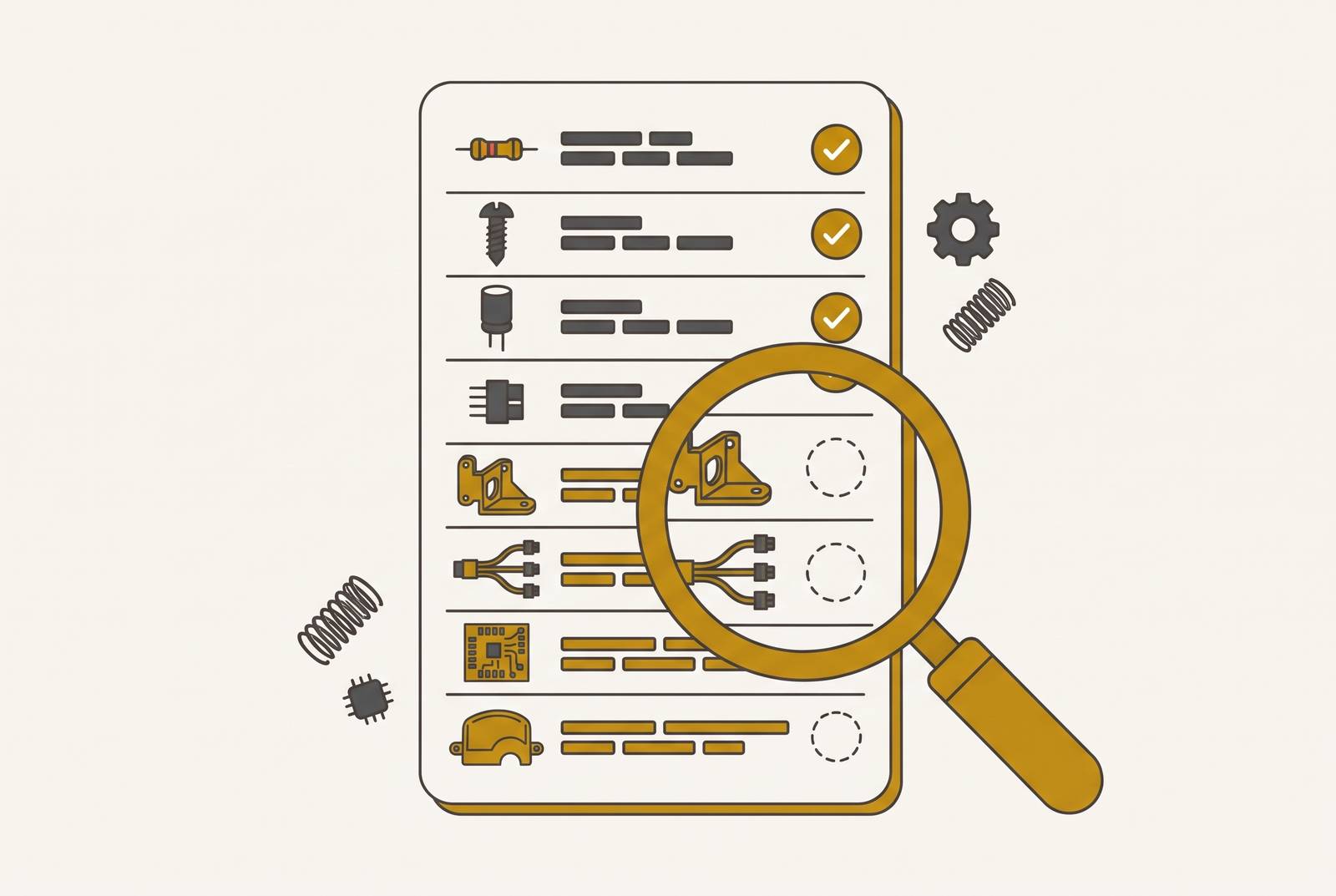
Completeness is the first signal. Has every line come back with a quote, or have some returned blank, marked “contact us,” or disappeared altogether? A catalog substitution for a custom requirement also fails this test. A platform that handles the commodity and engineered-custom lines but drops specialty fabrication is an easy-parts service.
DFM feedback is the second signal. Has the response flagged manufacturability issues relevant to the actual processes, or simply priced geometry that would fail in production? The presence of a warning is not itself a poor result. Fixing a flaw before ordering is better than getting a firm-sounding price that will change when the part is made.
Consolidation is the third signal. Is the response providing one quote, one purchase-order path, and one shipment? Or is the engineer being handed off to different vendors for different lines? The answer shows whether the platform is taking on coordination or returning it to the buyer.
Accountability is the fourth signal. Is the platform offering a remake-or-refund guarantee, or is the quality commitment left implicit? Run this test before placing an order for the real BOM. It costs nothing to ask for these signals, and a platform confident in its full-service capability will not hesitate to be evaluated this way.