Uploading a CAD File for a Quote Versus Submitting a Full RFQ Package
Quick CAD uploads suit simple parts; full RFQs lock in complex manufacturing requirements.

Instant DFM feedback with online part quoting helps engineers check manufacturability and get a budget price before they settle on a design. Uploading a CAD file and submitting a full RFQ package serve different levels of complexity and different deadlines. The upload route suits well-defined single parts, while a full RFQ gives suppliers the manufacturing, inspection, and production requirements needed for a binding, comparable quote.
Why the two quoting routes exist and what each one actually does
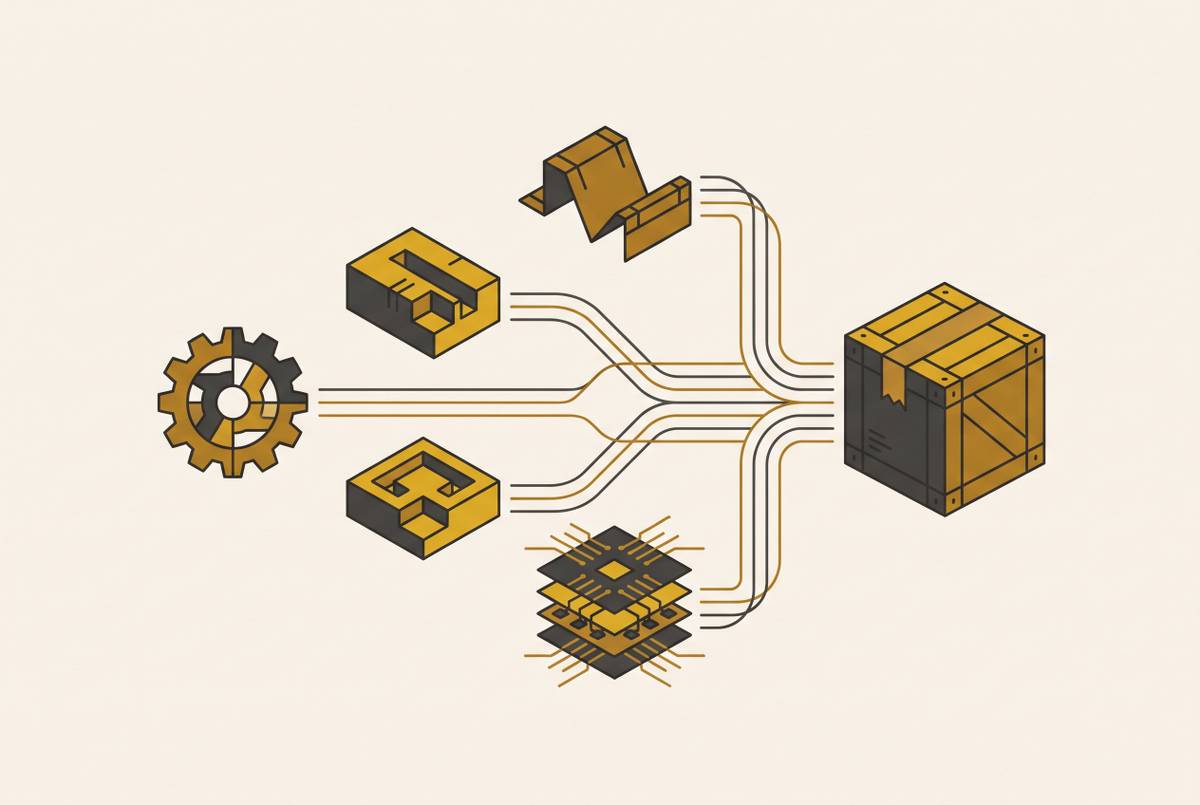
CAD-upload quoting assumes that geometry, the chosen material, and quantity tell enough about the work to price it. An engineer uploads a 3D file in STEP, IGES, SLDPRT, or another supported format, and AI analyzes the job without requiring manual engineer review. Pricing returns in seconds to hours. The engineer can then change material, quantity, and lead time within the interface and see price updates immediately.
A full request for quotation, or RFQ, starts from a different assumption. The design is final, but the supplier needs its complete manufacturing specification before committing to a price. The package includes the model, drawing, material, secondary operations, finish, quantities, quality requirements, application context, and delivery timeline. An engineer checks those requirements manually, often asking for details to be cleared up over several rounds. The supplier is pricing the manufacturing work for the final design.
That distinction also separates an RFQ from earlier sourcing conversations. A request for information, or RFI, gathers supplier capabilities before the design is final. A request for proposal, or RFP, asks suppliers to propose solutions for a complex, open-ended project. Each document asks a different question of the supplier. Their differences are about what must be decided.
What a bare CAD file can and cannot tell a supplier
A 3D model describes shape. Its geometry supports estimates of part volume, material stock, toolpaths, and approximate cycle time. STEP preserves solid model geometry, known as B-rep, and is the preferred format for DFM analysis, but it does not retain parametric feature history or feature relationships. STL suits rapid prototyping but also loses parametric data.
The missing information defines what counts as acceptable. A bare model does not reliably communicate tolerances, surface finish callouts, thread specifications, datum references, GD&T, or inspection rules. The 2D PDF drawing provides the contractual specification, while the STEP file serves the CAM programmer. Even product manufacturing information built into the file can be missed if the supplier’s CAM system does not read it. Conversely, sending only a PDF forces the supplier to rebuild the model, adding lead time and opportunities for interpretation errors.
Volume sits outside the geometry as well. The same shape can call for different processes, tooling amortization, and supplier tiers at low and high quantities. Include both the model and drawing, with production intent stated separately. The upload route works when the model and accompanying specifications define the job, and straightforward geometry reaches that threshold with less information than many engineers assume.
When does instant DFM feedback with online part quoting work well?
Straightforward machined and sheet metal parts at prototype and low-volume quantities are a strong fit for instant quoting. Their geometry provides enough information to estimate cost and cycle time when the drawing completes the specification. Suitable processes include 3-axis CNC milling, laser cutting, press brake bending, SLA and MJF 3D printing, and standard injection molding. The qualification is that the model and drawing fully define the work.
The speed advantage has a practical use during development. Engineers can compare material, quantity, and lead-time choices during a design meeting. Instant DFM feedback also provides an early check before the team commits to a design direction. That is useful when the immediate question is whether a part is practical and affordable, rather than whether a supplier has accepted every production requirement.
Sensitive designs also raise a question about how files are handled. Better platforms address it with end-to-end encryption, rules that delete files automatically, and files kept from suppliers until an order is confirmed. Zero-disclosure quoting analyzes files on secure servers before that handoff. For manual quotes, title blocks and client names can be removed to anonymize the files. These protections can make online quoting viable for medical, defense, and aerospace designs, although security does not expand what geometry analysis can price.
Where the CAD-upload route breaks down, and why the failures are predictable
The first limit appears when acceptance depends on requirements that geometry cannot express. Tight GD&T may call for a process-sensitive way of making the part, and critical features may need to be checked with CMM. A geometry-only quote cannot encode that inspection standard. Its price is therefore conditional until those requirements are reviewed. Likewise, an unstated tolerance class lets bidders price different standards, and an unspecified finish leaves a meaningful cost open to interpretation.
If the STEP and PDF disagree on dimensions or revision, the supplier must stop and ask which governs. More information has not helped if the information contradicts itself. Mixed-process work creates another gap, even when the files agree. CNC machining followed by anodizing, a pressed insert, and a secondary grind requires handoffs that geometry analysis cannot accurately sequence or price.
Production volume can also change the process itself. A stainless sheet metal bracket may be quoted as laser-cut and brake-bent when stamping would be more appropriate at higher quantities. The shape has not changed, but the economics have. Process selection depends on volume, tolerance, and application context that the file alone does not convey. The quantity entered for a prototype order does not tell the supplier what is planned for production.
Specialty fabrication exposes further limits in the input. Custom springs need material, wire diameter, critical dimensions, quantity, application, and load requirements, with torque, contact, and inspection requirements where relevant. A drawing, sample photo, or sketch can start that conversation. Tube bending needs bend radii that match the tooling, so a radius that matches tooling the shop already owns can save the cost of new dies.
Carbon fiber and composite structures demand a fuller sourcing conversation still. Mold fabrication, layup design, cure cycles, and post-machining each affect cost and lead time. Every part is essentially a bespoke hand build. Geometry cannot settle those variables, so a full RFQ package is non-negotiable. At assembly level, the same limitation extends to weldments, buyouts, outside processing, and kits, none of which reduces to pricing a single part’s geometry.
What a complete RFQ package must contain to produce a binding, comparable quote
A complete CNC RFQ addresses eight categories of information. The first two are a STEP model for CAM programming and a PDF drawing that defines the contractual requirements. The drawing needs full GD&T, tolerances, datum references, and surface finish callouts. The tolerance class and critical features must be explicit. Otherwise, suppliers can return prices based on different definitions of an acceptable part.
Material and secondary operations form the next two categories. The material specification states the alloy, temper, and certification requirement. Secondary operations identify required work such as anodizing, heat treatment, plating, passivation, or powder coat. Each operation adds cost and lead time. The finish specification must therefore state the requirements explicitly.
Quantity and quality requirements define the next part of the package. The volume profile includes prototype quantity, anticipated production quantity, and delivery cadence, together with the required delivery timeline. Quality requirements state the applicable needs for an ISO 9001 certificate, first article inspection per AS9102, CMM or calibrated hand tool sample lot inspection, and a documented change-control procedure. A supplier needs them before pricing inspection and documentation.
Revision control and application context are the last of the eight categories. The drawing revision must be clearly stated and match the model, because a conflict forces a supplier stop and adds business days. Application context gives the supplier enough information to flag a design issue before cutting metal. Examples include a bend radius too tight for the material or a tolerance tighter than the process can hold. The package establishes both what to make and the conditions under which it must work.
For BOM-level submissions, a pre-RFQ audit also checks the data on each line. Every line needs a complete manufacturer part number, a defined unit of measure, and at least one approved alternative where available. Minimum order quantity, or MOQ, is a sourcing constraint that applies only where relevant. Unresolved information triggers clarification before fabrication can begin. If the design or process is still open, the appropriate next step is an RFI for capabilities, lead times, or feasibility, or an RFP for proposed solutions such as full product development or multi-year supply agreements.
How a full mechanical BOM breaks the upload model structurally
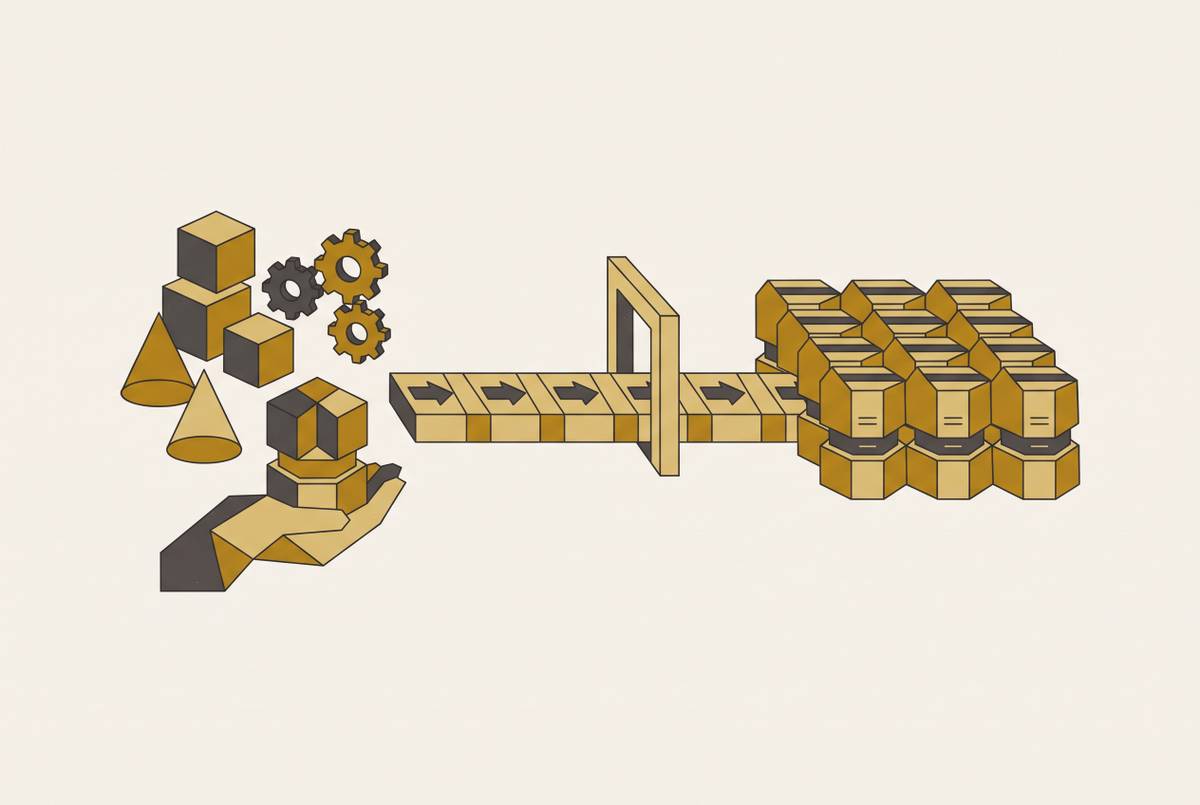
A BOM spanning CNC milling, sheet metal, a custom spring, tube bending, and a cast housing needs a different quoting approach for each process. Pricing one geometry does not price the assembly’s supply chain. No single geometry-based upload model handles all those lines and sequences their handoffs.
That coordination creates concrete work for the buyer. Quotations arrive on different timelines, and separate manufacturing lead times must be synchronized for assembly. Individual MOQs can force overbuy on some lines. Technical questions must be worked through with each vendor separately, and each may have different packaging requirements and drawing revision records to keep up to date. A quick quote on one part does not remove any of those obligations.
BOM data has to be put into a form each vendor can use, with part numbers, units, available approved alternatives, and applicable MOQ constraints resolved. This preparation cannot be compressed by uploading a model. Once the BOM spans several process families, the practical answer is one capable partner that can quote, manufacture, and deliver the full BOM.
How to decide which route fits a given job before submitting anything
Choose the route before uploading anything. Four questions determine the fit. How many distinct parts are involved, and how many processes do they require? Are the tolerances process-sensitive or tied to a given inspection standard? Does the file package fully define the job, including its intended volume and application?
Use the upload route for a single part or a small set of identical parts when the process and specification fit its scope. That includes 3-axis CNC, laser cutting, press brake bending, standard 3D printing, and standard injection molding. A complete 2D drawing should accompany the STEP file, and tolerances should not depend on a special process or inspection approach. Rapid budget validation, design iteration, and early DFM feedback are suitable goals. The route earns its place when those answers are already clear.
Use a full RFQ for tight GD&T, specific inspection standards, first article inspection, weldments, assemblies, or multi-process operations. Specialty work, including carbon fiber, custom springs, tube bending, urethane casting, wire EDM, and die casting, also belongs on that path. Production-scale volume strengthens the case when process selection depends on tooling amortization. Application context may call for the supplier to review the job before cutting begins. For a multi-process BOM, the decision becomes which partner can quote every line under one PO.
A hybrid route is often the right choice. Upload the STEP and drawing for an instant DFM check and budget range, then submit the full package once the design is stable and production intent is defined. The dividing line is not whether a quote arrives online, but whether the supplier has enough information to stand behind it.