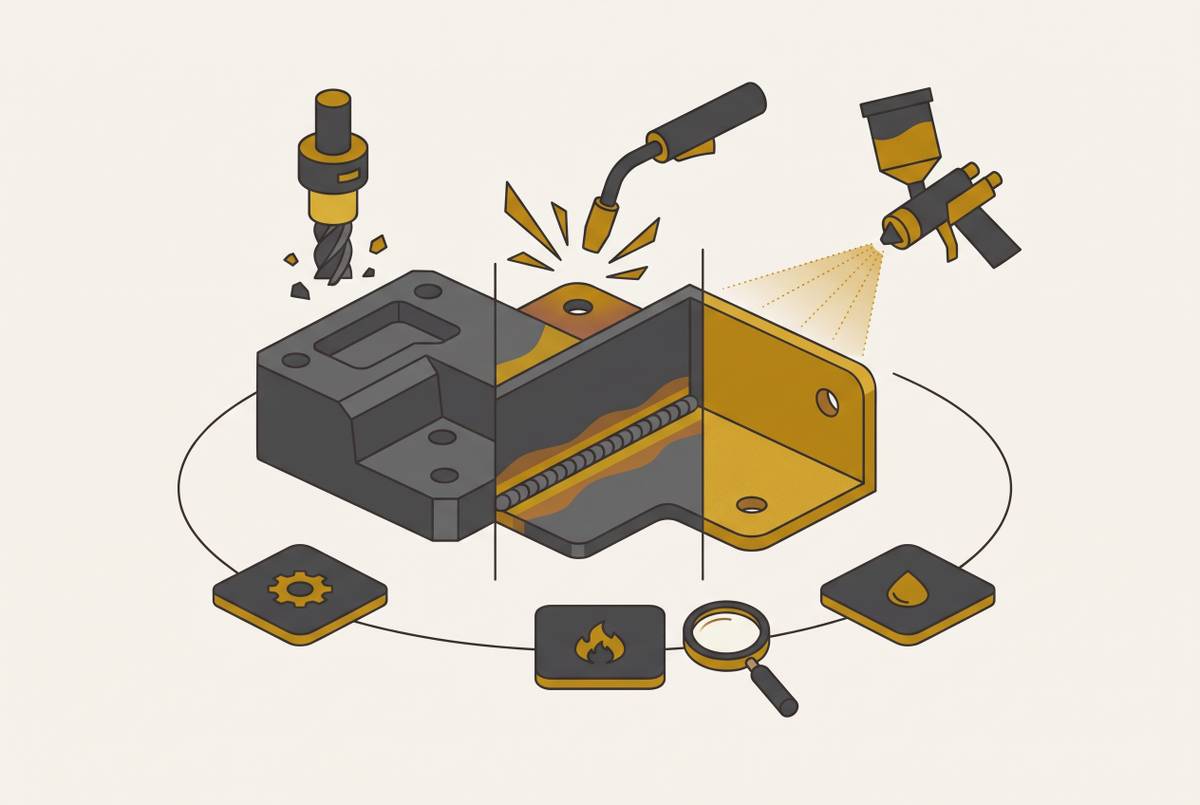
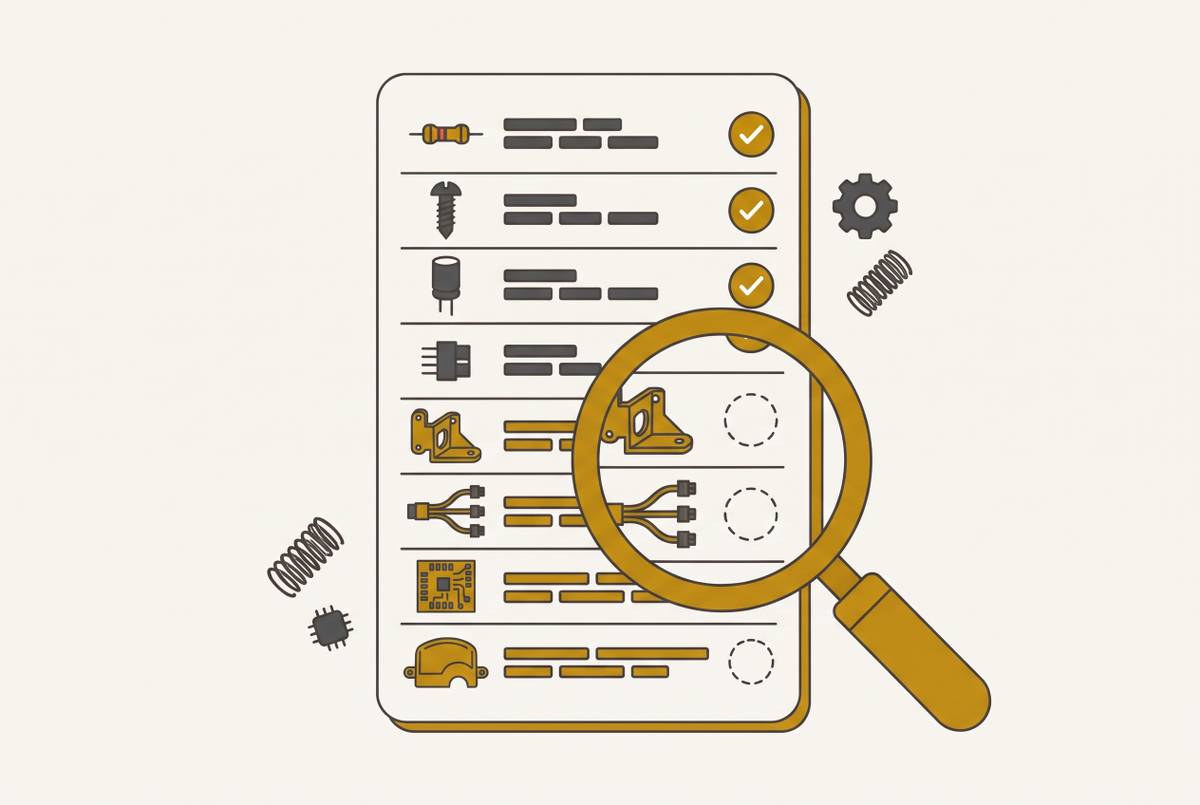
How CNC Turning Welding Plating and Assembly Collapse Into One Line Item on Your Purchase Order
Owning every process step cuts handoff delays and blame-shifting on defects.
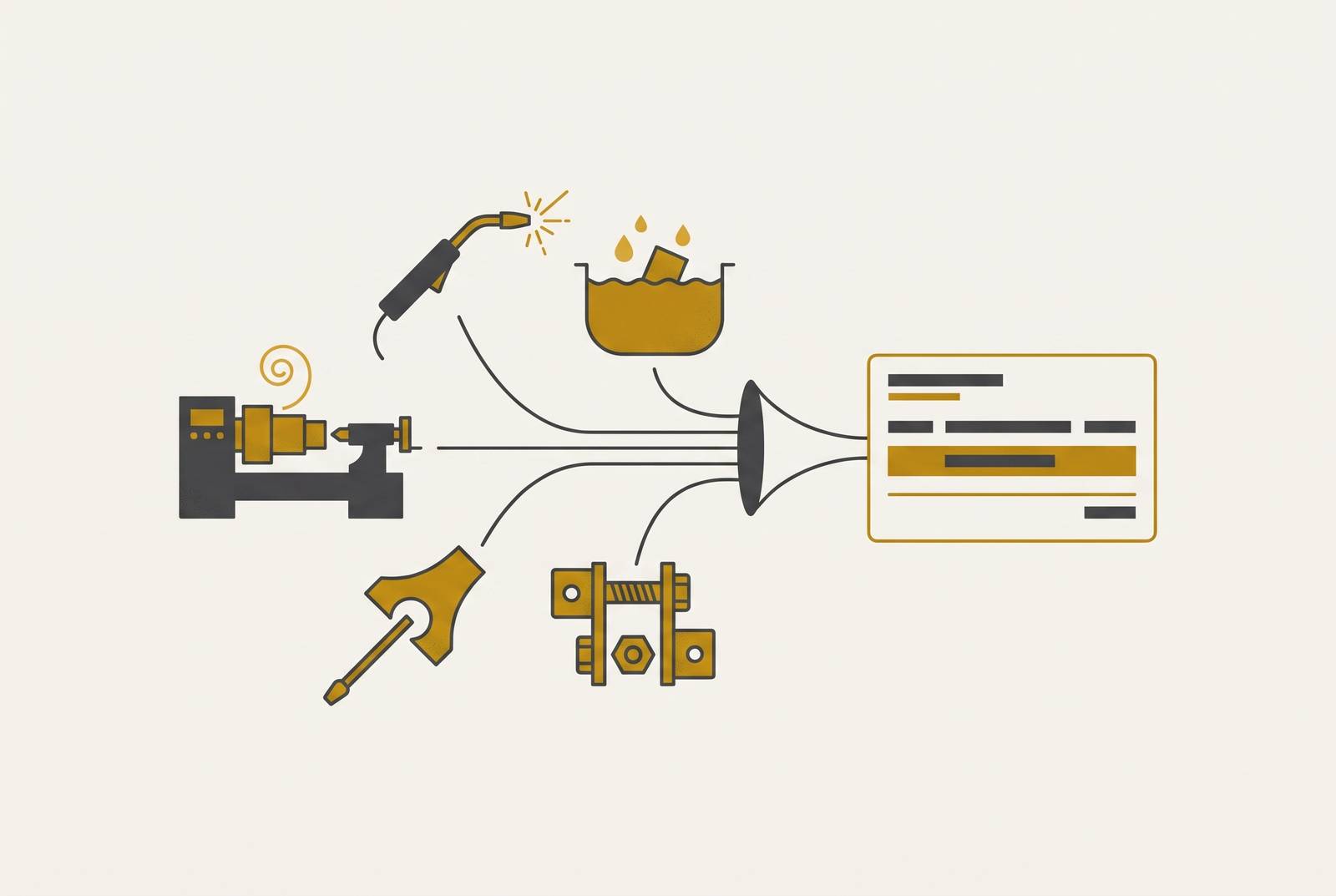
A multi-process mechanical assembly sourcing platform should deliver a finished assembly through one accountable production route spanning several trades. When one capable partner owns CNC turning, welding, plating, and assembly, five purchase orders can become one line item. The benefit comes from removing handoffs between vendors.
Why the five-vendor model for a single assembly costs more than the sum of its purchase orders
The quotes look competitive, but the assembly is late and chasing suppliers is taking engineering time away from the design. Procurement has acceptable prices for each operation. Operations has freight to arrange, parts to receive, and packaging to change before the next shipment. Someone also has to resolve nonconformances and find out which supplier has the current drawing. None of that work disappears because the piece-part prices look good.
A sheet metal enclosure with precision-milled interfaces, welded mounting points, and formed panels spreads dimensional responsibility across specialist shops. Each shop can do its own work as agreed while leaving the buyer to make sure everything fits. Even after an operation is done, the work can run into trouble at the next handoff.
To make that cost visible, the team should map the actual route from raw stock through cutting, forming, machining, welding, finishing, assembly, and delivery. That map needs every supplier transfer, receiving step, inspection point, and freight move. A chain whose transitions belong to nobody can cause trouble even when suppliers perform well.
Where delay actually accumulates at the inter-vendor handoff
A part leaving the forming shop travels, enters receiving, and joins another queue before reaching the finishing line. Its next operation may be short, but the wait still counts against the program schedule. Total lead time therefore covers the time spent on processing, in queues, in transit windows, and in receiving holds. No individual supplier can shorten a boundary it does not control.
Secondary operations make this particularly visible. Anodizing, plating, and heat treat add days to the work, and sending it outside adds time for transport. A small delay at cutting can also push the forming schedule, which pushes the welding queue and then finishing and assembly. The delay cascades through the route. Making up time in one operation may still leave the work without its missed place in the next supplier’s schedule.
Drawings travel through this chain as well. If a revision comes out after parts leave forming, it may reach finishing too late to stop the lot from shipping with parts built to the wrong revision. When fabrication, finishing, and assembly share a floor and scheduling system, the inter-facility dependencies disappear. The coater receives work through the internal production plan without waiting for a shipment. Internal queues still need management, but they sit within one organization’s control.
What quality accountability looks like when a defect crosses a vendor boundary
Tolerance stacking exposes the weakness of split accountability. Turning, welding, and finishing can each meet an individually reasonable requirement, yet their combined dimensional result can leave an assembly that works only when everything lines up perfectly. No single operation has to look obviously wrong. The failure emerges across the route, where separate shops have no shared responsibility for the cumulative result.
At final assembly, that makes diagnosis difficult. The machinist points to the drawing’s tolerance callout, the metal shop points to the coater, and the coater points to the substrate. Each explanation may be defensible within that supplier’s scope. The investigation becomes another delay on top of the defect. Cosmetic problems create the same gap when fabrication, substrate preparation, and coating belong to different parties.
One quality system changes who must resolve the problem. When inspection, traceability, and corrective action cover the whole route, the organization that built the part also owns its finished and assembled condition. That makes responsibility continuous, so the buyer can move corrective action forward without first settling a dispute between process owners. Certifications help support that system, but it still needs proof that it works across the processes used.
What “single-source” actually means beyond a vendor list
A capabilities page is not a production route. A supplier may say it offers turning, welding, plating, and assembly while sending the work through its own network of subcontractors. That arrangement can reduce the buyer’s coordination burden, but it does not remove external queues or freight. Moving more operations to one supplier, reducing supplier count within a product family, and assigning responsibility for a completed assembly are different scopes of consolidation. The last offers the largest operational gain and demands the strongest qualification.
To evaluate that distinction, a buyer should ask where each operation physically happens and how work moves between them. Who owns dimensions between turning and welding? How is work-in-process tracked through finishing and assembly? A credible answer identifies the planned routing, critical features, inspection approach, and limitations before order release. Process coverage must be supported by engineering control, repeatable capacity, and quality evidence on comparable work.
TCS Industries’ 2025 capability brochure documents an in-house stack that includes multi-axis CNC milling, CNC lathe and Swiss CNC turning, sheet metal fabrication, laser and MIG/TIG welding, and electromechanical assembly. Its internal finishing scope includes black zinc plating, yellow and clear chromate, passivation, printing, painting, and powder coating, under one roof with an integrated ERP and paperless inspection system. That concrete scope still leaves fit for each assembly to be established. Standard fasteners, proprietary electronics, highly regulated components, and specialized coatings outside a partner’s documented scope may still need separate sourcing strategies. Consolidation should remove avoidable handoffs while leaving unrelated requirements under separate contracts.
How DFM feedback changes when the turning, welding, and plating engineer are in the same conversation
Design for manufacturability, or DFM, is often limited by the supplier’s scope. A turning shop can assess whether it can make a feature without owning what welding and plating will do to the completed assembly. Tolerance interaction, fixturing repeatability between vendors, assembly sequence, and inspection practicality can therefore fall between reviews. These are not merely drawing problems. They concern how several processes work together.
A partner responsible for the full route can bring those process owners into the same discussion before the design is locked. That changes the question from whether each part can be made to whether the assembly can be made reliably and economically. The distinction becomes especially useful when moving from a machined prototype to build-to-print production involving welding and finishing. Even with prototype approval, some production constraints still need to be worked out. Moving from one process to the next can bring requirements that need another review.
Quoting can bring that review forward. Instant DFM feedback can examine material callouts, bend radii, hole-to-edge distance, weld symbols, finish specifications, and features critical to function when files are uploaded. Where that capability exists, a week-long exchange can become part of the submission session. Cross-process engineering still has to resolve the interactions those checks expose. Its value is catching tolerance stack-up, conflicting fixtures, and finish compatibility questions before parts have been built.
How do you get a single quote for an assembly requiring turning, welding, plating, and assembly?
Consider an enclosure assembly with a CNC-turned mounting feature, a welded connection, a plated surface, and a final assembly step. In the fragmented version, fabrication, turning, welding, plating, and assembly sit with five vendors. The buyer has to handle five purchase orders, five freight moves, and five receiving inspection points along the way. Each vendor quotes its part of the job.
The consolidated workflow starts with one submission containing the CAD files, drawings, BOM, or reference images needed to describe the work. The partner reviews the full assembly and returns a unified quote covering turning, welding, plating, assembly, and any required secondary operations, with DFM feedback included. The buyer approves one purchase order. Its line item covers the finished assembly, with all the work that an intermediate part would still need from another supplier.
Behind that line item, the partner schedules work-in-process internally and inspects it under one quality system. Turning, welding, finishing, and assembly remain distinct operations, but they no longer require separate external shipments and receiving holds. If a secondary operation is subcontracted, the partner manages it with full traceability. That removes separate coordination from the buyer’s workload while leaving the subcontractor’s queue and transit time in place.
The completed assembly then arrives in one shipment, creating one incoming inspection event at the hardware team’s facility. This is not a reduction to one inspection throughout manufacture. Process inspections still belong inside the route. On repeat orders, existing fixtures, programs, routing, and inspection plans let the partner execute without the buyer re-qualifying every step. The simpler purchase order is the result of that production structure.
The legitimate objection when a single partner owns the whole assembly
One partner can also become one point of disruption. Internal scheduling removes inter-vendor dependencies, but a capacity, quality, or financial problem at that partner can stop an entire part family. Consolidation changes the shape of supply risk. It trades scattered coordination problems for a concentrated dependency, which is a better deal only when capability, capacity, and financial stability have been qualified before volume moves.
Any transfer of the whole BOM should follow a controlled transition. A defined part family can run with the new partner while the existing vendor stays live. First articles then need sign-off based on acceptance criteria that can be measured. The old purchase order closes only after a defined run of conforming production lots.
After migration, a controlled route for urgent or uncovered needs preserves flexibility. Fill rate, on-time delivery, quality holds, and exception buying show whether the one-partner setup meets what the program actually needs. These measures test the scope as well as performance. If work keeps falling outside what the partner can do, the sourcing package may ask too much of one partner even when it does its core work well.
What to verify before collapsing your BOM into one line item
Start with a walkthrough of the proposed production route. Ask where turning, welding, plating or other finishing, and assembly physically take place, and identify any outside operations. Then find out who is responsible for scheduling and dimensions as work crosses those boundaries. The route should also demonstrate capacity for both prototype and production volumes, rather than treating success at one stage as proof of readiness for the other.
Next, ask for proof of engineering and quality on similar multi-process work. The team should be able to review turning tolerances, weld fit-up, and finish compatibility together at quote time. Inspection records, material traceability, weld control documentation, and corrective-action practices show how that responsibility is exercised. Certifications alone are not enough evidence of execution. The records need to cover work that crossed process families, because that is where the proposed consolidation must earn its value.
Speed claims need the same scrutiny. A four-day lead time is believable only when the schedule is under control at every process step, because outside secondary operations add their own queues and time in transit. A remake-or-refund commitment should likewise cover the delivered assembly, including its machined features. Finally, run a pilot on a defined part family, approve first articles against measurable criteria, and confirm that the route worked as described before migrating the remaining volume. The decision belongs on the production floor before it belongs on one purchase-order line.