Dividing Manufacturing Responsibilities Between Hardware Engineers and Program Managers
Clear ownership between engineering and procurement prevents costly surprises during manufacturing.
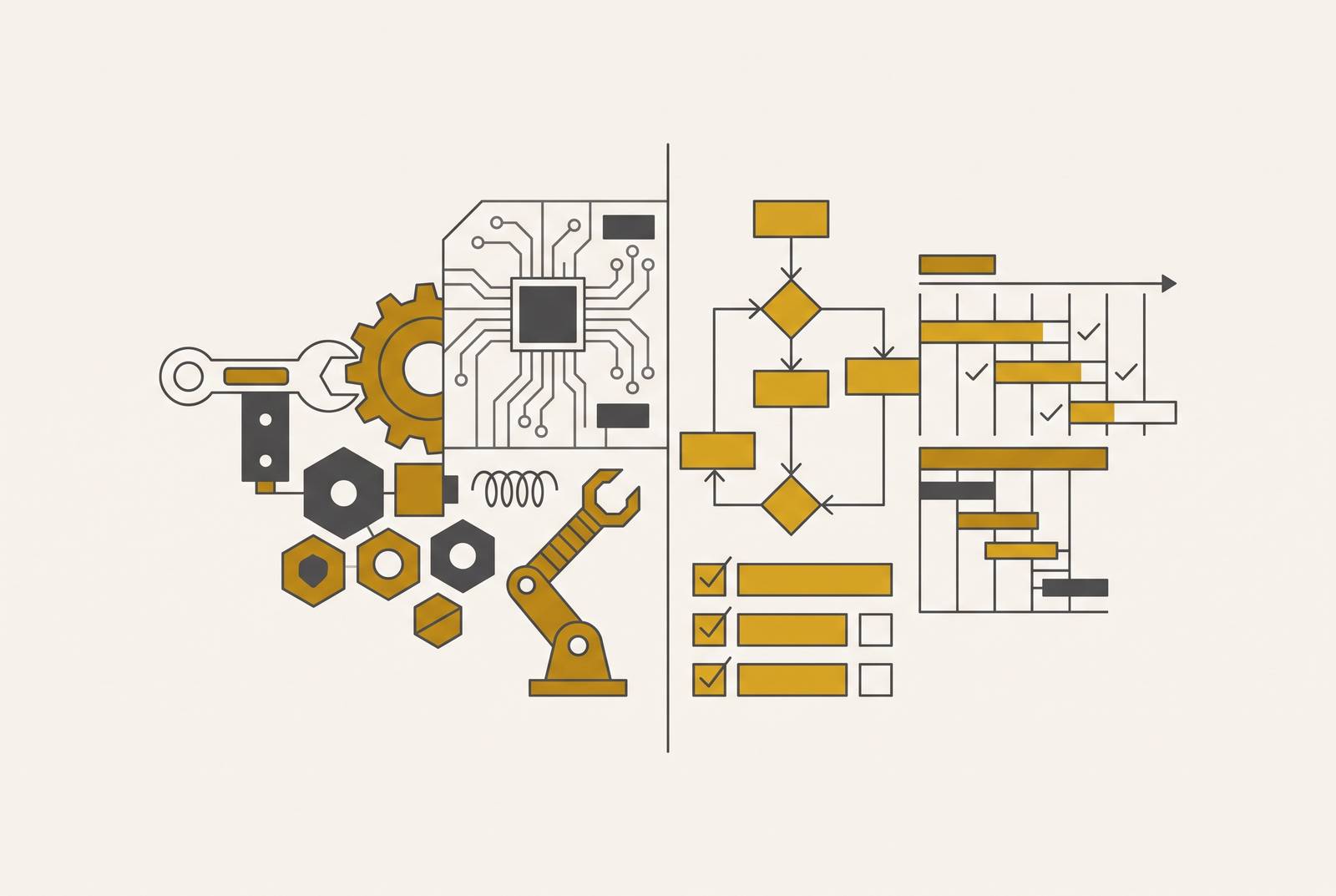
Engineers own whether the design can be made as intended, while program managers own whether the supply base can deliver it. Most delays and cost overruns happen where those decisions meet. To close that gap, each side needs clear ownership and shared checkpoints before the team commits to buying what it has designed.
Why the design-to-procurement boundary is where hardware programs break down
A design is frozen, the bill of materials is released, and only then does the team discover a component with a very long supplier lead time. The engineer has finished the design, but the program manager cannot buy a shorter wait. No improvement to the new product introduction process can close that gap. The program waits because a sourcing constraint was missing from the decision to freeze the design.
The same problem appears when a tolerance forces the use of a specialized supplier. Geometry, tolerance, process, and material choices determine the supplier pool, lead time, and cost before procurement begins. Yet engineers may not see those consequences when making the choices, and program managers may learn about them only after the schedule is at risk.
BenDFM research describes a split between designers who focus on functional requirements and production engineers who know more about manufacturing constraints. It identifies inadequate coordination between those groups in real-world workflows. The research also finds that design for manufacturing, or DFM, support tools are usually available within manufacturing departments. That leaves the people setting manufacturing constraints with limited access to the feedback needed to understand them.
What hardware engineers own — the design decisions that fix manufacturing constraints before procurement begins
The engineer’s job is to define a part that works and that the supply base can actually make. A material choice or feature shape fixes constraints that the program manager will later have to manage. Procurement can work within those constraints, but it cannot erase them without a design change.
BenDFM research names two stages of DFM, which are process selection and intra-process manufacturability assessment. The first asks which process suits the design intent. The second asks whether the specific geometry works within that process. Choosing sheet metal does not establish that every flange, hole, and bend on the drawing can be formed as intended. Engineering must make both decisions before drawing release.
Sheet metal makes the distinction concrete. Flange length should be at least four times material thickness to keep the angle consistent during forming. Holes and slots should sit at least two material thicknesses away from the start of a bend radius because closer features commonly distort or oval out. Powder coating also adds measurable build-up, which can turn a designed slide fit into an interference fit.
Process selection needs the same discipline. 3D printing suits complex shapes, lattices, internal channels, and organic structures, while CNC machining suits machinable features, flat surfaces, holes, threads, and precision interfaces. For high-volume programs, casting can produce near-net-shape geometry before CNC machining finishes critical surfaces, including flanges, seal faces, and threaded holes. When different processes need different geometry, engineers should keep separate design variants. A machining-optimized version eliminates draft angles and uses standard geometric features, while a casting-optimized version includes the necessary draft and filleting.
Tolerance decisions complete this responsibility. Tight tolerances belong on assembly-critical features, and the rest should follow a general standard such as ISO 2768. Tightening an entire drawing narrows the supplier pool and raises cost without improving function. Engineering owns the reason a feature needs precision. A program manager cannot decide that the precision is not needed just because it makes sourcing hard.
Where engineering decisions silently become procurement problems
Nobody questions the design, but nobody says what it means for purchasing either. A performance requirement becomes a material specification, and the sourcing consequence remains outside the conversation. By the time that consequence reaches the program manager, the design may already be frozen.
Titanium and Inconel show how that happens. These engineering-grade metals add meaningful lead time because of specialized tool wear and raw material procurement. An engineer may select them for performance without making the sourcing impact explicit. The material decision then reaches procurement as an unexpected schedule constraint.
Surface finishes can cause the same problem through what looks like a smaller drawing callout. Anodizing, powder coating, and electropolish add days across subtractive and sheet metal processes. If the finish arrives late or is treated as a minor detail, that time becomes an unplanned extension. A long-lead component discovered only when the BOM is released creates the same mismatch between design completeness and sourcing readiness.
BenDFM research identifies poor dissemination and reuse of DFM knowledge across organizations as a structural problem. Without set methods, teams depend on what each person has learned to spot these connections. That explains why the gap is larger than a missed message between two people. A process that depends on someone remembering every downstream consequence has no dependable way to surface the ones nobody notices.
What program managers own — the procurement and governance decisions that convert a stable design into a deliverable assembly
The program manager’s core responsibility is visibility across the full mechanical BOM. That work must run before design freeze, in parallel with engineering. A stable design is not automatically a deliverable assembly. The program manager owns the sourcing and governance decisions that connect the two.
The BOM is the main instrument for that work because several functions use it for different purposes. Design engineers write the engineering BOM and choose components, while procurement managers use it to source parts and track lead times. Manufacturing engineers translate it into the manufacturing BOM. Quality engineers reference it during inspection, and supply chain managers monitor it for obsolescence risk. Each transition is a program manager coordination point, even though the underlying technical work remains with its owner.
Risk classification makes this coordination concrete. High-risk items include single-region sourcing and components approaching not-recommended-for-new-design status, and they require an identified regional alternate. Medium-risk items have lead times in the upper portion of the moderate range with multiple sources, and they require an approved alternate and a buffer stock plan. These classifications must remain active as the BOM changes. A post-freeze audit records exposure too late to govern the decisions that created it.
A supplier that keeps cutting, bending, welding, hardware insertion, assembly, and surface finishing under one roof reduces the hand-offs where a project can slip. The choice is between one coordinated process chain and a set of separate relationships whose schedules must be managed. The program manager owns that choice and the schedule across whichever supplier set is selected.
Quality governance also belongs here. Requiring First Article Inspection and keeping batch-level inspection data on record helps guard against quality fade after the first approved batch, such as thinner material, a subcontractor who was not approved, or an inspection step that was skipped. Supplier qualification must set out which certifications the industry requires before production release. Those include AS9100D for aerospace and defense and IATF 16949 for automotive. ISO 13485 applies to medical devices as a voluntary standard, though regulators or customers often require it in certain markets.
How the prototype-to-production transition tests whether the responsibility map is actually working
A prototype is built to learn, while an early production run is built to establish a dependable process. That difference makes the transition a test of both owners. Before it happens, the BOM must be stable, assembly instructions must be clear, and the test method must be repeatable across every unit in the batch. Engineering and procurement both have to be ready at the same gate.
Choices made for speed during prototyping put pressure on that gate. Informal tolerances, substituted materials, and single-source components collide with the need for a supply base that can repeat the process reliably. If ownership is clear, the transition is a planned hand-off with known conditions. If it is blurred, this is where accumulated uncertainty becomes visible as rework, delay, or cost overrun.
Rapid tooling sits directly on this boundary. Traditional steel tooling supports high-volume production, while aluminum or rapid tooling approaches reduce initial tooling cost and shorten the path to pilot production. But when the team compares them, it must keep non-recurring tooling cost separate from recurring unit cost. Engineering supplies the technical inputs, including cavity count, slides, inserts, and surface polish requirements. The program manager supplies target volume, timing, and the budget allocation for non-recurring expense.
Rapid tooling is a good fit when the team needs representative molded parts for assembly fit, thermal testing, customer evaluation, or regulatory preparation before it commits to full production tooling. The responsibility map works only if both inputs shape the commitment before tooling is ordered.
How to draw the boundary in practice — decisions on each side and shared checkpoints
Each side needs a defined set of decisions that cannot be transferred merely because the other side sees the consequences first. Shared checkpoints then bring those decisions into line before work moves forward.
Engineering owns process selection and any separate design variants needed for different processes. Engineering owns geometry and feature compliance, including bend-to-hole spacing, draft angles, radius standardization, and feature consolidation before drawing release. Engineering owns tolerance specifications and the functional reason for each tight tolerance. Engineering owns material selection, with explicit documentation of exotics that affect sourcing. Engineering also owns surface finish specifications and the dimensional impact of coatings or treatments.
Program managers own supplier qualification, selection, and required certifications. Program managers own the living BOM risk register for long-lead, single-source, and not-recommended-for-new-design components. Program managers own lead time buffers, including safety stock, approved alternates, and long-lead purchase orders placed ahead of confirmed demand. Program managers own vendor consolidation and are accountable for the schedule across the suppliers they choose. Program managers also own first article requirements, batch inspection documentation, and supplier audit cadence.
The first shared checkpoint is the DFM review before design freeze. Engineering presents the process selection rationale and compliance with process constraints, while the program manager presents the current BOM’s sourcing risk profile. Both must sign off before release. Long-lead identification must also happen as selections are made, with engineering flagging sourcing risks and the program manager acting immediately, before the BOM is complete. At the prototype-to-production gate, engineering confirms a stable design and BOM, while the program manager confirms a qualified supply base and mapped lead times.
For a BOM spanning CNC machining, sheet metal, surface finishing, and assembly, this map also explains the value of a single capable sourcing partner. Separate vendor relationships create inter-supplier hand-offs where a tolerance, finish specification, or lead time can be lost. Consolidating the full BOM with one partner that covers the process range removes those hand-offs and gives the program manager a single point of accountability without requiring a redesign. That is the practical division of responsibility. Engineering owns what must be made, program management owns how its delivery is governed, and neither side releases work on an unspoken assumption about the other.