Evaluating Sourcing Platforms When Your Assembly Crosses Machining Welding and Powder Coating
Unified ownership of machining, welding, and coating prevents costly defect disputes.
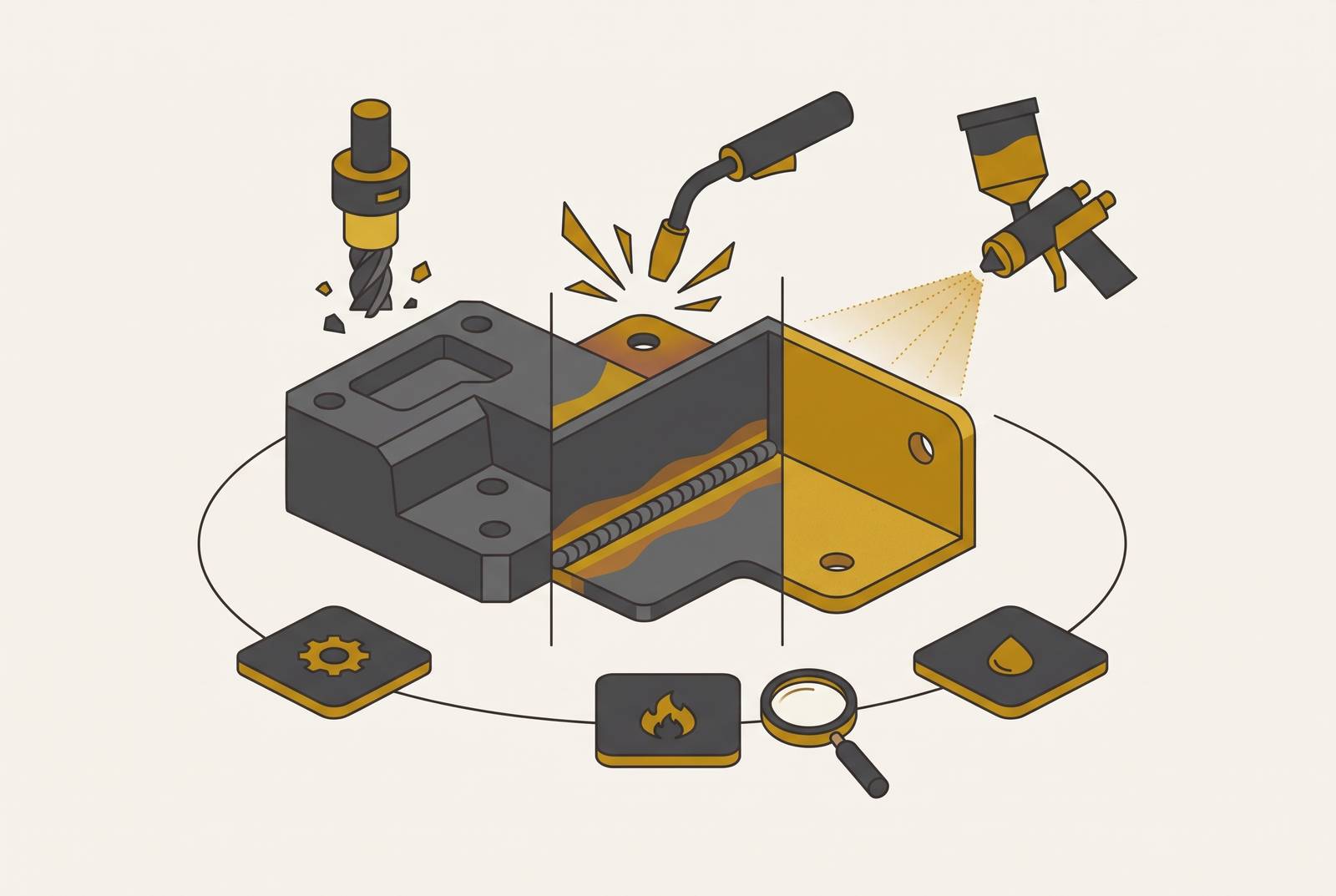
A multi-process mechanical assembly sourcing platform should own machining, welding, and powder coating as one sequence. The strongest choice is a partner whose engineering review, quote, and quality agreement cover the finished assembly. Evaluating that ownership means testing what happens between processes, especially when a defect starts in one operation but appears in another.
Why multi-process assemblies expose the real limits of sourcing platforms
A defect found after powder coating can look like a finishing problem even when it began with weld distortion. By then, the part has passed through operations that may each have been accepted on their own. If separate shops own welding and coating, the buyer can end up managing a dispute over where the failure began while repairs to the assembly remain on hold.
That is why this is not three independent procurement decisions. Machined features establish weld joint geometry, welding changes dimensions through heat distortion, and powder coating occupies clearances and covers grounding points. Each operation constrains what comes next. A review that stops at the machined part cannot establish whether the finished assembly will fit or function.
Separate vendors add scheduling dependencies to those physical dependencies. Each shop must wait for the previous operation to finish, and every transfer changes who is responsible for quality. The buyer must coordinate both the work and the response when something goes wrong. That burden is easy to miss when comparing individual process capabilities.
Asking whether a platform offers CNC machining or powder coating establishes that it can source an operation. It says little about who owns the handoff. For this assembly, the useful unit of evaluation is the complete manufacturing sequence, including the decisions and inspections that connect its stages.
How powder coating interacts with machined and welded geometry in ways a single-process vendor won't flag
Powder coating is a dimensional operation. It changes hole sizes, thread engagement depths, grounding contact areas, and clearances. A threaded hole blocked by the finish is still a failure even if the surface looks correct. Those effects need attention before machining tolerances are set, because the drawing must account for the condition in which the assembly will actually be used.
The first technical test is therefore whether the platform defines dimensions after finishing. Ask how coating thickness enters the dimensional callouts, and which features must meet their requirements after powder coating. A promise to apply the specified color is not enough. The review should produce an explicit finish specification rather than leave the effect on fit for the coating shop to interpret.
Masking needs the same level of definition. Ask for the masking plan and grounding point documentation, including how those requirements connect to the machined features. Verbal agreement is not a usable manufacturing output. A platform that leaves these details for the finishing shop to settle later has split up decisions that need to be made together.
Heat distortion can alter the dimensions assumed during machining, while tolerance stack-up across welded joints differs from stack-up across bolted or machined interfaces. Ask whether the post-weld tolerance review checks the mating features across those joints.
What a genuine multi-process DFM review produces versus what most platforms deliver
A design for manufacturability review, or DFM review, needs a named engineer and written findings. Without those, the label can disguise little more than a courtesy call after pricing is locked. The failure is often an absent review. The first substantive manufacturing question then arrives at first article or mid-production, when correcting the design is most costly.
For an engineer evaluating a platform, the useful test is to request the actual outputs. The tolerance stack-up analysis should cover mating features across welded interfaces. Material and process substitution recommendations should include their rationale. Without that explanation, the buyer has no way to judge whether the change suits the assembly.
Part count reduction recommendations also need a clear basis. Ask whether the review checks the parts that could be combined for relative motion, material difference, and maintenance access. The finish portion should be equally concrete, with post-finish dimensional callouts, a masking plan, and grounding point documentation.
These findings belong in one integrated review of fabrication, finishing, and assembly. Separate reviews can each be competent while leaving the process interactions unresolved. The platform’s questions provide an early signal. Questions about tolerances, use case, and assembly context show attention to the design, while a price returned without questions shows only that the drawing has been priced.
The timing of the report is the final test. Ask to see how its findings changed the design used for the quote. If the price was set before the review and left untouched, the buyer has no evidence that the findings shaped the offer. The written DFM report should precede and inform the final quote.
The four sourcing models available for multi-process assemblies and what each one gives up
A marketplace platform routes work through its choice of partner network, which can be useful for getting an indicative price quickly or reaching a niche process. The buyer must go through the platform to hold the plant doing the work accountable, so how the platform manages handoffs needs a close look.
An integrated digital manufacturer owns machines and automates the buying flow. That model works well for fast design iteration and small runs, where a quick price helps with decisions about prototypes. Speed comes with a review trade-off. The automated flow gives a price before someone reads the drawing, so it works better for prototypes than for production assemblies whose processes need to be reviewed together by engineering.
A managed network platform assigns vetted partners and provides hands-on technical program management. Its value is coordination and accountability. It can suit mixed-process programs or work that must be placed in a specific region. But problems still have to be solved through the platform rather than through direct contact with the shop floor.
A factory-direct or vertically integrated manufacturer has engineering, fabrication, finishing, and assembly in one organization. That structure removes the inter-vendor handoffs that contribute to rework, schedule risk, and quality disputes. It also concentrates production geographically. It typically offers less flexibility for exotic one-off processes than a broader network can provide.
None of these models replaces evaluation of the actual proposal. A model explains where responsibility is likely to sit, while the adequacy of a supplier’s documentation of that responsibility requires separate evaluation. For machining, welding, and powder coating, the decisive comparison is ownership of the sequence. The buyer needs to distinguish one accountable structure from a purchasing interface that brokers work between separate organizations.
How to stress-test a platform's accountability structure before you place an order
Start the vendor conversation by asking for the engineer responsible for DFM. Establish whether that person covers fabrication, welding, finishing, and assembly in one pass or hands the work to separate reviewers. A department name is not enough to establish ownership. The response should identify who is accountable for resolving findings across the whole assembly.
Then put a specific defect scenario to the platform. Ask who must fix a problem that final inspection finds when weld distortion caused it but it became visible only after powder coating. Ask for the quality agreement that puts that responsibility in writing. Follow through by asking how a disagreement between fabrication and finishing findings is resolved, and whether that process is internal or cross-vendor.
Ask whether first article inspection, or FAI, includes ballooned drawings, measured characteristics, and attached material and process certifications. Establish that it covers post-finish dimensions.
The quote also needs to be checked against the DFM findings. Ask whether it reflects the reviewed design or was issued before engineering review and left unchanged. For defense, aerospace, or strict traceability programs, AS9100, NADCAP, and ITAR registration are relevant additional signals. They do not replace the accountability questions.
Finally, test the answers with a pilot run or prototype batch before placing an order for the full volume. Agree on FAI criteria and traceability expectations before production begins. Production makes the claims testable. A real finished assembly and its inspection record provide stronger evidence than a capability presentation.
Where can one vendor cover machining, welding, and powder coating?
A vertically integrated partner is the clearest structural fit when it controls the full sequence under one accountable organization. Fabcon, for instance, has 220,000 square feet of vertically integrated manufacturing space across two U.S. facilities. That profile gives a buyer a concrete model to investigate. But the size of the facilities alone does not show whether a given program will get the engineering and inspection coverage described above.
The required capability profile begins with CNC machining and sheet metal fabrication, including laser cutting, punching, and forming. Welding must be followed by post-weld dimensional verification with the results in writing before finishing begins. That checkpoint cannot be left implicit. Powder coating and wet paint need a masking and grounding plan developed during DFM.
The same ownership must extend to the final inspection. FAI should cover post-finish dimensions, and one written DFM report should cover the process sequence with a named engineer in charge before the final quote is set. These are linked, mandatory requirements. They tie the accepted design to the manufacturing plan and then to evidence about the finished assembly.
For a broader mechanical bill of materials, consolidation can extend beyond machining, welding, and finishing. A program may also need CNC milling, turning, custom springs, gaskets, tube bending, wire EDM, or casting. Bringing that scope into one quote, one purchase order, and one shipment reduces the coordination imposed by separate vendors.
The useful offer is therefore more than purchasing convenience. The offer should include DFM as part of quoting, same-day access to an engineer, and a quality guarantee that covers the finished assembly as well as individual parts. One purchase order is only the administrative surface. The value underneath it is a partner responsible for how the parts and processes work together.
A practical transition plan for moving a fragmented multi-vendor assembly to a consolidated partner
Moving a program already in production is risky if the new partner’s process has yet to be proven. The practical response is a staged pilot. Begin by mapping the current vendor chain. Document every outsourced operation, including finishing and wiring subcontractors, so the proposed scope includes handoffs that might otherwise remain hidden.
Bring the partner being considered into design review before the drawings are released so cross-process DFM can shape the design before pricing. Ask for the written findings and their owner. Confirm that the final quote follows the completed report and reflects the design that emerged from it.
Before the pilot starts, agree on FAI criteria and traceability expectations. Specify post-finish dimensions, ballooned drawings, and material certifications rather than accepting inspection of pre-finish geometry alone. These requirements define the evidence the pilot must produce. They also keep the acceptance discussion from beginning only after the parts have been made.
Use a prototype or low-volume run to test the partner’s process, quality system, and cross-process accountability. The pilot should establish whether one partner is actually faster, cheaper, and less risky for this assembly than the existing vendor chain. This week, map one assembly’s outsourced steps and bring that package to a prospective partner for DFM review and a well-scoped pilot.