Tracking Mechanical Parts Across Multiple Vendor Shipments
A master tracker, specific POs, and check-ins keep vendor parts converging.
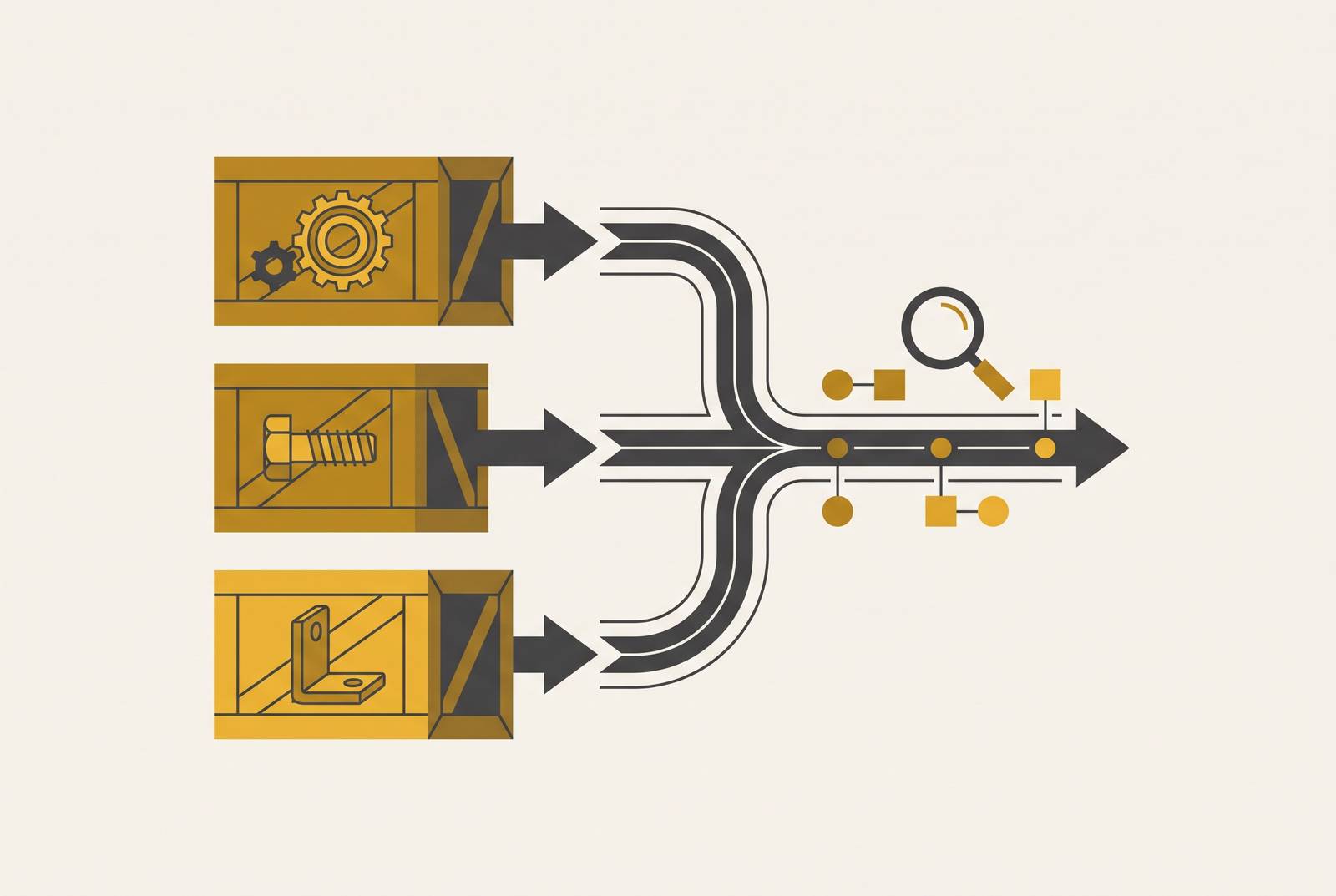
A mechanical assembly split across six or eight vendors is six or eight separate supply chains that happen to converge on the same assembly bench. If you don't track them as a system, these six or eight separate supply chains that happen to converge on the same assembly bench will not converge on their own. They'll just show up whenever they show up, and you'll find out the hard way what's missing.
That's the real problem with fragmented sourcing. A CNC vendor, a sheet metal shop, a casting house, a spring supplier, a gasket cutter, and a tube bender each run their own production schedule, their own packaging convention, and their own paperwork. Every shipment is a distinct event with its own risk of being late, wrong, or incomplete. And the failure mode isn't abstract: a bracket shows up with the wrong hole pattern, or a weldment slips two weeks past its promised date, and the assembly line stops cold. Supply chain disruption isn't a rare event either. In the past year, roughly 80% of supply chains experienced at least one major disruption, and only about 3% of companies considered themselves fully prepared for it. That gap between exposure and preparation is real even at large scale, with logistics teams and buffer inventory to absorb the hit.
Small hardware teams don't get that cushion. Running five to fifteen vendors on a prototype or low-volume build means no safety stock, no backup supplier waiting in the wings, no procurement department quietly fixing things behind the scenes. Every miss lands directly on the engineer's desk. OneWeekParts, a custom parts ordering platform that quotes a full mechanical BOM, hard-to-make parts included, and ships it under one PO, is one way teams cut that vendor count. The fix isn't complicated, but it does require discipline: a tracking system that starts before the first PO goes out and doesn't stop until the last part clears inspection.
Building the master tracking document before any PO is issued
Everything traces back to the BOM. Before any part can be tracked, it has to exist as a controlled line item: part number, revision, quantity, material, finish, and assigned vendor. No BOM, no tracking, full stop.
But the BOM and the tracker are not the same document, and treating them as one is where a lot of teams get into trouble. The BOM answers "what are we building." The tracker answers "where is each piece of that build right now, and can I trust the answer." One is engineering's document. The other is procurement's, and it sits on top of the BOM rather than replacing it.
At minimum, each line in the tracker needs:
- Part number and revision, matched to the actual drawing revision, not to whatever was said on a phone call
- Vendor name and contact
- PO number and PO date
- Quoted lead time and a calculated due date
- Quantity ordered versus quantity the vendor actually confirmed
- Shipping method and expected carrier
- Actual ship date and tracking number, filled in once it ships
- Received quantity and received date
- Inspection status: pass, fail, or hold
- A notes field for anything still open
Revision control is the quiet killer in all of this. A drawing changes after the PO goes out, and unless every vendor building to that part gets notified and confirms they're now working from the updated revision, someone ends up building the old version, correctly, on time, and completely wrong. Add a column for "revision at PO" next to "current revision." When those two columns disagree, you want that visible at a glance, not discovered at final inspection.
Writing POs that make tracking possible
A PO is only as trackable as it is specific. If there's room for the vendor to interpret what was agreed to, there's room for a mismatch at receiving, and that mismatch always costs more to fix after the part is built than before.
The fields that actually make tracking work:
- Drawing number and revision level, stated exactly, never implied
- Material and finish spec written out in full, not referenced back to a conversation
- Required ship date, which is a different number than required delivery date once you factor in transit time
- Shipping method and who's paying freight, since that affects when you can reasonably expect a tracking number to appear
- Inspection requirements: first article, certificate of conformance, material certs, whatever the part actually calls for
- Packing and labeling instructions: part number, revision, quantity, and PO number visible on the outside of the box
PO acknowledgment is the first real checkpoint, and it's underused. Require every vendor to confirm quantity, price, and ship date in writing within 24 to 48 hours of receiving the PO. That's the cheapest moment in the entire process to catch a discrepancy, because nothing has been cut, bent, or machined yet.
Split deliveries need their own rule written into the PO up front. If a vendor is shipping partial quantities, state how those partials get documented, each one needs its own packing list tied to the specific PO line and the exact partial quantity shipped. If that step is skipped, receiving turns into a reconciliation exercise nobody has time for.
Managing the gap between PO issuance and shipment confirmation
This is the most dangerous stretch of the whole process, because it's the quietest. Five vendors, five schedules, and none of them calling to say they're running behind until it's already too late to do anything about it.
Knowing typical lead times helps spot trouble early. Low-volume CNC machining generally runs 10 to 15 days. Sheet metal and finishing lead times vary by vendor and complexity, but secondary processes like anodizing or powder coat typically add meaningful time on top of the base fabrication window. A vendor who's vague about where they stand against those norms is usually a vendor who's behind and hasn't said so yet.
A simple check-in cadence closes that gap:
- At 50% of quoted lead time, confirm the part is actually in production and there's no material or programming holdup
- At 80%, confirm the ship date is still on track; if it's not, get a revised date immediately and figure out what it does to the assembly sequence
- The day before expected ship, get the tracking number or a direct ship confirmation
Not every part deserves the same attention here. Some parts gate the entire build, everything downstream waits on them, and those need the tightest check-in cadence of all. A bracket running two days late is an annoyance. A structural weldment running two days late means the whole assembly sits idle. Sort the BOM by what's actually on the critical path, and spend the check-in effort where it matters most.
Receiving and reconciling shipments from multiple vendors
Receiving is the first physical proof that what showed up matches what was ordered. It's the first physical proof that what showed up matches what was ordered, and it's the last inexpensive chance to catch a problem before the part gets anywhere near assembly.
Every inbound shipment needs the same checklist run against it:
- Match the packing list to the PO line on all three counts: part number, revision, quantity
- Confirm the revision on the packing list matches the correct revision in the tracker, not just that a revision number is printed somewhere
- Count the parts before signing anything, don't take the packing list's word for quantity
- Inspect for visible shipping damage before the carrier drives off
- Collect the paperwork the PO required, cert of conformance, material cert, first article report. A required item missing from the box makes the receipt non-conforming, even if the parts themselves look fine.
Update the tracker the moment the shipment is processed, received quantity, received date, documentation status, all of it. A tracker that's two days behind reality is a rumor, and the assembly team will plan around information that's already wrong.
Partial shipments need the same discipline. Mark the line as partial, note what's still outstanding, and confirm with the vendor when the rest is coming. A partial that never gets chased down doesn't disappear, it just resurfaces as a shortage at kitting, which is the worst possible time to discover it.
Incoming inspection as the final gate before parts enter the assembly
Receiving and inspection get treated as one step all the time, and that's a mistake. Receiving confirms you got the right part in the right quantity. Inspection confirms that part actually meets the drawing. If inspection is skipped and receiving is assumed to have covered it, a non-conforming part walks straight onto the assembly bench.
Not every part needs the same scrutiny. Calibrate inspection depth against:
- How complex the part is and how tight its tolerances run
- The vendor's track record on comparable work
- What happens if the part fails once it's in the assembly, a gasket sealing a pressure vessel carries a very different consequence than a bracket holding a cover panel
- Whether a first article was already required and already reviewed
For precision mechanical parts, the minimum protocol looks like this: verify critical dimensions against the drawing, at least the features that mate with something else in the assembly. Check surface finish, thread condition, and hole locations wherever they're called out. Confirm material and finish, hardness check, anodize color and thickness, plating adhesion, whatever applies. Then document the outcome: pass, conditional pass with the specific deviation noted, or reject with the nonconformance spelled out.
First article inspection earns its cost back every time it's used on a new vendor or a new part. Measuring one part fully before the rest of the run ships catches a tooling or setup error while it's still a one-part problem. Failing to catch a tooling or setup error in the first part causes that same error to appear in the fiftieth part, where it becomes an expensive one.
Using the tracker to manage assembly readiness across the full BOM
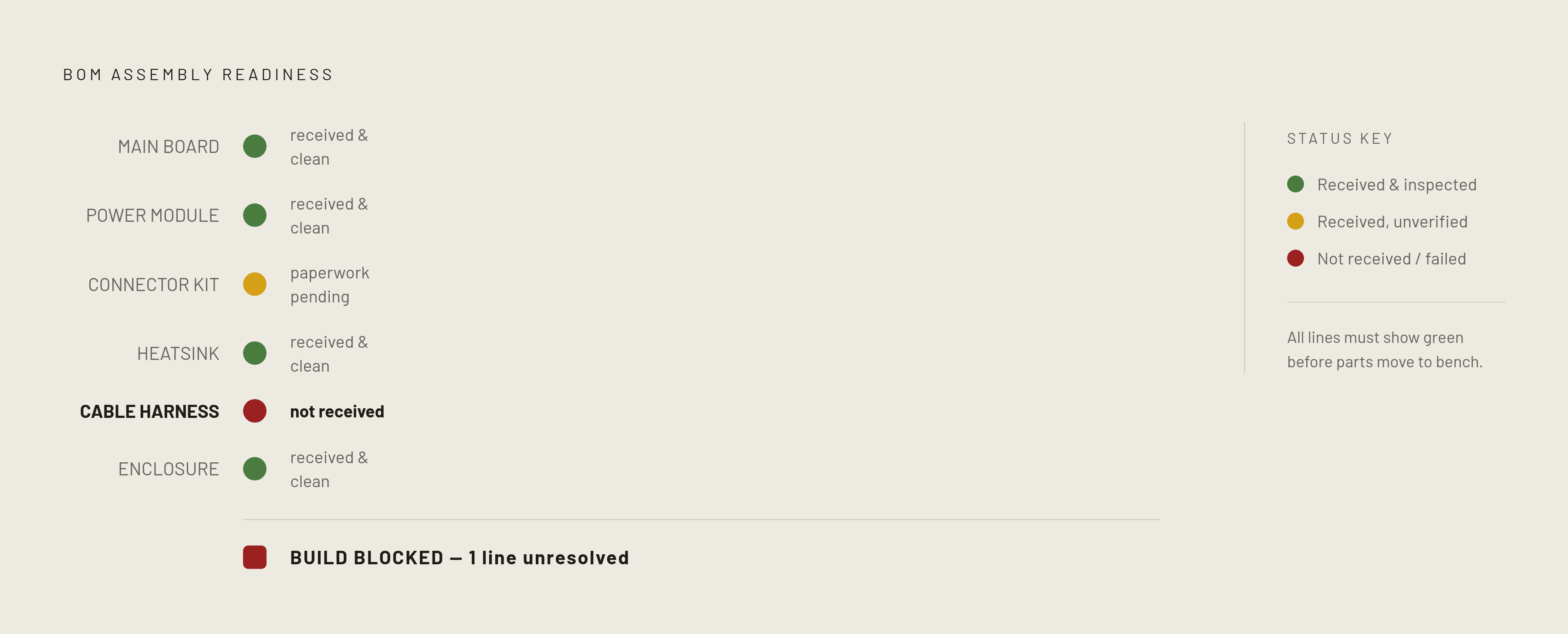
None of this matters part by part. Assembly readiness is a BOM-level question, and the entire point of the tracker is to roll every individual line into one answer: how many lines are sitting at inspection pass, and how many are still in transit, waiting on inspection, or stuck on hold.
A basic status color makes that answer visible without scanning every row. Green for received and inspected clean. Yellow for received but not yet inspected, or missing paperwork. Red means not yet received, or failed inspection. Anyone glancing at the tracker should be able to tell assembly readiness in seconds, not after reading every cell in the sheet.
Before parts get pulled to the bench, run a kitting check against that status column. Every line for the assembly needs to show green. One red line means the build doesn't start, and it's far better to know that from the tracker than to find out after the workspace is already torn apart and half the kit is laid out on the table.
The deeper truth here is that every vendor added to a BOM multiplies the work: another PO to write, another check-in cadence to run, another shipment to receive and inspect, another relationship to manage on its own terms. The tracking system exists because that fragmentation is real and has to be managed somehow. But the more durable fix sits one layer upstream of the tracker itself: fewer vendors touching the same assembly means fewer places for the whole thing to quietly come apart.