Scaling a Prototype Supplier Relationship Into Low-Volume Production
Treating scaling like engineering, not procurement, prevents production disasters.
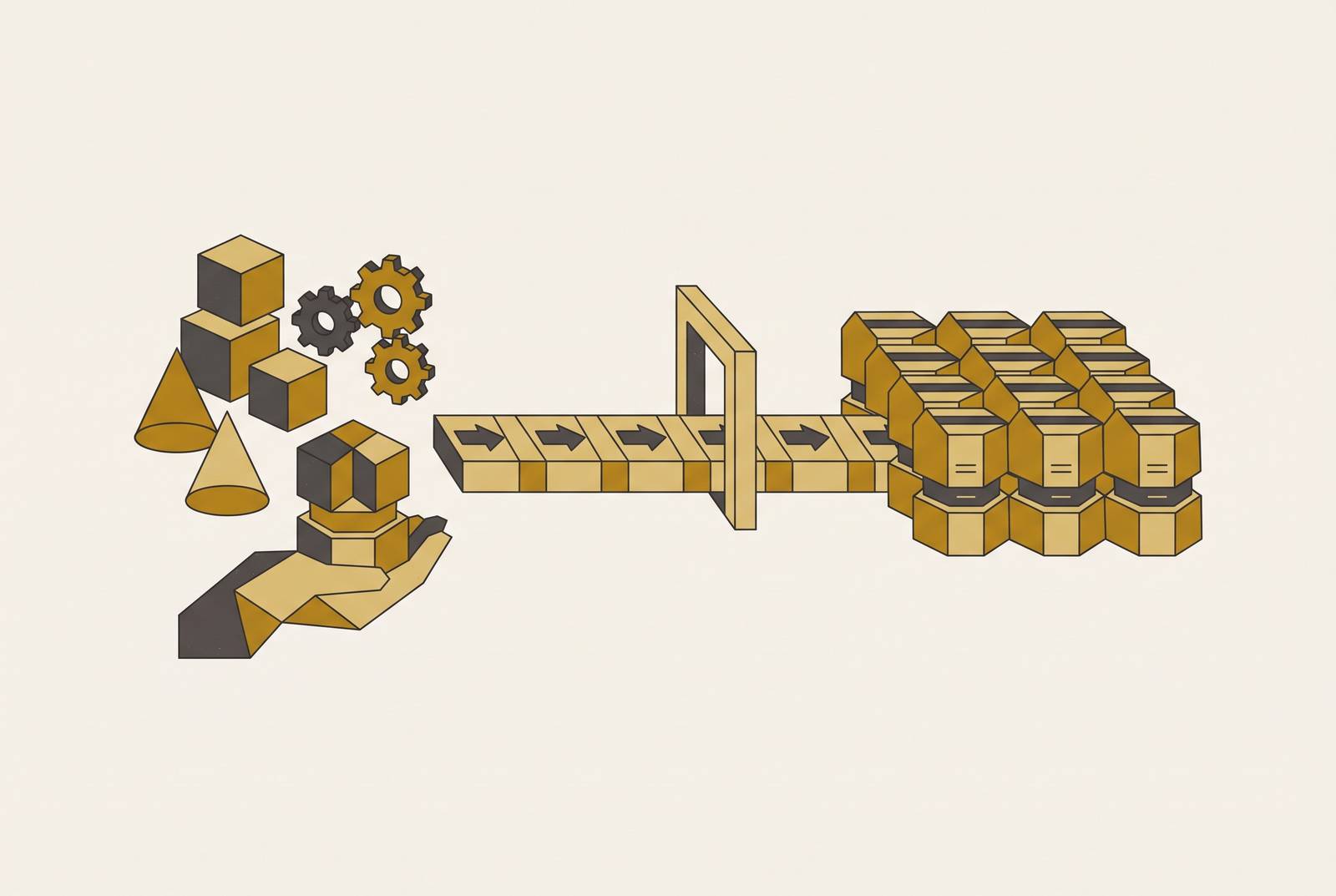
Scaling a prototype supplier relationship into low-volume production is an engineering problem, not a purchasing transaction. The engineers whose programs stall are the ones who treat it like procurement: issue a bigger PO, expect the same parts back at higher quantity, and move on.
Why the prototype-to-production transition is an engineering challenge
A design that works in CAD, and works once on the bench, does not automatically produce stable, repeatable output when the order quantity goes up. The constraints change. A feature could be machined at prototype quantities, but it often depended on extra setups, manual intervention, or an operator skilled enough to work around a tricky geometry. None of that scales.
Good prototype work usually runs on informal collaboration: the supplier calls with a question, the engineer adjusts a tolerance on the fly, and the part ships. That's a relationship, not a process. It works at low quantities because a person is actively compensating for gaps that were never closed. That same relationship cannot carry production volume because nothing was ever formalized. No process alignment existed. No quality agreements were in writing. No DFM pass was ever run against the actual production configuration.
The milestone a production-bound engineering team needs to plan for is when its supplier relationship becomes a production system, not when it places the production PO. Those are different questions, and answering only the first one is how programs end up with inconsistent parts, blown schedules, and a supplier who feels ambushed by expectations nobody wrote down.
What changes structurally when quantity goes up, even slightly
When you move from a handful of prototype parts to even a modest low-volume run, the manufacturing physics involved changes. Setups that were tolerable once become cost drivers when repeated across dozens of units. Process variation that a machinist corrected by hand during prototyping turns into yield loss at volume. Lead time assumptions built around prototype scheduling stop holding.
At prototype quantities, a skilled operator can compensate for a design that's hard to hold. At production quantities, that same compensation must happen on every single unit, and it shows up as inconsistency. A tolerance scheme can be achievable with care on one part, but once it's repeated across a run, it may demand slower feeds, additional inspection passes, or a higher scrap rate. Over-tolerancing turns from a theoretical inefficiency into a line item at this point.
Specialty materials carry their own structural shift. DOM tubing, custom spring wire, precision elastomers: these don't compress at low volume the way commodity materials do. A two-week prototype material pull can turn into a multi-week gate on the production schedule, simply because the supplier now needs to commit real inventory and real machine time to it.
The supplier's own scheduling logic shifts too. Prototype work often fills opportunistic gaps between other jobs. Production work needs a committed slot, so the supplier's capacity picture starts to matter in a way it never did during prototyping. Layer supply chain disruption on top of that: raw material delivery windows have lengthened considerably since the pre-pandemic baseline, and that disruption spans industrial metals, aluminum, polymers, and the other materials mechanical engineers have long treated as standard, dependable stock.
Applying DFM discipline to the production configuration, not just the prototype
DFM run at the prototype stage is necessary, but it doesn't cover the production configuration. A separate DFM pass, built around actual materials, actual tooling, actual process sequence, and actual volumes, is what turns a design that worked once into one that works repeatedly.
DFM has two stages that both need to happen for a part to be production-ready: process selection, which matches the manufacturing method to the target volume, and intra-process manufacturability assessment, which verifies the design holds up within the limits of whatever process got selected. Skipping either one leaves a gap.
Process selection is volume-sensitive in ways that are easy to misjudge. You can use vacuum casting, with a silicone mold built from a 3D-printed master, for small plastic-part batches in a volume range well below injection-molding minimums. That's a deliberate process choice for that band of quantity, not a placeholder on the way to injection molding. Aluminum injection mold tooling fits plastic parts in the low thousands: it cuts faster than hardened steel and can deliver production-quality geometry, though it has real limits on slides and actions that complicate geometrically ambitious parts. Custom extruded profiles pay off at high volume and get expensive fast at low volume, and a production DFM review is exactly where a team catches a design calling for a custom extrusion when a standard extrusion or flat-stock fabrication would do the same job for less.
Intra-process DFM catches the tolerance and geometry calls that looked fine in CAD but that add real cost once a run is underway. Over-tolerancing is one of the most common offenders: a tolerance tight enough to matter for most features isn't the same as one that forces a special measurement artifact, slower feeds, or extra inspection steps, and tightening a callout past what the part actually needs taxes every single unit that gets made. Non-standard thread forms, deep narrow pockets, and internal features without enough tool clearance can survive prototyping because a supplier can work around them once. At volume, that workaround raises price or extends cycle time, and often both. If sheet metal geometry ignores bend spacing, hardware placement, weld access, or coating allowance, it creates cost escalation that's invisible on a single unit and very visible across fifty.
The supplier DFM review done before the first production run, run as a collaboration rather than handed down as a finished design package, is where tolerance relaxation opportunities, setup reduction, and material substitutions get found. That conversation is what turns a prototype relationship into a production partnership. Industry analysis of the design process finds that design choices set roughly 70 percent of a product's cost, with only a small fraction coming from downstream decisions about machines and production plans. That makes the DFM review before production lock the single highest-leverage cost conversation an engineering team gets to have, and it sets up the next question directly: how does the team make sure what gets agreed on in that review actually holds once parts start shipping.
Formalizing quality agreements before the first production run ships
Informal trust is what makes prototype collaboration fast. At production volume, that trust needs backup: a documented quality agreement that spells out what "good" means for this part, in this process, at this quantity, before the first unit ships.
First Article Inspection is the structural checkpoint that formalizes this. FAI requires a complete inspection and full documentation of the first production part made under the intended production conditions: approved material, the actual CNC programs, the actual tooling and fixtures, the actual operators. It is not a quick first-piece check and it is not routine sampling. FAI covers every requirement on the drawing and produces objective evidence of compliance, and for low-volume and single-part manufacturing, it's often the single most thorough inspection the program runs, because there's so little volume to catch variation across.
Which standard applies depends on the industry. Aerospace and defense use AS9102. Automotive runs on IATF 16949, with APQP and PPAP as the required core tools inside that framework. Medical devices fall under ISO 13485. General quality management integration runs on ISO 9001. An engineering team needs to know which framework governs its application before the production run starts, not after a nonconformance forces the question. For ongoing production acceptance, AQL-oriented sampling plans under ISO 2859 or ANSI/ASQ Z1.4 define inspection levels and accept/reject rules, and agreeing to those terms before the run starts heads off disputes later about what counts as a passing lot.
A supplier who sat through the DFM review is already positioned to run a credible FAI, because they understand the part's production configuration from the inside. A supplier handed a production PO with no DFM conversation beforehand is being asked to produce a First Article Inspection Report for a design they were never set up to hold. Formalizing that transition means documenting tolerances, agreeing on process steps, and defining quality checkpoints, established before volume ramps. Platforms that pair instant DFM feedback with multi-process quoting force a formal bill of materials and process selection up front, which exposes the gap between prototype assumptions and production reality before a team commits to a run.
Planning specialty fabrication lead times as production gates, not afterthoughts
Custom springs, gaskets, and tube bending get consistently under-planned on mechanical BOMs, and each one carries a lead time long enough to gate an entire assembly if it isn't treated as a production milestone from the start.
Custom springs range from a few days for standard configurations in stocked materials to six weeks or longer for complex, precision-critical work that needs specialty wire, new tooling, and documented finishing. Certification adds real time even to a geometrically simple part: a compression spring that needs material traceability, stress relief, passivation, and lot documentation carries a multi-week lead time for a coil shape that would otherwise ship fast. Finishing steps like shot peening or electroplating, often necessary to improve fatigue life or corrosion resistance, don't always make it onto the BOM schedule until they've already caused a delay.
Custom gaskets typically run two to three weeks for precision elastomer work when drawings are complete and materials are in spec. The delay driver there usually isn't fabrication capacity, it's incomplete specifications that arrive late. Tube bending can stretch to many weeks under standard lead times, and the most common cause of delay is an incomplete RFQ. Clear, complete specifications cut quoting time from days to hours and head off scheduling bottlenecks before they ever form.
The pattern holds across all three categories: lead time is predictable when the specification is complete and the order goes in early. But if these parts get treated as late-stage details instead of early-stage production milestones, it turns unpredictable, and often program-critical. A production transition plan needs to list these parts as explicit gating items with their own lead time buffers from day one, not as line items waiting to be quoted once everything else is settled. And because each of these specialty processes often sits with a different vendor, this is exactly where a fragmented BOM starts to create risk of its own.
The structural risk of managing five vendors for one assembly at low volume
Splitting a low-volume mechanical BOM across a fabricator, a finisher, a spring supplier, a gasket supplier, a tube bender, and an assembler doesn't spread risk around. It multiplies scheduling dependencies and adds coordination overhead that a prototype program can absorb informally but a production program can't.
Inter-facility scheduling creates a cascade. A coater can't start until the fabricator ships. Assembly can't start until coating finishes. One slip anywhere in that chain delays everything downstream, and at low volume you have no buffer inventory sitting around to absorb it. Rework disputes become structural, too: a nonconformance at assembly leaves the fabricator, finisher, and assembler each holding partial accountability, and each has an incentive to point at someone else. A single-source partner has nowhere to redirect that blame, because the accountability sits in one place.
The prototype-to-production transition is exactly the moment when informal coordination between an engineer and a trusted prototype shop stops being sufficient, because the production configuration involves more processes, more handoffs, and more vendors than the prototype ever did. Consolidation carries its own risk, too: too few suppliers creates exposure if even one falters, a real concern given how volatile supply chains have remained. The goal is enough consolidation to eliminate the inter-facility scheduling dependencies that gate the assembly in the first place, not maximum consolidation for its own sake.
A practical approach to this maps out vendor capabilities, categorizes them, scores supply risk, runs DFM reviews with the consolidated supplier set, runs a pilot production build, sets measurable quality and delivery metrics, and holds regular reviews against them. That's a structured engineering process, not a sourcing preference. A partner capable of quoting the full mechanical BOM under one PO, covering CNC, sheet metal, springs, gaskets, tube bending, casting, and finishing, eliminates inter-facility scheduling dependencies at the source: scheduling stays internal to that one supplier, and accountability for the finished assembly belongs to one party. When specialty materials, committed machine slots, and supply-chain windows all tighten at once, the risk of a single delayed sub-assembly gating the whole production build climbs fast. A single-source supplier able to coordinate CNC, sheet metal, 3D printing, casting, springs, and other processes under one quote and one shipment removes the lead-time handoff cascades that make low-volume runs fragile to begin with.
Structured process alignment between engineer and supplier
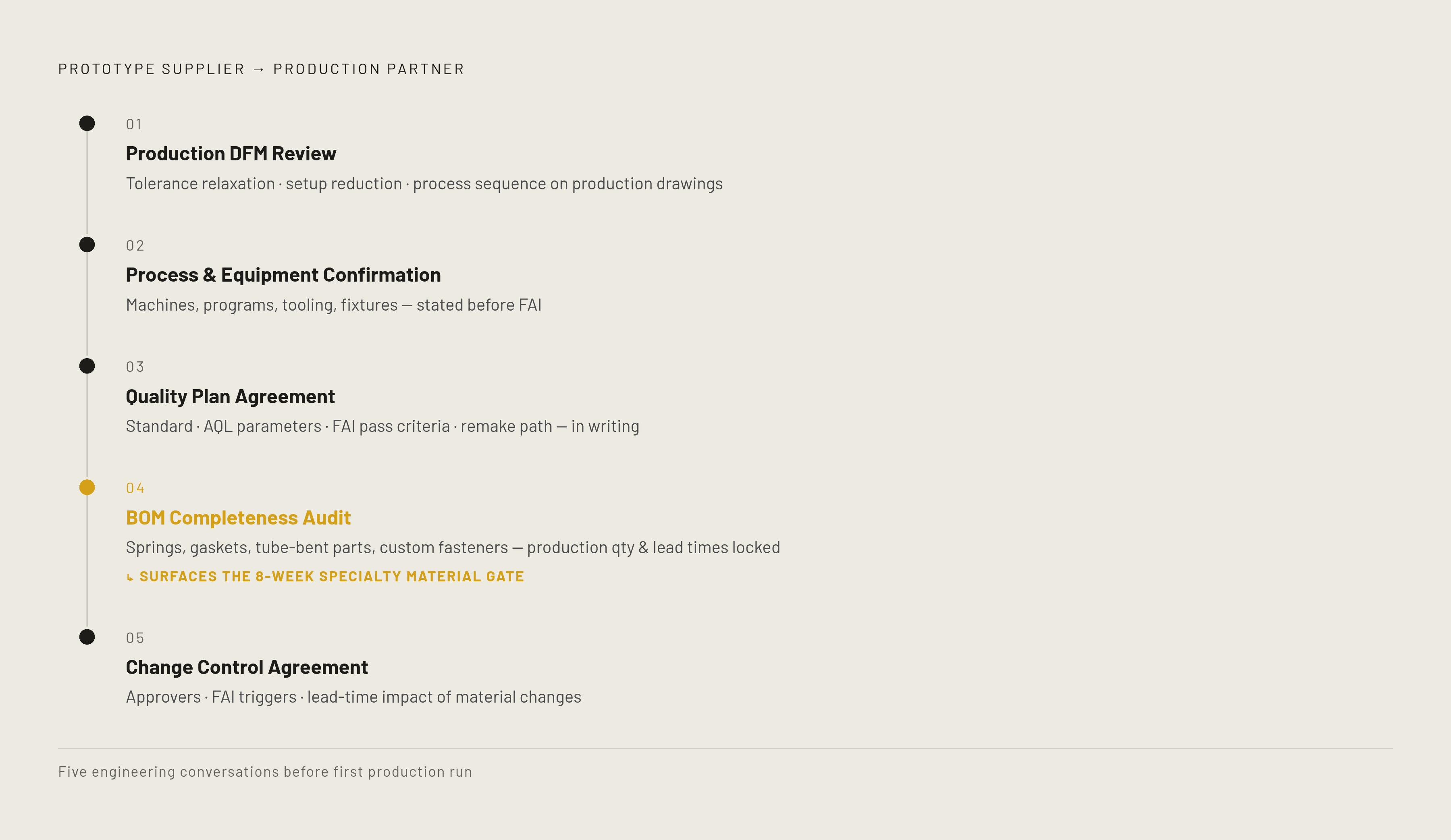
The engineers who get through this transition cleanly treat it as a series of deliberate engineering conversations with their supplier, not a handoff, and they cover process configuration, quality agreements, BOM completeness, and change control before the first production run ships, not after the first nonconformance shows up.
That starts with a production DFM review run with the supplier directly, using the actual production drawing set rather than the prototype drawings, focused on tolerance relaxation, setup reduction, and process sequence. This is the conversation that converts a working prototype relationship into one that's configured for production. It continues with process and equipment confirmation: before FAI, the supplier states which machines, programs, tooling, and fixtures will run the production job, because that setup is often not identical to whatever built the prototype. Quality plan agreement comes next: which standard governs inspection, what the AQL parameters are, what counts as a passing first article, and what the remake or resolution path looks like if FAI fails, all written down before production starts. A BOM completeness audit follows, identifying every specialty part, springs, gaskets, tube-bent components, custom fasteners, and getting each one quoted at production quantity with a lead time on the schedule before the overall program timeline gets locked in. That audit is what catches an eight-week specialty material gate while there's still time to plan around it. Change control agreement closes the loop: a protocol for engineering changes once production has started, covering who approves a change, what triggers a new FAI, and what lead time impact a material change carries, protecting the schedule the earlier planning work established. Delivery and inspection confirmation should also be settled ahead of time, so the supplier inspects every part before it ships, the engineer knows what inspection records will arrive with the delivery, and the quality evidence is in hand before assembly starts.
DFM applied to the production configuration means verifying manufacturability within the real constraints of the chosen process, material, and tooling at the target volume, not in the abstract. Online quoting platforms that return instant, structured DFM feedback force that verification to happen during design for production, rather than letting it surface as a surprise once the first production run is already underway. OneWeekParts is built around that model: instant quoting with DFM feedback, same-day engineer support, and full BOM coverage across CNC machining, sheet metal, casting, springs, gaskets, and tube bending, consolidated into one quote, one PO, and one shipment, with a remake-or-refund guarantee that puts quality accountability where it belongs. The transition from prototype to production was never going to manage itself. Engineers who plan it as a deliberate engineering milestone, with the DFM, quality, scheduling, and vendor decisions made on purpose rather than inherited by default, are the ones whose programs make it to volume without stalling.